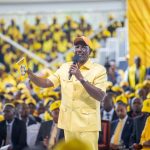
A year after the political détente between President William Ruto and the late opposition leader Raila Odinga, a new implementation report sheds light on the progress and limits of the so-called broad-based government agenda.
The Ten-Point Agenda Implementation Report, released on March 7, is the first comprehensive update on reforms arising from the National Dialogue Committee (NADCO). The process was established after the political tensions and protests that marked Kenya’s post-2022 election period.
The report outlines achievements across governance, economic reforms, youth employment and anti-corruption measures. But it also reveals that several key legislative proposals remain unfinished.
The Ten-Point Agenda was agreed upon in March 2025 by the ruling United Democratic Alliance and opposition Orange Democratic Movement as part of a political cooperation framework. It was designed to address structural governance issues that have repeatedly triggered political crises in Kenya.
The agenda covers reforms ranging from electoral justice and devolution to youth livelihoods, national debt management and the protection of the right to protest. To oversee implementation, a five-member committee chaired by Agnes Zani was established in August 2025.
Electoral and Political Reforms
One of the central pillars of the agenda was restoring confidence in elections after disputes surrounding the 2022 polls. The report says nine legislative proposals were introduced to implement reforms arising from the NADCO process.
So far, the report says, three laws have been enacted, including amendments to electoral and anti-corruption legislation. At the same time, two bills are under parliamentary mediation, while four others are still under consideration in Parliament.
Among the most consequential developments was the reconstitution of the Independent Electoral and Boundaries Commission, with new commissioners sworn in July 2025.
The commission has since resumed operations, conducted by-elections and begun preparations for voter registration and boundary review.
However, major political reforms, including legislation establishing the office of Leader of the Official Opposition and constitutional amendments on political party discipline, are still pending.
Economic and Social Inclusion Measures
The report highlights several economic measures that the government says have eased the cost of living and improved inclusion.
A fertiliser subsidy programme cut prices from Sh7,000 to Sh2,500 per bag, while fuel prices reportedly fell by 14 per cent due to exchange-rate improvements and global trends.
Other initiatives target marginalised communities and vulnerable groups.
These include a Sh500 million scholarship programme for children from marginalised areas and increased funding for the Equalisation Fund from Sh5 billion to Sh9.6 billion.
In the health sector, the transition to the Social Health Authority has expanded coverage from 7 million to nearly 30 million beneficiaries, while more than 107,000 community health promoters have been deployed nationwide.
Youth Employment
Youth employment remains one of the most prominent pillars of the Ten-Point Agenda.
The report says the NYOTA programme has created opportunities for more than 820,000 young entrepreneurs, while over 90,000 youth have received training and placement in employer organisations.
Other initiatives included in the report are 600,000 youth entrepreneurs trained under government procurement programmes, 121,000 young people receiving business training and startup grants and 290 digital labs established in technical training institutions.
The report says that beyond entrepreneurship, government programmes have generated employment through large public initiatives.
These include 640,000 jobs linked to the Affordable Housing Programme, 200,000 through climate-related work programmes, and more than 547,000 Kenyans employed abroad under labour mobility schemes.
Debt Management
Kenya’s public debt management also features prominently in the report.
The government says it has reduced reliance on external borrowing and improved its debt profile through liability management and bond buybacks.
Between 2024 and 2026, the Treasury conducted several Eurobond buyback transactions to smooth repayment schedules and reduce default risks.
In January 2026, the ratings agency Moody’s upgraded Kenya’s sovereign credit rating from CAA1 to B3 with a stable outlook, citing improved external liquidity and debt management.
The government has also established a National Infrastructure Fund to mobilise private and institutional investment for large projects.
On governance reforms, the report cites progress in digitising government services and strengthening oversight systems.
More than 23,000 government services have been digitised on the eCitizen platform, reducing cash payments and opportunities for corruption.
The Conflict of Interest Act 2025 is also highlighted as a key step toward improving accountability in public office.
Meanwhile, the Ethics and Anti-Corruption Commission reports filing 143 asset recovery cases worth Sh22.9 billion, recovering assets worth Sh9.8 billion, and securing 86 convictions.
Remaining Challenges
Despite the progress outlined, the report acknowledges that several reforms remain incomplete.
Among the key unresolved issues are Constitutional amendments to entrench development funds, legislation establishing the office of Leader of the Opposition, and electoral reforms related to election offences and procedures.
The oversight committee recommends that Parliament fast-track the outstanding NADCO bills within 90 days.
The broader question, however, is whether the political cooperation that produced the Ten-Point Agenda can endure long enough to deliver deeper institutional reforms.
For now, the report suggests that the political truce has translated into measurable policy changes but the most contentious constitutional reforms are still ahead.