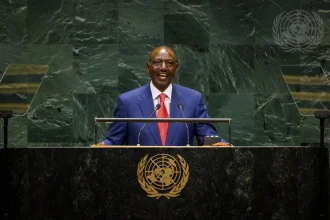




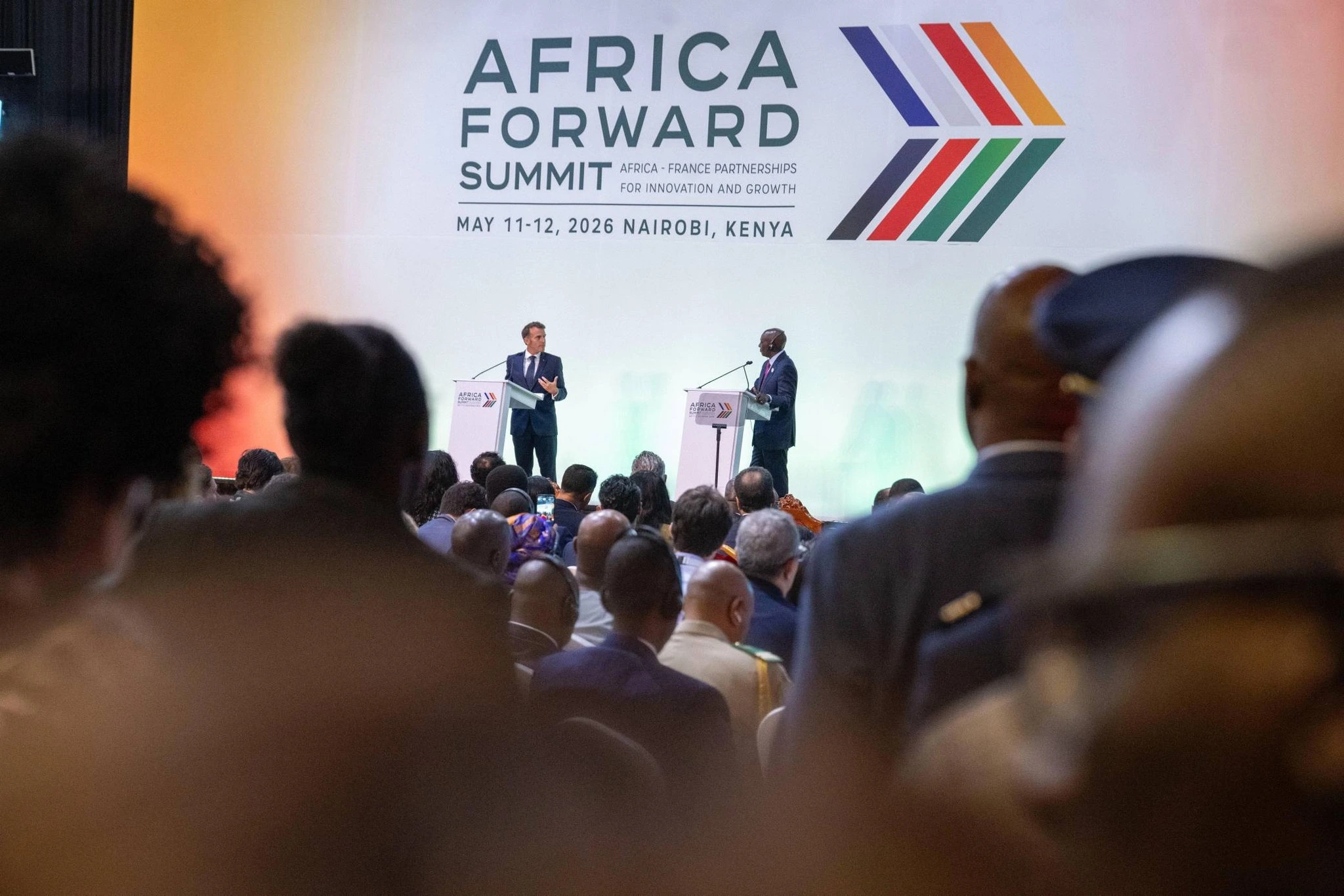
When President William Ruto addressed the Africa Forward Summit 2026 in Nairobi, his rhetoric eschewed the traditional language of gratitude or supplication.
Instead, he presented a doctrine of necessity, signalling a fundamental shift in how African leadership intends to navigate its engagements with the West.
“Not dependency, but sovereign equality; not aid, but investment; not extraction, but shared value,” Ruto declared. This tripartite formulation was a pointed rejection of the asymmetric power dynamics that have long defined the continent’s external relations.
The summit, convening African heads of state, French President Emmanuel Macron, UN Secretary-General António Guterres, and African Union Commission Chairperson Mahamoud Ali Youssouf, represents one of the most high-profile Africa-Europe diplomatic engagements of the year.
Yet beneath the ceremonial warmth lies a continent recalibrating the terms on which it is willing to engage, and Nairobi chose to make that recalibration explicit.
Ruto’s framing is significant not just for what it says, but for what it displaces. For decades, the dominant vocabulary of Africa-France relations has been structured around aide au développement (development assistance).
This is a framework that, critics argue, has embedded asymmetric power dynamics while serving French strategic and commercial interests across Francophone Africa.
The so-called “Françafrique” system, characterised by opaque political ties, CFA franc monetary dependency, and preferential access to natural resources, has faced mounting African backlash.
Military coups in Mali, Burkina Faso, Niger, and Gabon between 2021 and 2023 explicitly cited French influence as a grievance. France has since withdrawn its forces from several of these countries under pressure.
Against this backdrop, Ruto’s insistence on “sovereign equality” is less a bilateral courtesy and more a continental positioning statement; one that aligns Kenya, a majority Anglophone, non-Francophone nation, with a broader African consensus that the old frameworks are untenable.
Macron’s Strategic Recalibration
That France sent its president, not a minister, not an envoy, to a summit in Nairobi is itself analytically significant. Macron has spent much of his tenure attempting to reset France’s African relationships, acknowledging colonial wrongs more explicitly than his predecessors while seeking to preserve French influence in a rapidly shifting geopolitical environment.
His reaffirmation of France and Europe’s commitment to Africa’s “peace, stability, and prosperity” follows a script he has rehearsed at forums from Montpellier to the Élysée Africa summits. The more concrete pledge that France and Kenya would jointly champion Africa’s agenda at the UN and during the Evian G7 engagements signals a strategic alignment with Nairobi that carries geopolitical weight.
Kenya’s seat at these tables gives France an African partner that is stable, economically dynamic, and diplomatically credible. For Kenya, the arrangement offers an amplified voice in global institutions.
But the partnership’s durability will depend on whether France’s institutional commitments translate into tangible shifts in trade architecture, debt relief, and technology transfer, areas where African frustration with Western partners runs deepest.
Ruto’s call for African countries to strengthen continental financial institutions, mobilise domestic resources, and accelerate investments in infrastructure, industrialisation, clean energy, and regional connectivity is not new in its components.
What is notable is the sequencing: domestic mobilisation and continental institution-building precede, rather than follow, external partnership, which reflects a broader intellectual shift on the continent.
The African Continental Free Trade Area (AfCFTA), the push to denominate more intra-African trade in local currencies, and efforts to reform the African Development Bank’s capitalisation all reflect a growing consensus that Africa’s vulnerability in global negotiations stems partly from its own fragmented financial architecture.
UN Secretary-General Guterres reinforced this structural lens, highlighting Africa’s renewable energy potential while calling for reforms to address high borrowing costs, climate injustice, and what he termed the unfair exploitation of Africa’s critical minerals.
The minerals point is particularly charged: as the global green energy transition intensifies demand for cobalt, lithium, manganese, and rare earths, resources concentrated heavily in Africa, the question of who captures the value from their extraction has become a frontline issue in global economic justice debates.
AU’s Growth Narrative
AU Commission Chairperson Mahamoud Ali Youssouf’s characterisation of Africa as the “future engine of global growth” is a framing that the continent’s leadership has embraced with increasing confidence.
Africa’s demographic trajectory, projected to account for over a quarter of the world’s population by 2050, combined with its resource endowments, makes the growth narrative credible in the long run.
Yet, significant hurdles remain. Infrastructure deficits, debt vulnerabilities, and the disproportionate impact of climate change threaten this trajectory.
Even as collective GDP grows, major economies like Nigeria and Ethiopia face severe macroeconomic stress, highlighting the gap between potential and realisation.
The perennial risk of African summitry is that aspirational framing continues to outpace institutional delivery.
Nairobi’s selection as summit host is not incidental. Under Ruto, Kenya has pursued an assertive diplomatic posture: leading the multinational security mission in Haiti, deepening ties with the United States (culminating in Kenya’s designation as a Major Non-NATO Ally in 2024), and positioning itself as a hub for climate finance and technology investment.
Hosting the Africa Forward Summit consolidates Kenya’s claim to continental convening authority. It also places Ruto in a role he has visibly embraced, as an articulate voice for a new African economic nationalism that is pro-investment but anti-exploitation, internationalist but sovereignty-conscious.
Whether this posture translates into durable policy architecture or remains a summit-circuit register is the question his tenure will ultimately answer.
The Deeper Question
The Africa Forward Summit 2026 opened with the language of transformation. The ultimate test, however, is whether it closes with the substance of it – and more importantly, whether that substance endures in the months that follow.
France has heard African demands for partnership reform before. Africa has launched transformation agendas before. The architecture of dependency Ruto critiqued did not build itself overnight, and it will not be dismantled by declarations, however well-crafted.
What distinguishes this moment is a unique convergence of pressures: intense geopolitical competition for African alignment, rising domestic demand for tangible returns on resources, and a new generation of leaders who refuse to accept the old terms of engagement.
Ruto’s “win-win” framing is a minimum condition for future cooperation, not a maximum ambition. It remains to be seen if the West is ready to treat Africa as a peer, or if it will continue to offer old aid in new packaging.