


On the morning of June 7, three judges of Kenya’s High Court walked into a courtroom in Nairobi carrying the weight of a question no Kenyan court had ever been asked to answer in quite this way: can the Judiciary review the impeachment of a Deputy President, and if so, what happens when it finds that rights were violated but the outcome cannot be reversed?
Judges Eric Ogola, Anthony Mrima and Freda Mugambi took nearly eighteen consolidated petitions, filed by 58 petitioners ranging from Rigathi Gachagua himself to civil society organisations and ordinary citizens, and delivered a judgment that is at once a vindication of the rule of law, a rebuke of the Senate, a frustration for Gachagua’s political allies, and a constitutional landmark that will shape Kenyan governance for years to come.
The bottom line, stripped of legal language, is this: the impeachment stands, but it was conducted wrongly; Gachagua cannot be reinstated, but the Senate must pay him Sh50 million; and Parliament must now enact a law it should have written years ago.
What the Court Found
The bench began with jurisdiction: the question of whether courts have any business reviewing a parliamentary impeachment at all. The respondents had argued strenuously that impeachment is a political process, final upon the Senate’s vote, and beyond judicial reach. The Court rejected that argument entirely.
The judges held that the impeachment proceedings are justiciable, and that the High Court possesses jurisdiction to determine whether Parliament acted within constitutional bounds, complied with constitutional procedures, respected constitutional rights, and remained faithful to the constitutional safeguards governing the impeachment.
That finding alone is consequential. It means that no future Parliament can conduct an impeachment behind a wall of legislative immunity. The Judiciary has now formally asserted supervisory authority, and future parliaments have been warned.
On the specific charges, the court found that the allegations of bias, predetermination, and conflict of interest levelled against the Speakers, Members of Parliament, and Senators were unsubstantiated; resting on political inference and suspicion rather than objective evidence. The impeachment motion and the parliamentary procedures that followed it were not, in the court’s view, unconstitutional in their structure.
On public participation, the bench found that the National Assembly’s process met the constitutional threshold and that the Senate was not required to conduct its own independent public participation exercise in addition.
The court further held that the Standing Orders of both Houses were not unconstitutional, and that the failure to involve the IEBC in the appointment of Deputy President Kindiki was constitutionally immaterial.
Where the Senate Went Wrong
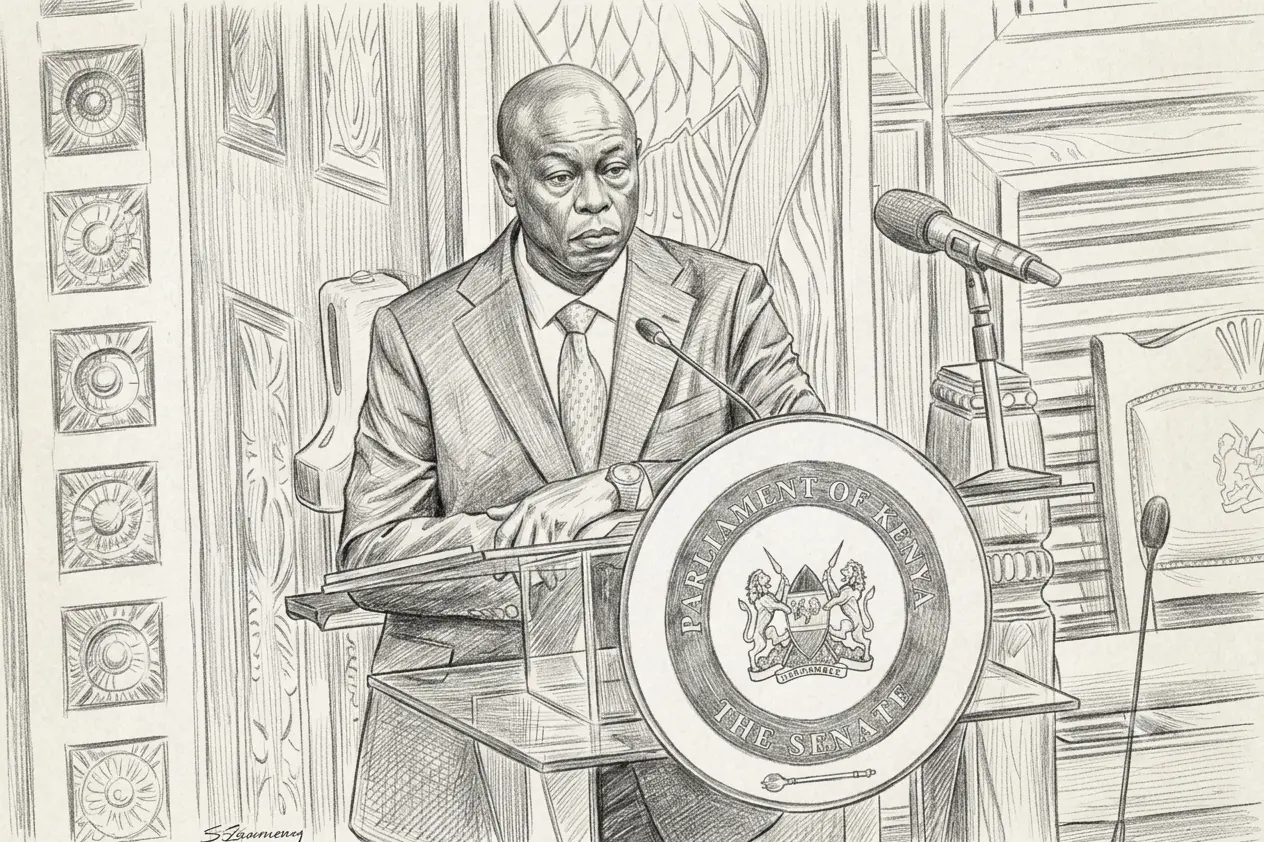
The most notable finding against the respondents pertained to the right to a fair trial. The court determined that Gachagua’s rights under Articles 47 and 50 of the Constitution were violated when the Senate refused to grant an adjournment during his impeachment trial, as he was absent due to hospitalisation.
The bench was clear: this constituted a constitutional breach. However, the judgment takes a complex and constitutionally innovative turn here. After identifying the violation, the court ruled that it could not annul the Senate’s resolution, reinstate Gachagua, or overturn the outcome.
The court characterised the impeachment provision in the Constitution as embodying what it referred to as “constitutional finality.” This implies a self-executing, irreversible outcome that does not allow for reinstatement, whether judicial or otherwise.
While the violation of Gachagua’s right to a fair trial does not lead to reinstatement, it does result in something more limited yet historically significant: declaratory relief and monetary compensation. The court awarded Sh50 million in constitutional damages payable by the Senate.
This amount is not intended to compensate for the loss of office but rather to uphold the Constitution, restore Gachagua’s dignity, and deter similar violations in future impeachment proceedings.
Legislative Gap Exposed
Beyond the specific findings on Gachagua, the judgment contains a directive that may prove to be its most durable legacy. The bench found that Parliament ought urgently to enact a dedicated statutory framework for the removal of the Deputy President under Article 150.
The Constitution’s instruction that the presidential impeachment process apply to the Deputy President “with the necessary modifications” is, the court held, a substantive constitutional directive, not a vague suggestion.
The absence of dedicated legislation does not retrospectively invalidate the Gachagua impeachment, but it cannot continue indefinitely. Parliament has been put on formal notice. This matters because the ambiguity created by that legislative gap was at the heart of much of the litigation.
The eleven grounds cited in the impeachment motion, the Senate committee process, and the adjournment question all of these disputes were made harder to resolve cleanly because there is no dedicated statute prescribing exactly how a Deputy President’s impeachment must be conducted. The court has now made the enactment of that statute a constitutional obligation, enforceable in law.
Gachagua and the Politics of 2027
For Gachagua personally, the judgment delivers something and withholds something larger. He receives formal judicial vindication that his constitutional rights were violated, and compensation, payable by an institution his allies have long depicted as having acted in bad faith.
In Kenyan political culture, a court’s declaration of rights violation carries moral and rhetorical weight that will be deployed in every speech and every interview between now and the 2027 election.
After the ruling, Gachagua announced that he would be taking a break from political mobilisation to what he termed a strategic retreat for consultations on a single opposition candidate to face Ruto in 2027.
It has already dawned on Gachagua that the court upholding his impeachment dims hopes of him being on the ballot in 2027. It is, therefore, only strategic for him to accelerate efforts to have a united opposition candidate against Ruto.
“Having a single candidate against President William Ruto is not negotiable and is the only way to liberate this country,” Gachagua said a day after the court ruling.
Gachagua is now moving from positioning himself as a frontrunner for President to becoming the Kingmaker, banking on the rich-vote Mt. Kenya region rallying behind him.
Constitutional Landscape After Verdict
Read carefully, the judgment does something that transcends the Gachagua case. It establishes, for the first time in Kenya’s constitutional jurisprudence, that impeachment is justiciable; that the Judiciary can and will review parliamentary conduct for constitutional compliance; that constitutional finality on the outcome does not mean constitutional immunity for the process; and that rights violations in the course of impeachment proceedings attract real remedies, even when reinstatement is impossible.
The court also noted, in a passage that reads almost as an invitation, that the tension between constitutional finality and the vindication of rights is a recurring problem in comparative jurisprudence, and that a constitutional amendment clarifying the scope of impeachment finality and the role of judicial review may be warranted.
That is a court telling the political class that the current constitutional design is imperfect and that the question will return. It will. The next time a Deputy President faces impeachment, whenever that may be, the legislature will face a judiciary that has now established what it is watching for and what it will do when it sees it.
The Deputy President Gachagua chapter, in one sense, is closed, but the constitutional questions it opened are not.