





Hundreds of women marched through Nairobi on Madaraka Day, demanding the government call femicide what it is: a national emergency. The data says they are right.
On May 16, 2026, gospel singer Rachel Wandeto was walking home in Nairobi when three men doused her in petrol and set her alight. She did not survive.
On Madaraka Day, the holiday on which Kenya celebrates its self-rule, her name became one of more than 500 written on a single banner, carried through the streets of the capital by a crowd dressed in white, red and black.
As President William Ruto led Madaraka Day celebrations in Wajir, hundreds of kilometres from the capital, women, mothers of missing and murdered children, and human rights activists took to the streets of Nairobi CBD in protest over rising cases of violence against women and children.
The demonstrators walked from Jevanjee Gardens to the Kimathi Street and Kenyatta Avenue intersection, where they sat for a moment protesting the rising cases of killings of children and women and government inaction.
The choice of date was not incidental. The protesters said Madaraka Day, meant to celebrate Kenya’s self- rule, had instead exposed the painful contradiction where women and children continue to live in fear with little protection from the state. Independence, the marchers were saying, means little if half the population cannot walk home safely.
Numbers That Demand a Name
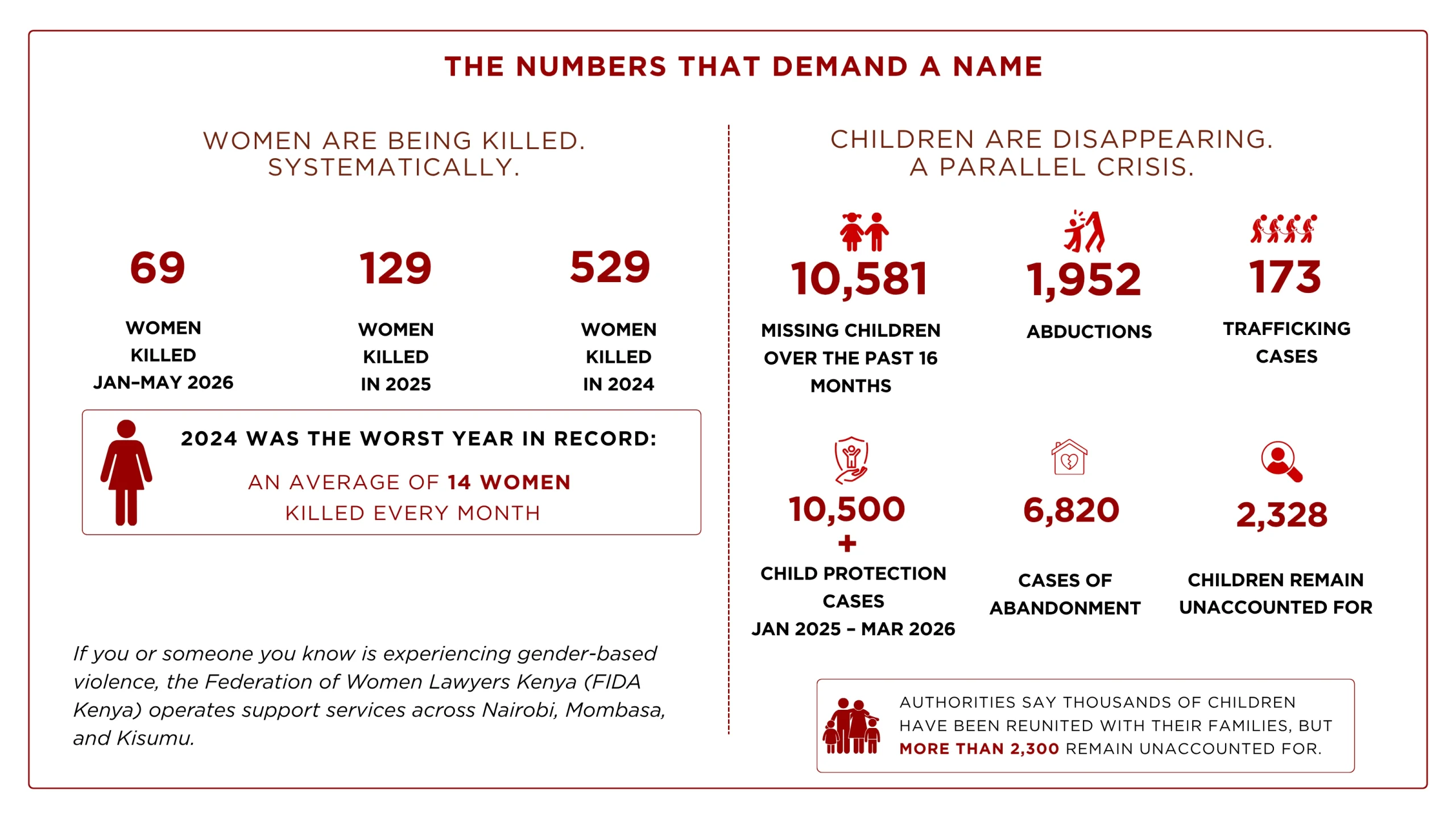
At least 69 women have been killed in Kenya since January 2026, according to data compiled by data firm Odipo Dev and media outlet Africa Uncensored.
By comparison, 129 women were killed between January and March 2025 alone, and in 2024, the worst year on record, 529 women were killed, an average of 14 every month.
The crisis extends beyond femicide into a parallel emergency involving children. The Kenyan government has recorded 10,581 missing children over the past 16 months, including 1,952 abductions and 173 trafficking cases.
More than 10,500 child protection cases were recorded between January 2025 and March 2026 in total, including 1,952 abductions and 6,820 cases of abandonment, according to data released by Children Services Principal Secretary Carren Ageng’o. Nearly 2,328 children remain unaccounted for.
Activists are urging Kenya to recognise femicide as a distinct crime and prioritise survivor-centred support services. Amnesty reports that in 2026, at least eight cases of femicide were reported weekly, and 23 children disappeared daily.
These are not abstractions. The ultimatum to the government demanding action, issued on 21 May, came as the Federation of Women Lawyers in Kenya reports receiving roughly 70 gender-based violence cases every week across its three offices in Nairobi, Mombasa, and Kisumu.
Seventy cases a week, in three cities, is not a series of isolated tragedies. It is a pattern with a shape, and patterns, unlike individual tragedies, can be addressed by policy. The question the marchers were asking is why that policy has not arrived.
Crisis the State Already Studied, and Shelved
What separates this protest from a generalised cry of anguish is its specificity about what the government has and has not done.
The demonstrators particularly faulted the government for the failure to implement recommendations from a presidential task force on Gender-Based Violence, including femicide, whose report was submitted months ago.
President Ruto set up a taskforce on the issue last year, but activists say there has been no action. This is the crux of the accountability gap. Kenya does not lack a diagnosis.
That taskforce report contains recommendations. Those recommendations sit, unimplemented, while the death toll the taskforce was created to address continues to climb.
There is some institutional movement to acknowledge. In May, police said they had formed a specialised investigative unit, bringing together criminal intelligence analysts, forensic experts, homicide investigators and other specialists.
This is a genuine, concrete step, but coming eight days before the protest, it may have been an attempt to pre-empt the criticism the march would bring.
Whether a new investigative unit can meaningfully change outcomes for women already navigating a justice system that, by the Federation of Women Lawyers’ own account, is overwhelmed with 70 new cases a week per office, remains to be seen.
A unit that investigates more cases is valuable. A unit that investigates more cases within a system that does not prosecute, convict, or protect is a more efficient way of documenting failure.
Naming the Problem Correctly
The demonstration underscored a harrowing reality: women and children in Kenya are facing an unprecedented crisis of violence, predominantly at the hands of men. The marchers carried a “Wall of Shame”: a physical registry bearing the names of the women and children whose lives have been brutally cut short.
Part of the activists’ argument is linguistic, and it is not a small point. “Femicide is not homicide,” activists argue. “What is not named is ignored.”
The lack of recognition of femicide as a distinct category of crime, with distinct patterns, distinct perpetrators, and distinct warning signs, has consequences for how cases are investigated, how resources are allocated, and how the public understands the scale of what is happening.
A homicide is a single event. A femicide crisis is a pattern that implicates social attitudes, law enforcement priorities, judicial outcomes, and state capacity all at once.
Treating each killing as an isolated homicide, prosecuted or not on its individual merits, obscures the structural nature of what advocates say is happening: that being a woman in Kenya in 2026 carries a measurable, rising, and largely unaddressed risk of violent death.
Advocates at the march stressed that because men are overwhelmingly the perpetrators of this violence, men must be the ones to step up and dismantle it; true allyship cannot be passive; it requires men to show up physically to support these movements.
“Men are our brothers, fathers, and sons, and they need to stand up for us. We call upon men to join us in the anti-femicide movement,” one speaker told the crowd.
What “National Emergency” Would Mean
Kenyans describe the trend as a “national security crisis,” saying “every delayed response costs lives.”
This framing matters because it locates femicide not in the domain of social policy or gender affairs, where it can be perpetually deprioritised against budget pressures, infrastructure projects, and electoral politics, but in the domain of security, where the state has historically found resources, urgency, and institutional machinery when it chooses to.
A national emergency declaration is not merely rhetorical. It typically triggers dedicated budget lines, inter-agency coordination structures, reporting requirements, and, critically, a political cost to inaction that currently does not exist.
At present, a presidential taskforce report can be received, filed, and quietly set aside without any institutional consequence. A national emergency framework makes that kind of quiet shelving harder.
A Test the Government Cannot Outwait
Kenya has, in recent years, demonstrated that sustained public pressure can shift government behaviour, sometimes dramatically, sometimes only after the cost of inaction became politically unbearable.
The question this protest poses is whether the femicide crisis will require that same trajectory: months or years of escalating mobilisation before the state responds with anything more than a new investigative unit and a taskforce report gathering dust.
The marchers carried flowers, candles, and an empty coffin. That is not the language of people demanding incremental administrative reform.
It is the language of people who believe, with data behind them, that the failure to act is itself a form of violence, compounding the violence they are marching against.
The taskforce report exists. The recommendations exist. What does not yet exist is the political decision to treat them as urgent. Sixty-nine women have been killed this year, while that decision has been deferred.
The marchers who walked from Jevanjee Gardens to Kenyatta Avenue on Madaraka Day were, in the simplest terms, asking how many more will be killed before it is made.