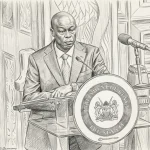




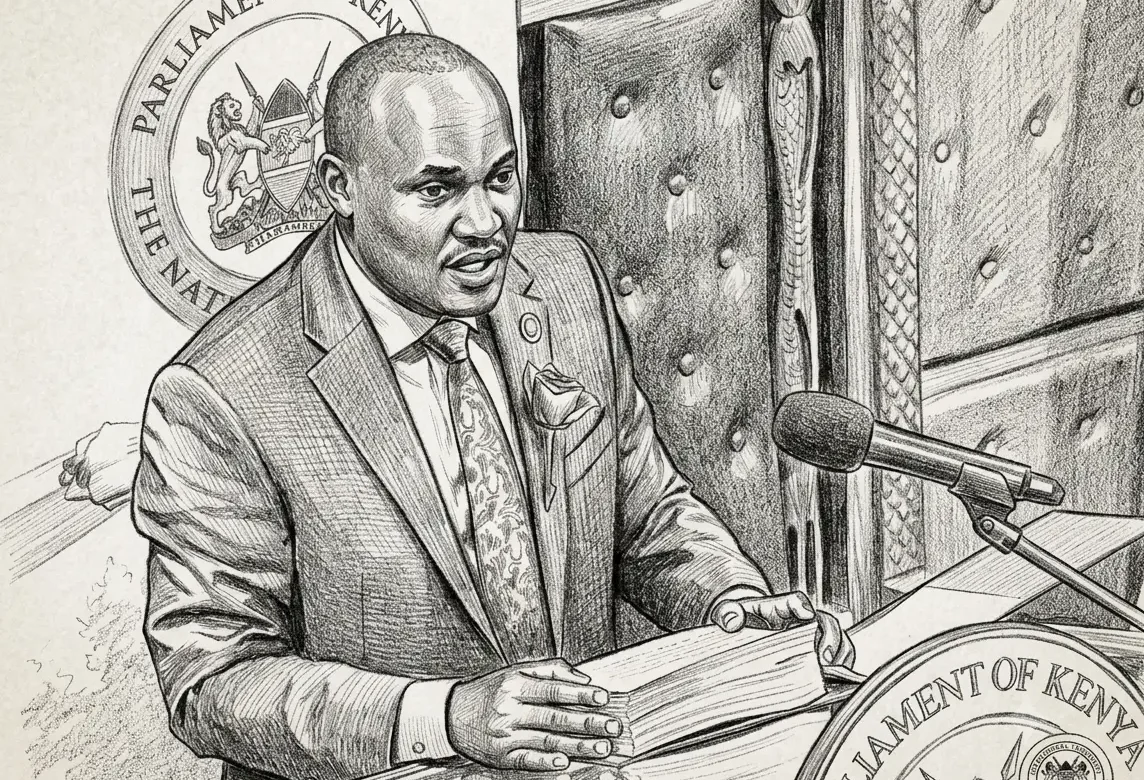
Just after 2pm on June 11, Treasury Cabinet Secretary John Mbadi walked into the National Assembly chamber carrying the same battered black briefcase that has become a fixture of Budget Day theatre, flanked by security details thicker than usual.
Outside, the streets around Parliament Buildings had been cordoned off for hours, a precaution Treasury insiders attributed less to any specific threat than to institutional memory.
Two years earlier, a Finance Bill had triggered the kind of unrest that ended with the Treasury’s neighbouring building scorched and an entire piece of legislation withdrawn under pressure.
Framed under the theme “Sustaining the Bottom-Up Economic Transformation Agenda (BETA) for Resilient and Inclusive Growth amid Global Uncertainty,” the state’s narrative focuses heavily on cushioning the mwananchi, funding universal healthcare, and boosting agricultural production.
However, an analysis of the data reveals a deeper fiscal reality. When the massive numbers are stripped down, the true priorities of a debt-reconciling state emerge, laying bare a stark contrast between political rhetoric and actual accounting.
Debt servicing is larger than the entire education allocation, Kenya’s biggest single sectoral spend at Sh784.5 billion. It is larger than health, agriculture, social protection and the Digital Superhighway combined, several times over.
To understand where Kenya’s money actually goes, one must look past ministerial public relations. Out of the Sh4.82 trillion total budget, a massive Sh1.50 trillion will not go to a single school, hospital, road, or security operation. Instead, it is swallowed entirely by Interest Payments, Pensions, and Net Lending.
This means that nearly 31.2 per cent of the entire national budget is consumed by past obligations and debt service before the government can buy a single desk or bottle of medicine.
For context, the entire ministerial development budget, which is the actual money allocated for building roads, water dams, and electricity grids, stands at just Sh 809.0 billion. Kenya is spending nearly double its development budget just to keep up with interest payments and pensions.
This is the arithmetic that budget speeches rarely dwell on: the government’s room to manoeuvre is shrinking even as the headline figure grows.
The Winners
Maintaining its position as the largest ministerial block, Education walked away with Sh784.5 billion (26.8 per cent of national government ministerial allocations).
Digging into the line items, the Teachers Service Commission (TSC) accounts for the lion’s share at Sh408.5 billion.
Higher education loans (HELB) and scholarships received Sh 96.4 billion, while Junior Secondary School (JSS) capitation was handed Sh30.9 billion. Notably, Sh4.9 billion was explicitly set aside for the conversion of 20,000 intern teachers to permanent and pensionable terms starting January 2027.
Comprising the physical scaffolding of the economy, Energy, Infrastructure, and ICT secured Sh531.3 billion (18.2 per cent of allocations). Within this, road construction, rehabilitation, and maintenance command Sh220.4 billion, while railway transport and infrastructure received Sh38.1 billion.
The guns and boots remain heavily funded. National Security was allocated Sh316.2 billion ministerially, though total security operations tracking (including defence and intelligence) reflects an aggregate footprint of Sh557.0 billion across agencies. This includes Sh13.0 billion for police vehicle lease financing and Sh7.0 billion for police modernisation.
A major political pillar under BETA, Housing and Settlement, received direct financial backing, with Sh50.6 billion allocated for the construction of affordable units and Sh20.9 billion for social housing units.
Quiet Losers: The Rhetoric-vs-Reality Gap
While the Kenya Kwanza administration champions “Agricultural Transformation” and “Affordable Healthcare” as core pillars of the BETA plan, the macro-allocations tell a more conservative story.
Despite being the backbone of the economy and employment, the entire Agriculture, Rural, and Urban Development sector received just Sh111.7 billion, a minor 3.8 per cent of ministerial allocations. While the Sh18.0 billion fertiliser subsidy programme is highly publicised, the broader sector remains remarkably lean relative to its mandate.
The Health sector received Sh177.2 billion (6.1 per cent of ministerial allocations). Although the government highlighted KSh 19.1 billion for the Primary Healthcare Fund and Sh 18.5 billion for the Global Fund, an aggregate allocation of 6.1 per cent means Kenya is still missing the 15 per cent target set by the historic Abuja Declaration.
County governments were allocated Sh502 billion. However, their actual Equitable Share of revenue raised nationally stands at Sh428 billion. The Treasury points out that this represents 21 per cent of the revenues raised nationally for the FY 2022/23 baseline. But against the current Sh4.82 trillion reality, counties are left managing expanding local mandates under severe financial strain.
Borrowing Mix Tells Its Own Story
Here is where the “fiscal consolidation” narrative runs into trouble. The deficit for FY2026/27 stands at Sh1,146.2 billion, or 5.5 per cent of GDP, Treasury’s own projections show this declining to 3.3 per cent by FY2028/29, but for now it represents a deficit larger, both in absolute terms and as a share of GDP, than the previous year’s.
More striking is how it will be financed: net domestic borrowing jumps to roughly Sh1.03 trillion, while net external financing falls sharply to Sh116.2 billion. A year ago, the split between domestic and external borrowing was far more even.
Treasury is leaning almost entirely on domestic markets, a choice that avoids the currency-risk exposure of dollar-denominated debt, but one that risks crowding out private-sector credit just as lending rates have started to ease and businesses are beginning to borrow again.
Local banks will naturally favour risk-free government paper over lending to small businesses, threatening the very MSME recovery the budget claims to support.
Where the Finance Bill Comes In
The entire structure rests on an assumption: that the Finance Bill 2026 delivers an additional Sh120 billion in revenue on top of the roughly Sh3 trillion the Kenya Revenue Authority is expected to collect through existing tax structures. Income Tax is expected to supply 38.1 per cent of revenue, followed by Value Added Tax (VAT) at 22.8 per cent, and Excise Duty at 10.5 per cent.
Unlike its predecessor, which proposed outright rate increases and was withdrawn after nationwide protests, this year’s Bill is built around base- broadening and compliance; digital tax enforcement, a restructured mobile phone excise charged at activation rather than import, and a tax amnesty designed to bring defaulters back into the net without raising headline rates.
Mbadi has spent weeks personally touring electronics shops in Nairobi’s CBD to make this case directly to traders, an unusual level of retail political effort for a Treasury chief.
The risk is straightforward. If Parliament amends the Bill substantially, and early debate over the mobile phone levy and rental income provisions for non- resident landlords suggests it might, that Sh120 billion gap does not disappear.
With international markets expensive, the government would be forced to borrow even more aggressively from the domestic market, driving up local interest rates and placing the economy on an unsustainable fiscal trajectory.
The alternative would be to force in-year cuts to programmes that, on June 11, were presented to Parliament as settled and funded.
Which brings the story back to where it started: a briefcase, a chamber full of MPs, and a Sh4.8 trillion figure that sounded, for one afternoon, like a settled fact. It was approved.
What it actually buys, and for whom, depends on numbers that won’t be tested until the Finance Bill clears, the borrowing markets respond, and the first quarter’s revenue collections come in against a target that history suggests is optimistic.
Beyond the Numbers
Viewed purely through expenditure tables, the 2026/27 budget appears balanced and politically careful. Education is protected. Health gains funding. Counties receive more money. Social protection survives. Flagship government projects remain intact.
But the deeper story is about fiscal space, or the lack of it. Kenya is attempting to fund growth, maintain social spending, service debt and reduce deficits simultaneously. That balancing act explains many of the budget’s contradictions.
The winners are visible in the allocations. The losers are harder to spot. They include future development projects delayed by debt obligations, businesses competing with the government for domestic credit, and taxpayers expected to generate ambitious revenue targets without triggering another political backlash.