




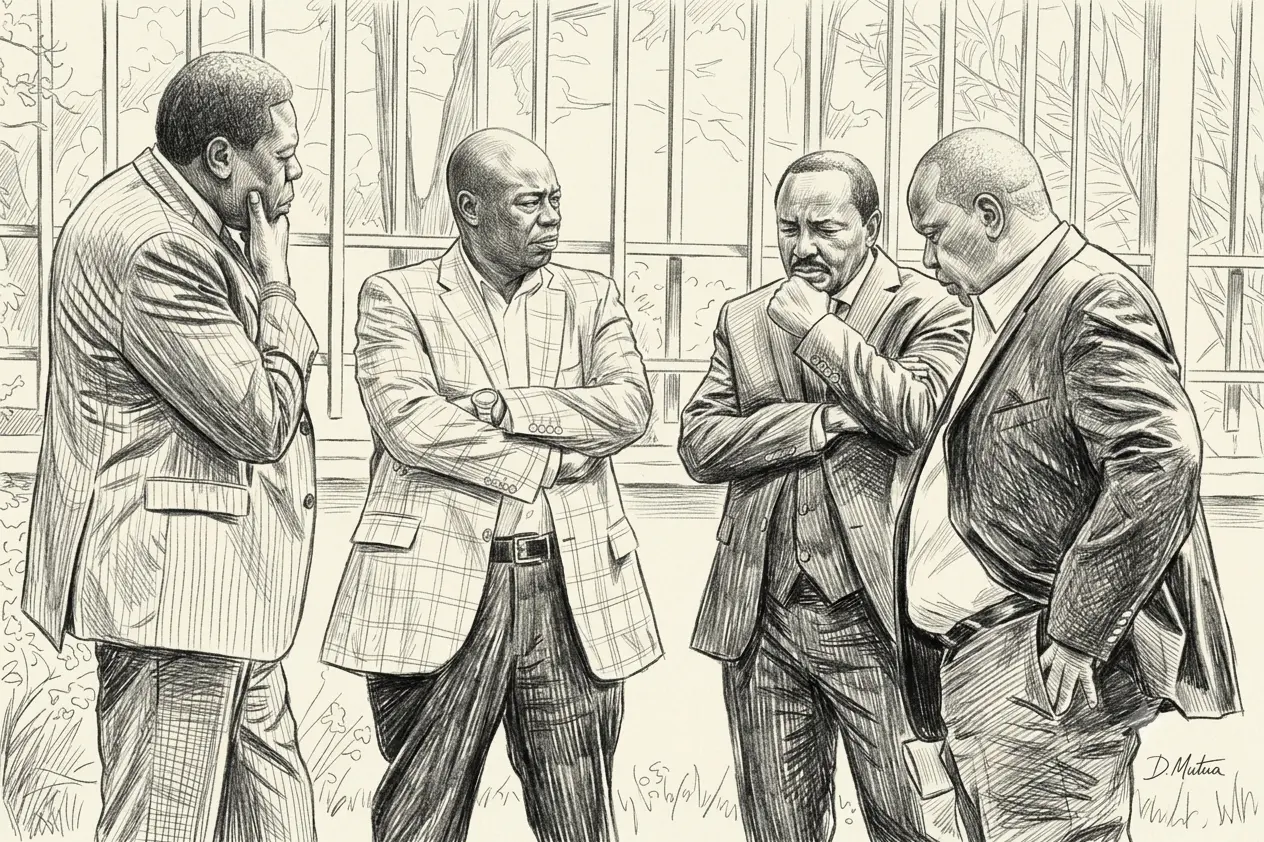
Kenya’s opposition has spent much of the past year fixated on a single question: who can defeat President William Ruto in the 2027 election? This preoccupation with personality, however, could be obscuring a more fundamental structural challenge.
The critical question is not which individual holds the broadest appeal, but whether the opposition can achieve the internal cohesion necessary to translate disparate political capital into a unified strategic force.
Across the political landscape, several heavyweights are actively positioning themselves for influence.
Former Deputy President Rigathi Gachagua has repositioned himself as a formidable critic from the Mount Kenya region. With the High Court having upheld his impeachment, he is positioning himself more as a Kingmaker than a frontrunner in the opposition ranks despite insisting he will be on the ballot.
A long-term government minister and former vice- president, Kalonzo Musyoka, maintains his standing as a seasoned coalition builder. However, there are those still wary of his infamous last-minute manoeuvres that have left allies high and dry in the past.
There is Martha Karua, who is slowly seeking to shed the iron-lady tag that has been associated with her politics. Having been a running mate in the 2022 contest, Karua appears to want to go it alone and has been missing from most of the united opposition’s meetups recently.
Justin Muturi, Eugene Wamalwa and Fred Matiang’i further complicate the calculus, representing critical regional interests and administrative gravitas, respectively.
There are also the new additions to the growing anti- Ruto brigade, including Nairobi Senator Edwin Sifuna and Muranga Governor Irungu Kangata.
The primary hurdle, therefore, is not a deficit of leadership but a surplus of competing ambitions; an abundance of viable candidates that risks fragmenting the very base required for victory.
Too Many General
History offers a clear precedent: opposition coalitions in Kenya succeed when leaders resolve the flag- bearer question early. The National Rainbow Coalition achieved this in 2002. The National Super Alliance eventually did so in 2017. Azimio la Umoja entered the 2022 election with a clearly identifiable presidential candidate.
Today’s opposition has not reached that point.
Multiple figures are simultaneously positioning themselves as potential standard-bearers while also insisting on the importance of unity. These dual objectives, individual brand-building and collective cohesion, increasingly operate as a zero-sum game.
Without a formal mechanism for establishing hierarchy, the opposition remains in a state of perpetual internal friction. Every public rally becomes an exercise in measuring political strength. Every endorsement becomes a proxy battle for influence.
Every opinion poll becomes ammunition. The resulting discourse is characterised less by the development of a robust counter-offensive against the incumbent’s record than by a contest for intra- coalition dominance.
The numbers are unforgiving. While President Ruto’s approval ratings face economic headwinds, the structural advantages of incumbency, access to state resources and the capacity to set the national agenda remain significant barriers to entry. The opposition, therefore, requires consolidation, not fragmentation.
A divided opposition creates two compounding risks. First, it splits financial and organisational resources. Second, and more consequentially, it splits voter expectations. The electorate tends to reward stability and clarity of vision, whereas political elites often prioritise the flexibility of ongoing negotiations. This disconnect creates a vacuum of leadership that the incumbent is well- positioned to exploit.
The longer coalition leaders postpone difficult decisions, the harder it becomes to craft a compelling alternative narrative. By mid-2027, the opposition will not only be competing against Ruto’s record but also against the perceptions created during the coalition-building process itself.
If that process is perceived as a series of opaque power-sharing deals, voters may conclude that the opposition is more interested in the spoils of office than in the rigours of governance.
Lessons from the Past
Kenyan political history offers repeated examples of opposition alliances collapsing under the weight of succession disputes. Coalitions are typically strongest when confronting a common opponent and weakest when discussing internal hierarchy. The current opposition risks entering that familiar cycle.
Each leader brings distinct assets. Gachagua possesses visibility and a growing support base in parts of Central Kenya. Kalonzo retains experience and an established political network. Karua has positioned herself as a defender of the people. Sifuna is appealing to the young demographic, and by extension, new voters. Matiang’i appeals to voters who associate him with administrative competence. Wamalwa offers coalition-building credentials and regional influence.
Yet under the current electoral arithmetic, none of these figures possesses the individual reach to secure a national mandate without the active support of the others. Their strength lies in combination; their weakness, in competition.
Beyond Anti-Ruto Politics
There is a further strategic limitation. Opposition politics cannot survive indefinitely on opposition alone. A platform built solely on anti-Ruto sentiment is insufficient; it fails to offer a distinctive governing philosophy capable of withstanding the rigours of a multi-year campaign.
The 2024 social upheavals highlighted a profound public demand for systemic reform rather than mere personnel changes. This new generation of voters is increasingly immune to traditional ethnic or personality-driven mobilisation, more interested in outcomes than in personalities.
The opposition, therefore, faces a strategic choice. It can continue focusing primarily on criticising the administration, or it can articulate a coherent programme addressing jobs, taxation, debt, healthcare, and governance.
The latter path, while intellectually and politically more demanding, is the only sustainable route to long-term electoral legitimacy and, critically, it is more likely to win elections.
The opposition’s biggest obstacle is not William Ruto. It is time. Every month spent in stalemate over internal hierarchy is a month lost to the critical task of socialising a national alternative to the status quo.
Every public disagreement reinforces doubts about cohesion. Every unresolved succession question strengthens the incumbent’s position.
Political history demonstrates that presidents are rarely defeated by opposition grievances alone. Incumbents fall not because they are disliked, but because a credible, unified, and persuasive alternative emerges, one that effectively mirrors the aspirations of the governed.
The opposition still has time to build that alternative. But the clock is moving faster than many of its leaders appear to realise.
The question facing them is no longer whether they can challenge Ruto. It is whether they can first agree on who should lead the challenge, and on what terms.