




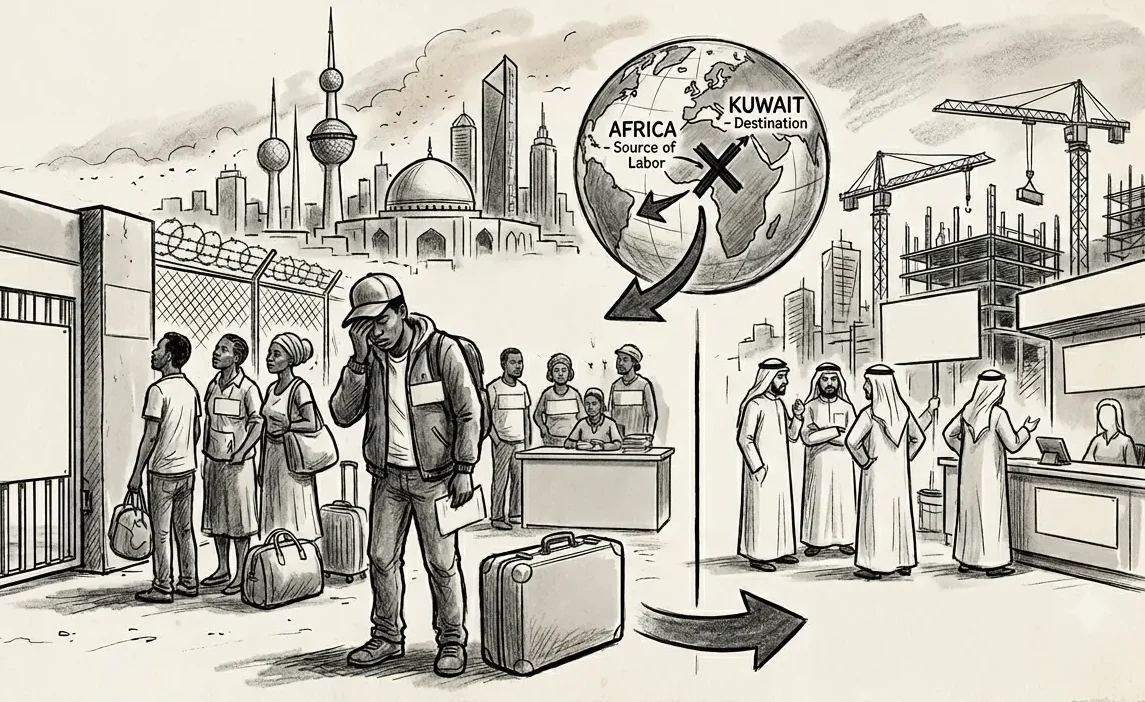
African TikTokers are taking to social media to shed light on daily life in Kuwait, capturing widespread attention at a time when the Gulf nation has banned citizens from Kenya, Nigeria, and 25 other countries from seeking domestic labour jobs there.
According to local media reports, Kuwait’s Interior Ministry issued these restrictions as part of updated regulations governing the domestic labour sector. Under the new rules that took effect on June 7, domestic workers can now only be recruited from South Africa, Benin, Eritrea, Ethiopia, the Philippines, Sri Lanka, India, Vietnam, and Nepal. Senegal remains on the approved list, but recruitment is strictly limited to male workers.
All hiring procedures must now be processed through the country’s governorates, which are Kuwait’s localised administrative counties. Beyond country-specific bans, Kuwait has also overhauled its strict sponsorship (kafala) system to clamp down on the sector.
The revised rules impose strict limits on the number of workers that an expatriate or citizen can sponsor, based on family size and gender.
These rigid new caps will drastically reduce employment opportunities for Africans who have traditionally sought work in the Gulf. Under the previous system, fewer restrictions meant that households would often employ several domestic staff.
The new caps, coupled with the outright ban on Kenyan recruitment, have in effect frozen a vital economic pipeline.
Kafala System
Single women: Eligible to sponsor one domestic worker only; drivers are not permitted.
Married, divorced or widowed women with children: Allowed to sponsor one domestic worker and one driver.
Married, divorced or widowed men with families: Can sponsor up to three domestic workers and one driver to accommodate larger households.
Single men: Eligible to sponsor one driver only; domestic workers are strictly prohibited.
On TikTok, migrant content creators are sounding the alarm and urgently warning job seekers back home not to pay rogue recruitment agents who make false promises about Kuwaiti visas. However, for the thousands of Kenyans already working in Kuwait, particularly as drivers, the focus has shifted towards demystifying life in the Gulf state.
One Kenyan TikToker, marvelling at the region’s incredibly low fuel prices, shared an amusing cultural aspect of working as a driver.
“The good thing about Kuwait,” he said, “Is that their cars are never turned off. You just park the car and leave it running. Whether people go for two, three, four or five hours, it doesn’t matter.”
Another creator, this time American, took his audience on a journey to fill his car with 20 Dinar (about $64), which shocked him as he got a full tank of fuel.
“The good thing about Kuwait,” he said, “Is that their cars are never turned off. You just park the car and leave it running. Whether people go for two, three, four or five hours, it doesn’t matter.”
Another Kenyan creator published a viral video in Swahili, sharing what he wished he had known before arriving. He swiftly dispelled common misconceptions about basic living conditions and social constraints.
“Firstly, the water is extremely clean,” he noted. “Secondly, partying isn’t illegal, and there is no strict policing on that. There are no rigid rules restricting you socially.”
However, he pointed out a societal contradiction: while premarital relationships are legally and socially frowned upon, contraceptives are openly sold in pharmacies, a situation he humorously described as a ‘set-up’.
He also highlighted the region’s undeniable financial allure, driven by strong currency, balanced against a high cost of living. “Thirdly, the Kuwaiti currency (the dinar) is the strongest in the world. If you convert it to Kenyan shillings, 1 dinar is equivalent to Sh418,” he said.’But number four, the cost of living is very high. A simple single room can cost around Sh24,000 (approximately 50–60 dinar) per month.”
Regarding labour, he did not sugarcoat the gruelling realities facing migrant workers: ‘You can easily lose yourself. You work 13-hour days, six days a week. You only have one day to rest. And on that day, you have other personal chores to take care of.’ However, he ended his video on a positive note, saying, “Anything is possible.”
‘But number four, the cost of living is very high. A simple single room can cost around Sh24,000 (approximately 50–60 dinar) per month.”
Other banned nationalities echo this mixture of caution and optimism. Nigerian TikTok user offered her compatriots some sobering advice online.
“If you’re thinking about visiting Kuwait, this video is tailored for you. There are three crucial things you need to keep in mind,” she cautioned. “Be prepared to respect the country’s laws and customs. Remember, you’re here to work, and the shifts can be long and demanding. Patience is a necessity in this country, not just a choice.”
Despite the challenges, she emphasised the transformative potential of working in the Gulf.
“Kuwait will reward your efforts, and it will positively change your life story.”
While social media platforms provide essential guidance for workers adjusting to the new normal, formal diplomatic channels remain silent. The fate of thousands of nationals from banned countries who currently hold valid contracts in Kuwait is uncertain, as their home governments have yet to provide official responses or directives for their citizens abroad.
The Kenyan Embassy in Kuwait clarified that recent regulatory updates are not new restrictions against Kenya. Kenya voluntarily suspended domestic worker deployment a decade ago, a stance that remains unchanged.
Current Kuwaiti communications simply reflect existing regulations for the domestic labour sector rather than new policy shifts. Active consultations are underway to establish a bilateral framework with safety safeguards for future domestic labour agreements.
The Embassy stressed that restrictions apply only to domestic workers; all other Kenyan professionals remain eligible for employment in Kuwait under applicable laws.