



There is a version of Kenya’s G7 appearance that looks like a foreign policy triumph.
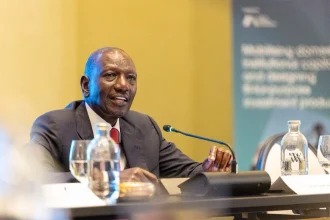
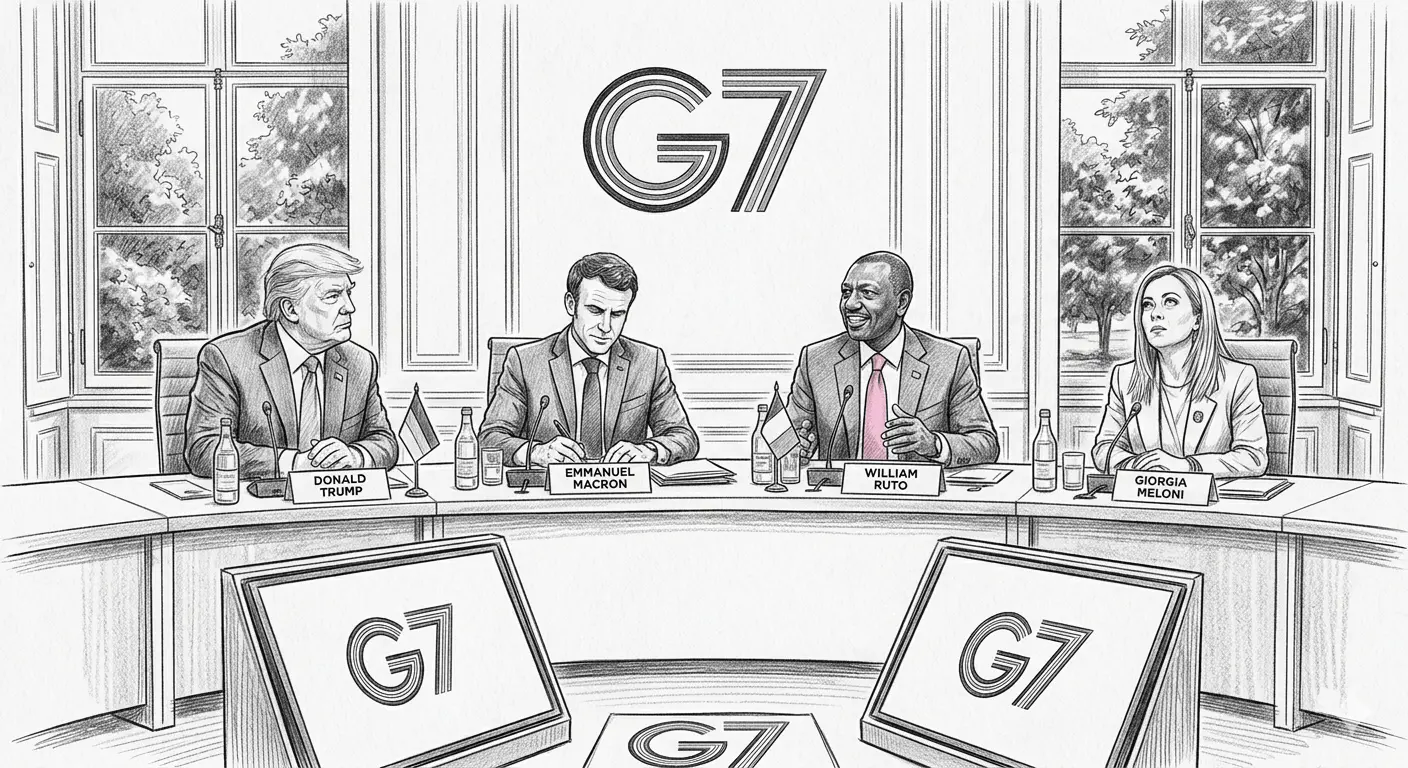
President William Ruto was the only African head of state invited to Évian, not as an observer, but, in the government’s own framing, as an “agenda-shaping partner” carrying priorities agreed at the Africa Forward Summit co-hosted by Ruto and President Macron in Nairobi just weeks earlier.
Over three days, he led sessions on global finance, economic growth and artificial intelligence, and several of his specific proposals found their way into the summit’s eight closing outcome documents. That version is accurate, as far as it goes.
The other version is equally true. Kenya came home to a Sh1.1 trillion budget deficit. Debt servicing still absorbs a disproportionate share of government revenue. Borrowing costs remain elevated. And not a single dollar of new financing was announced in France.
Both things are simultaneously real. That tension is what makes the Évian summit worth examining closely.
What Ruto Actually Argued
Strip away the diplomatic choreography, and Kenya’s pitch to the G7 was structurally coherent. Ruto did not go to France seeking aid. He went seeking reform, specifically, reform of the mechanisms that make African borrowing artificially expensive.
His central argument: African economies routinely pay significantly higher interest rates than countries with comparable economic fundamentals, because lenders continue to price in a continent-wide risk premium that has more to do with assumption than evidence.
The result is a self-reinforcing cycle. High borrowing costs constrain investment. Constrained investment limits growth. Limited growth feeds the risk narrative. And the narrative keeps the rates high.
But Ruto added a figure that sharpened the argument considerably. Africa, he told G7 leaders, holds more than $4 trillion in financial assets, in pension funds, insurance pools and central bank reserves. The continent does not lack money. It lacks the financial architecture to convert those resources into long-term productive investment.
His ask was therefore not charity. It was engineering: guarantees and risk-sharing instruments deployed through institutions such as the African Trade and Investment
Development Insurance and the Multilateral Investment Guarantee Agency, designed to lower perceived risk and unlock private capital at competitive rates.
“A guarantee, though not money, is confidence,” he told the assembled leaders.
He also pushed for debt restructuring progress under the G20 Common Framework, local value-addition requirements for critical minerals, Africa holds roughly 30 per cent of global reserves yet captures only a fraction of their value, and governance reforms at the IMF, World Bank and UN Security Council.
The logic is sound. The question is whether sound logic, expressed at a summit, translates into changed behaviour in bond markets and private boardrooms.
One element of Kenya’s participation at Évian received less attention than the finance debate but may prove equally significant over time.
In the session on artificial intelligence, Ruto advanced a case that most G7 delegations were not leading with: that African children are already engaging with global platforms and AI systems at scale, and that the protections built into those systems are systematically inadequate for African users.
Kenya called for stronger platform responsibility, age-appropriate design, parental controls, rapid removal of harmful content and, critically, meaningful safety measures in Kiswahili, Sheng and other African languages.
This is not a peripheral concern. Kenya’s digital penetration is among the highest on the continent. The gap between the pace of AI deployment and the reach of regulatory safeguards is a live domestic issue.
The Commitments on the Table
The G7 did not ignore Kenya’s priorities. The summit’s formal outcomes included endorsement of guarantees, blended finance and exchange-rate risk instruments to mobilise private capital; renewed backing for debt transparency and restructuring reform; a commitment to local processing in critical mineral supply chains; expanded infrastructure partnerships through the Partnership for Global Infrastructure and Investment and the EU’s Global Gateway; and a leaders’ call mobilising more than $870 million to address the Ebola outbreak in the Democratic Republic of Congo, Uganda and the wider region.
For Ruto, this represented meaningful alignment between what Kenya brought to the table and what the summit formally endorsed. The problem is that communiqués are not disbursements.
No specific financing package for Africa was announced. No reduction in Kenya’s borrowing costs occurred as a result of the summit. No debt restructuring deal was concluded. What emerged from France was a direction of travel, genuine momentum, in some areas, but momentum that must still navigate the long distance between political agreement and economic reality.
The Diplomacy-to-Delivery Gap
This is the structural challenge that will define whether Kenya’s growing international visibility produces domestic dividends or merely diplomatic prestige. International policy reform operates on multi-year cycles. Kenya’s fiscal pressures are immediate.
The domestic economy needs cheaper credit, more investment and stronger growth now, not after the next round of G20 negotiations produces an updated debt framework.
The G7 summit cannot compress that timeline. What it can do is establish commitments that serious, sustained diplomatic follow-through converts into actual reform. That work, quieter, less visible, more technical, is what will ultimately determine whether Évian was a turning point or a talking point.
President Ruto’s argument in France deserves to be taken seriously because it is correct. Africa is not a basket case requiring aid. It is a continent being systematically disadvantaged by financial architecture designed for a different era, and one that holds $4 trillion in assets it cannot yet fully deploy for its own development.
Changing that architecture requires exactly the kind of engagement Kenya is pursuing. But African leaders have made versions of this argument for decades.
The question is not whether the G7 agrees in principle. Increasingly, many of them do. The question is whether agreement in principle becomes policy in practice. That test does not play out in Évian.
It plays out in bond spreads, in private equity allocation decisions, in the terms attached to infrastructure financing and in the speed with which debt restructuring frameworks produce actual relief.
Kenya earned its seat at the table. Earning the results is a different assignment.