






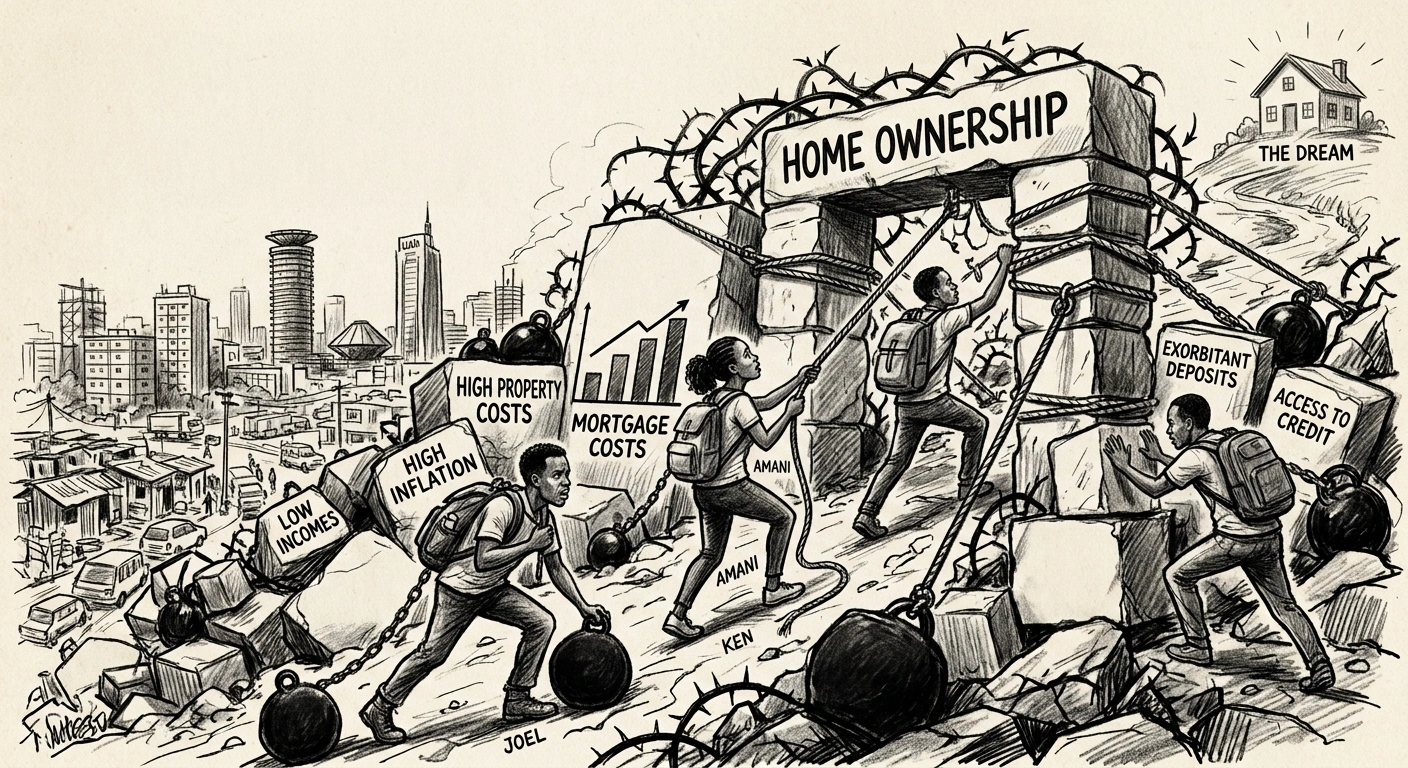
There was a time when the Kenyan middle-class dream could be described with remarkable simplicity, almost as a sequence of life events that followed one another with a sense of predictability.
Education, stable job, marriage, the purchase of a plot, the gradual construction of a house, perhaps a second property later in life, and eventually retirement anchored in something tangible that could be passed on to the next generation.
It was never an easy path, nor was it universally accessible, but it carried a widely shared assumption that a reasonably educated and steadily employed Kenyan, given enough time and discipline, would eventually convert income into ownership.
For a growing number of young professionals, that assumption is becoming harder to sustain, not because aspiration has diminished but because the economic conditions that once made that sequence plausible have shifted in several directions at once.
Land in areas close to employment and infrastructure has become more expensive, construction costs have remained persistently high, and mortgage finance, while available, still sits beyond the reach of many households whose incomes have not grown at a comparable pace.
Interest rates and broader cost-of-living pressures reduce the space within which savings can accumulate, leaving the path to ownership longer, more uncertain, and more sensitive to small disruptions in income or expenditure.
The result is a quiet but significant transformation in the meaning of the Kenyan middle class, where a generation that was expected to transition into property ownership is increasingly finding itself in long-term renting arrangements that no longer feel temporary but instead resemble a stable, if constrained, form of urban life.
The Mathematics Of The Dream
At the centre is a simple but unforgiving arithmetic that begins with income and ends with what remains after the demands of urban life have been met. A young professional may earn a salary that would, in earlier decades, have comfortably supported gradual asset accumulation.
However, once rent, transport, food, utilities, healthcare, support for family members, taxes, and the recurring costs of city life are accounted for, the portion of income available for saving becomes far smaller than the aspiration of home ownership.
Even when savings are possible, the entry cost into the property market is not limited to the price of a house or plot. It includes deposits, legal fees, valuation, and often additional expenses related to furnishing or incremental construction.
These costs accumulate at the very moment when property prices are rising, creating a situation where the target is not only distant but also moving, as individuals who save consistently often discover that the property they were aiming for has appreciated faster than their ability to accumulate capital.
In this sense, the challenge of home ownership is not only about affordability but about a dynamic mismatch between income growth and asset inflation, which gradually reshapes expectations about what is achievable within a working lifetime.
In earlier generations, renting was widely understood as a transitional stage that bridged early adulthood and ownership. That sequence is increasingly less reliable in practice, in Nairobi and other rapidly urbanising centres where housing demand has grown faster than the supply of affordable options.
Renting is therefore becoming less of a prelude and more of a long-term condition, not because younger Kenyans have abandoned the desire to own homes, but because the economic pathway to ownership has become more complex and extended.
This shift carries implications that extend beyond monthly rent payments, since home ownership has historically functioned as one of the primary mechanisms through which households accumulate wealth, build collateral, generate rental income, and secure intergenerational transfer of assets.
When ownership becomes more difficult, wealth accumulation itself slows, raising broader questions about what happens when an entire cohort reaches midlife with significantly lower levels of property ownership than the generation before it, and how that gap may shape inequality over time.
The Mortgage Constraint
Kenya’s mortgage market, while structurally important, has not yet become a mass pathway to home ownership, largely because the financial conditions required to make long-term borrowing viable remain difficult for many households.
The idea of a mortgage is straightforward in principle, allowing households to convert future income into present housing, but in practice the combination of interest rates, income uncertainty, and relatively high property prices means that monthly repayments often compete directly with rent while also introducing debt obligations that many households are cautious to assume.
For salaried workers in particular, the challenge is amplified when even modest homes are priced at several multiples of annual income, creating a gap between financial responsibility and feasibility.
As a result, many households continue to rely on alternative mechanisms such as SACCO savings, family contributions, incremental construction, employer schemes, or inherited land, all of which reflect an adaptation to a formal credit system that has not fully resolved the affordability constraint.
Home building remains a phased process rather than a single transaction, beginning with land acquisition, followed by incremental construction, periods of pause driven by financial constraints, and eventual continuation when resources allow, a method that is often inefficient but remains more realistic than large-scale borrowing for many households.
The challenge of housing affordability is also deeply geographical, shaped by the fact that the strongest concentrations of employment are often located in the same areas where property is most expensive.
Nairobi illustrates this tension, as households are forced to balance the cost of proximity to work against the financial relief of living farther away, where housing may be cheaper but transport costs, commuting time, and reduced quality of life introduce other forms of economic pressure.
This trade-off between housing and mobility means that affordability cannot be understood purely in terms of price, since the true cost of housing is also shaped by access to infrastructure and employment.
As secondary cities such as Nakuru, Eldoret, and Kisumu expand, they offer partial alternatives to Nairobi’s pressures, though they too are beginning to experience similar dynamics as population growth and investment follow opportunity, gradually reshaping affordability in new urban centres.
Housing As An Asset Class
Alongside its role as shelter, housing is increasingly functioning as a financial asset, with property serving as a retirement strategy, a source of rental income, a hedge against inflation, and a store of value in rapidly developing areas.
This investment dimension is rational for those who already possess capital, but it also alters market dynamics for first-time buyers, who find themselves competing not only with other households seeking shelter but also with investors seeking returns.
This dual function of housing creates a structural tension in the market, where activity remains strong and development continues, yet accessibility for entry-level buyers becomes progressively more constrained, reinforcing the perception that the market is moving faster than incomes can follow.
Underlying all of these dynamics is the often understated role of inheritance and family assets in determining access to property. In a context where land, housing, and financial support are frequently transferred across generations, the ability to enter the property market is not solely determined by individual income but also by the presence or absence of family wealth.
This creates divergent trajectories within the same generation, where individuals with access to family assets can leverage land or financial support to enter ownership earlier, while those without such support face a significantly longer and more uncertain path, turning housing into a quiet but powerful mechanism of intergenerational inequality.
Changing Definition of Success
None of these shifts implies that Kenyans have abandoned the aspiration of home ownership, but they do suggest that the meaning of economic success is becoming more varied and less linear.
Some individuals are choosing flexibility over ownership, prioritising mobility, investment diversification, or lifestyle choices that do not centre on property acquisition, while others are delaying ownership in favour of education, entrepreneurship, or migration opportunities.
At the same time, many are adjusting expectations rather than abandoning them, redefining what a “home” means, whether through smaller units, shared ownership, incremental building, or relocation to more affordable towns, all of which represent adaptations to a changing economic environment rather than a rejection of aspiration itself.
The broader question that emerges is whether economic growth is translating into asset formation at the household level, since the middle class risks becoming a class defined more by consumption than by accumulation.
In that sense, the housing question is not separate from Kenya’s wider development trajectory, but central to it, because it speaks to whether rising incomes are sufficient not only to sustain daily life but to build lasting financial security.