



The Kenyan consumer was one of the country’s most attractive economic stories, supported by a growing population, rapidly expanding cities, rising smartphone ownership and a young workforce.
This created the expectation of a steadily expanding consumer market that would gradually move from basic needs towards better products, improved services and higher levels of discretionary spending.
That assumption is being tested in ways that are reshaping the market. The Kenyan consumer has not disappeared, but the way they spend has changed.
Households are becoming more deliberate about what they buy, more willing to compare prices, more comfortable switching brands when necessary and increasingly prepared to trade convenience for affordability when budgets become tight.
However, they have not abandoned aspiration, and this combination of caution and ambition is forcing businesses to rethink one of the oldest assumptions in retail and consumer markets that economic growth automatically produces consumers who simply buy more of everything.
More Calculating Consumer
The pressure begins at the household budget, where rising costs of food, housing, transport, education, healthcare and other essentials are consuming a larger share of income. And this leaves less room for discretionary spending, making it harder for households to protect non-essential purchases.
As a result, consumers are increasingly making choices that may appear inconsistent when viewed in isolation but are entirely rational when the full structure of household spending is considered.
A household may continue paying for internet access because it is essential for work, education and communication, while cutting back on restaurant meals. A young professional may delay replacing a smartphone while still prioritising spending on occasional experiences that feel meaningful.
This is therefore not simply a decline in consumption, but rather a reorganisation of consumption patterns across categories and priorities.
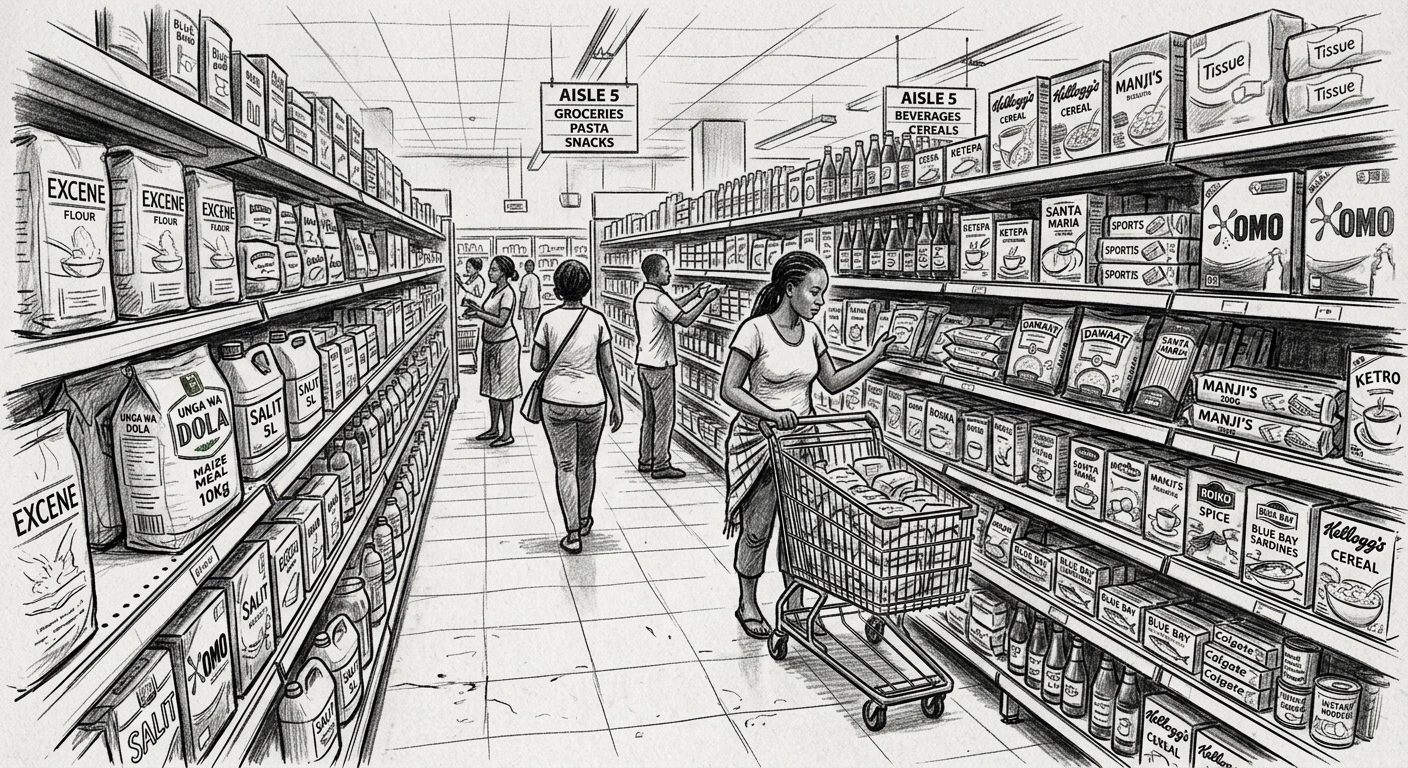
One of the clearest responses to this shift has been the rapid growth of smaller, cheaper and more flexible purchasing options across multiple sectors, as businesses attempt to align their offerings with households’ reduced purchasing power.
If a customer cannot spend Sh1,000 at once, a business may have a better chance of completing a sale by offering entry points at Sh100 or Sh300, even if this requires rethinking packaging, pricing structures and distribution models.
This trend is visible across food and household goods, transport, entertainment and even financial services, where companies are increasingly designing products that allow consumers to buy without committing large sums upfront.
This strategy is not simply about making products cheaper in absolute terms, but rather about lowering the psychological and financial barrier to purchase in a way that keeps consumers drawn to the category.
But this creates a difficult balancing act for businesses because smaller packages can increase packaging and distribution costs, lower prices can compress already-thin margins, and frequent promotions can train consumers to delay purchases until discounts are available.
Companies that succeed in this need to develop an understanding of the economics of affordability, rather than treating it as a simple pricing decision.
Price-Sensitive But Aspirational
One of the most important characteristics of the current consumer market is that affordability pressures have not eliminated aspiration, even though they have reshaped how that aspiration is expressed in everyday spending decisions.
Kenyans continue to want better phones, homes, food, holidays, healthcare and experiences, but what has changed is the willingness to pay for these improvements without first evaluating whether they offer sufficient value relative to competing needs.
This has created a consumer who is simultaneously aspirational and cautious, often holding both tendencies when making purchasing decisions.
A customer may want to eat at a fashionable restaurant but will still compare prices across several options before making a booking, or may want a new smartphone but will seriously consider refurbished or older models if the price difference is significant.
They may want to travel but will actively search for deals, affordable accommodation and flexible payment options before committing.
The implication for businesses is therefore significant, as brand prestige alone is becoming less powerful when the price difference cannot be easily justified by clear, visible value.
As a result, companies must increasingly explain why their product is worth paying more for, rather than assuming that recognition or reputation will automatically drive demand.
This shift makes quality, reliability, convenience and customer experience far more important, since businesses can no longer rely on brand strength alone to sustain premium pricing in a market that is becoming more analytical and comparison-driven.
Role of Digital Tools
The adoption of smartphones has changed the balance of power between businesses and consumers by reducing the cost and effort required to compare prices, evaluate alternatives and make informed purchasing decisions.
A customer no longer needs to physically visit multiple shops to understand price differences, because they can now search online, consult social media, ask WhatsApp groups, read reviews or compare multiple sellers within minutes before making a decision.
This has significantly reduced the information advantage that businesses traditionally enjoyed, while also increasing the speed at which consumer sentiment can shift across the market.
It has made reputation far more fragile, since a poor customer experience can spread quickly through social networks. A good deal can be amplified almost instantly across digital communities, creating both opportunities and risks for businesses.
Small businesses can now compete more effectively with established brands by using digital platforms to reach customers. At the same time, large companies can lose market share quickly if they fail to adapt their online presence to changing expectations around transparency, pricing and responsiveness.
The result is a market in which convenience and information increasingly move together, as consumers expect to know what something costs, where it is available, whether it works and what other customers think about it. Businesses that don’t make this information easily accessible create unnecessary friction with customers who are unwilling to do extra work to make a purchase.
Informal Economy Adapting
The pressure on household incomes is also reinforcing the importance of informal commerce, which continues to play a central role in how many Kenyans access goods and services.
For consumers, informal businesses often provide a level of flexibility that formal companies struggle to match, since a small trader can sell in smaller quantities, negotiate prices, deliver locally, extend informal credit or adjust faster to changing needs.
This gives informal businesses a competitive advantage, particularly in localities where convenience, familiarity and responsiveness matter as much as price.
Formal businesses face constraints that make it hard to compete purely on price, since their costs include rent, regulation, taxes, compliance requirements, employee obligations and other overheads. As a result, formal businesses must increasingly compete on reliability, quality, scale, convenience and trust.
Therefore, the future of Kenyan retail is unlikely to be defined by a simple battle between formal and informal commerce, as the two are borrowing from each other in ways that blur traditional boundaries.
Formal businesses are becoming more flexible in their offerings and pricing, while informal businesses are becoming more digitally connected and sophisticated in how they reach and serve customers.
Payment Flexibility: A New Norm
The consumer market is also being reshaped by how Kenyans pay for goods and services, particularly through the expansion of mobile money and the growing use of instalments, subscriptions, digital credit and other forms of flexible payment.
However, this introduces an important caution as a consumer who can comfortably afford monthly payments may not necessarily be able to afford the total cost of the product or service being financed. The expansion of flexible payment models therefore creates a delicate balance between improving access and encouraging overextension.
For businesses, this means that while financing options can increase sales and broaden customer reach, they must also be carefully managed to avoid contributing to unsustainable levels of consumer debt that could eventually reduce overall demand.
Despite broader financial pressures, there is a seemingly contradictory trend in which spending on experiences has remained relatively resilient, particularly among younger urban consumers who continue to prioritise activities that offer social, emotional or lifestyle value.
Restaurants, running clubs, concerts, domestic travel, short-stay accommodation, wellness activities and similar leisure-oriented businesses are therefore competing for a share of increasingly selective discretionary income.
In many cases, consumers are not necessarily spending more overall, but are instead allocating a larger proportion of limited discretionary funds towards experiences that feel meaningful, memorable or shareable.
This creates an important distinction for businesses, because consumers are not always looking for the cheapest option available, but are instead looking for the strongest justification for spending within their available budget.
A weekend experience that feels unique, social or emotionally rewarding may therefore survive a household budget squeeze more easily than a generic product that can be purchased anywhere without a clear sense of added value.
This is why experience, community and identity have become increasingly important commercial assets in a market where emotional justification is often as important as financial affordability.
Make Money Feel Spent
The Kenyan consumer is not necessarily becoming poorer in every dimension, but is instead becoming more discerning, more selective and more intentional in how money is spent across competing needs and priorities.
This distinction is important because it suggests that the businesses most likely to thrive in the coming years will not simply be those offering the lowest prices, but those that understand the trade-offs households are making and design their products and services accordingly.
The winning proposition may take many forms, including smaller packages, flexible payment plans, improved customer experience, more convenient locations, reliable digital services or products that last longer and deliver more consistent value over time. In each case, however, the underlying expectation remains the same, which is that your money will feel well spent.
This may ultimately become the defining principle of Kenya’s consumer economy as the country moves towards 2027, where success will depend less on persuading people to spend more, and more on convincing them that spending with a particular business is worth it.
The businesses that understand the new consumer will therefore not ask how to extract more spending from households, but will instead ask a more fundamental question: How do we make consumers believe that spending with us is worth it?