



For decades, Nairobi’s major sports facilities have been treated as places where events happen — a match is played, an athletics meet is held, a concert takes place, and the crowds go home. The economic activity around the event has usually been an afterthought, and Zaria Group is betting on a different model.
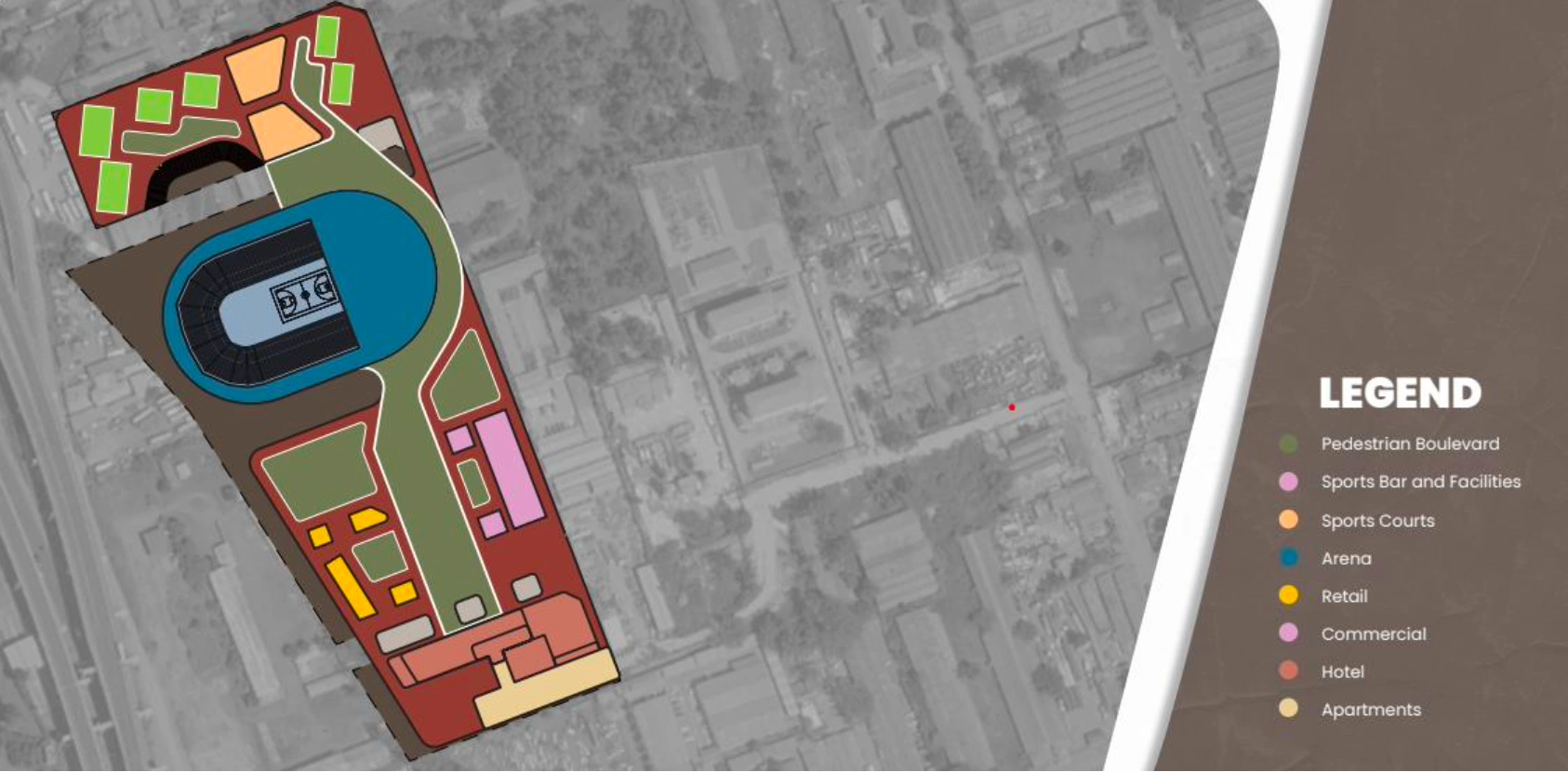
Its proposed development at Nairobi Railway City is not simply a new venue. Phase One will feature a 10,000-seat multipurpose indoor arena, supported by a 140-room branded hotel, 70 serviced apartments, retail outlets, restaurants and leisure facilities.
Plans also include a public plaza, a green pedestrian boulevard and an outdoor performance space. The development is expected to occupy approximately 6.8 hectares near Nairobi Railway Station, according to regulatory filings.
The components tell a more interesting story than the headline seat count. The Arena is meant to anchor a commercial and entertainment district where people can attend an event, stay overnight, eat, shop, work, meet and spend time, without necessarily leaving the development.
This changes the question from whether Nairobi needs another stadium to whether the city can build an economy around one.
The Arena as an Economic Engine
The Nairobi project sits inside the much larger Railway City redevelopment, intended to transform the area around Nairobi Central Railway Station into a modern urban district.
Zaria’s role is to provide one of the development’s major entertainment anchors: a multipurpose arena capable of hosting sporting competitions, concerts, conferences and other large gatherings, surrounded by the infrastructure needed to turn individual events into sustained commercial activity.
The design of Phase One is revealing. A 10,000-seat arena creates the audience. The hotel provides accommodation. The serviced apartments extend the stay. Restaurants and retail capture spending around events. Leisure facilities give people a reason to visit when there is no major event on. The plaza, boulevard and outdoor performance space add further areas where activity can happen.
The model, in other words, is less “build an arena” and more “build a destination around an arena” — an important distinction as Nairobi tries to position itself as a regional centre for sport, entertainment, conferences and culture.
A major event pulls people into the district, and those people need transport, accommodation, food, security, retail, broadcasting and entertainment.
Businesses emerge around the activity; organisers, artists, athletes, technicians and other professionals create demand for specialised services. The arena becomes the starting point, not the finished product.
Following the Money
The most significant development around the Nairobi project is the involvement of the International Finance Corporation. IFC says its partnership with Zaria covers sports and entertainment districts in both Nairobi and Kigali.
For the Nairobi project, IFC’s planned equity investment of up to USD18 million is expected to help mobilise as much as USD100 million in additional equity and approximately USD70 million in debt financing — potentially up to USD188 million in identified equity and debt financing around the project, though these figures should be read as planned and mobilised financing rather than money already spent on the ground.
The financing structure matters because it illustrates how the business case for Africa’s sports and entertainment sector is changing. The sector is increasingly viewed not just through ticket sales, but through intellectual property, event management, hospitality, retail, media and tourism.
The physical development reinforces that logic: a hotel room can generate revenue even when the arena is quiet, restaurants and retail can serve residents and visitors beyond event days, and serviced apartments add another income stream. The economic proposition is built around frequency and multiple revenue streams, not on the occasional large event alone.
IFC estimates the Nairobi project could create approximately 3,500 construction jobs, more than 1,000 permanent jobs and tens of thousands of event-related jobs. The bigger economic question is whether those jobs and opportunities stay concentrated inside the development, or spread into the city around it.
Can Nairobi Supply the Ecosystem?
This is where the project’s real test begins. A modern arena can attract a major concert, host a basketball game, an athletics event, a conference or an international production — but the economic value of those events depends on what happens beyond the gates.
Can Nairobi’s hotels absorb the visitors? Can local restaurants and retailers capture their spending? Can Kenyan production companies supply lighting, sound, staging and broadcasting? Can local musicians, designers, photographers, security firms, transport operators and event managers get into the value chain?
The 140-room hotel and 70 serviced apartments will provide some of that capacity themselves. But the larger opportunity lies in the surrounding ecosystem. A successful arena needs a calendar, not occasional spectacles — enough events through the year to keep the infrastructure commercially active.
That means Nairobi must become not merely a city capable of hosting large events, but a city that international organisers consistently choose.
This is where the Zaria project intersects with the other stories in this week’s The Chronicle Weekly. Kenya has secured the 2029 World Athletics Championships. It is preparing for AFCON 2027. Nairobi is trying to strengthen its position as a creative and entertainment centre, while attracting new corporate investment and international financing. Each development creates an opportunity; together, they raise the possibility of an ecosystem. But ecosystems don’t emerge simply because buildings get built.
The Real Test Is What Happens Around It
The temptation with large infrastructure projects is to measure success by the ribbon-cutting ceremony, the size of the building or the value of the announced investment. The more useful measure comes later.
How many events does the arena actually host? How many businesses grow around it? How much of the spending generated by international visitors stays in Kenya? How many Kenyan companies enter the supply chain?
What happens to employment once construction ends? Can the hotel and retail components stay commercially viable between major events? And does the surrounding Railway City development make the project easier to access and more attractive — or does the arena end up an isolated destination?
These questions matter because Kenya has no shortage of impressive infrastructure announcements. What has been harder is building the institutional, commercial and operational capacity that lets infrastructure generate value consistently.
Zaria’s project, then, represents something larger than another arena in Nairobi. It is a test of whether Kenya can move from hosting events to building an events economy — which is also why it belongs in the wider story of Kenya’s growing global visibility.
The World Athletics decision gives Nairobi an international sporting platform. The Recording Academy discussions point toward a larger cultural economy. New corporate transactions show that international investors still see opportunities in the Kenyan market.
The opportunity is increasingly visible. The harder task is capturing it.
For Nairobi, the arena will ultimately be judged not by how impressive it looks on opening day, but by what happens in the streets, businesses, hotels, studios, restaurants and creative enterprises around it for years afterwards.
An arena is no longer just an arena. If the model works, it becomes a piece of economic infrastructure.