

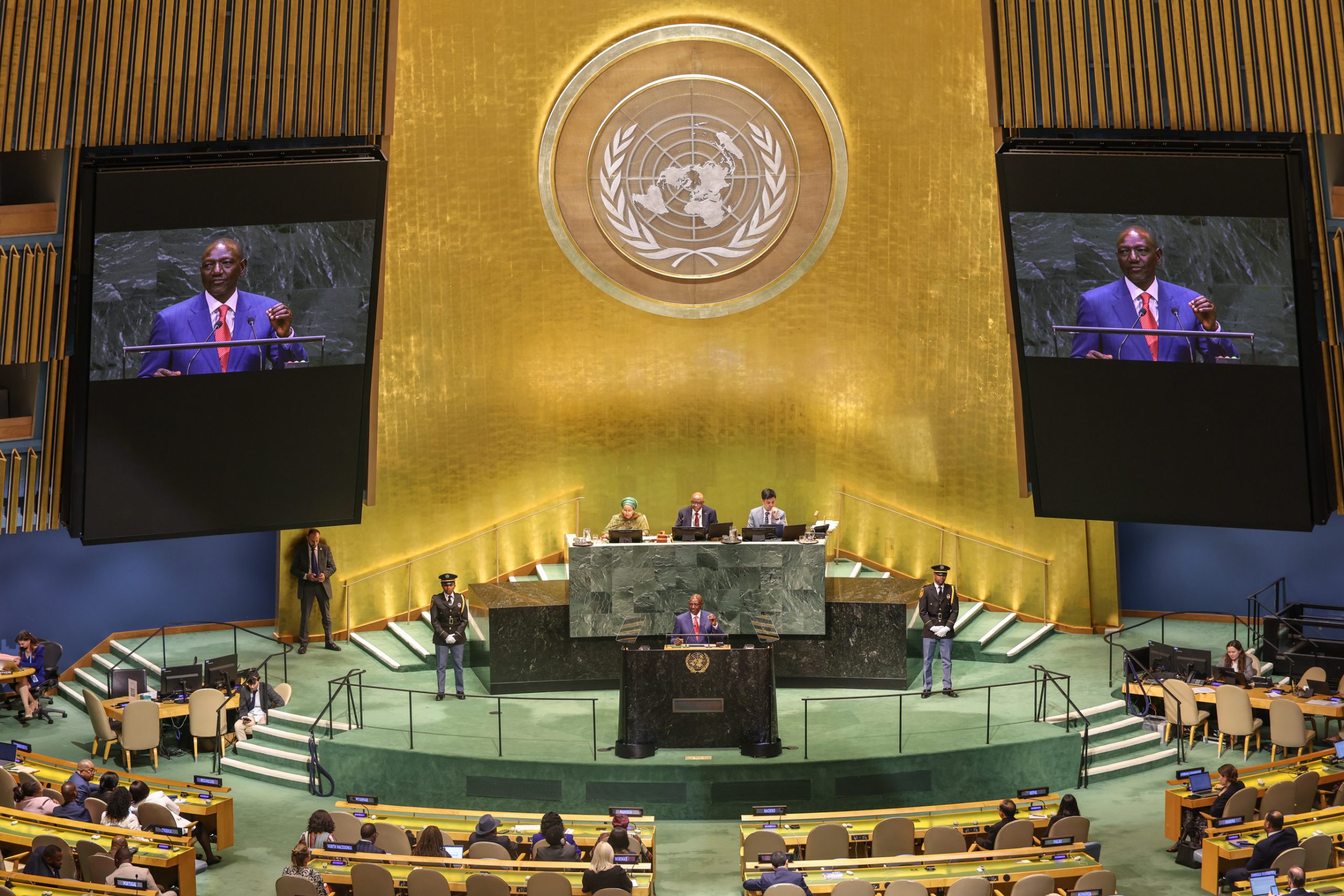
Between September 21 and 23, President Ruto addressed the Accra Reset digital-skills gathering, the Africa We Build roundtable on regulation and risk, the COMESA side event on the Pact for the Future, the Committee of African Heads of State on Climate Change, and the UNICEF dialogue on debt and child investment.
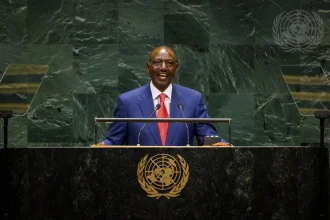
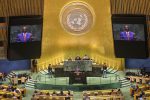
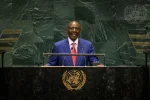
He also addressed the Coalition for Children’s Rights in the Age of AI, the Kenya-EU Partnership for Multilateralism summit, a high-level event on clean cooking, and, finally, the General Debate of the UN General Assembly itself.
Nine platforms, nine different audiences – regulators, development bankers, child-rights advocates, climate negotiators, EU heads of state – and, underneath almost all of them, one sentence, restated with only minor variation each time.
At the Africa We Build roundtable he put it most bluntly: Africa’s problem, he said, was no longer the amount of capital available to it, but the set of rules that decide where that capital is allowed to go. Two days later, at the General Debate, the same idea returned in harder language: capital must price risk; it must not price prejudice.
That repetition is worth noticing before anything else. Heads of state deliver dozens of remarks during UNGA week, most of them courteous filler pegged to whichever committee convened them. Ruto’s week reads differently – closer to one argument tested in nine settings than nine separate speeches.
The Political Case
In the General Debate, Ruto made the institutional argument in its starkest form: every nation at the UN holds one vote, but on the gravest questions of war and peace, five nations possess a permanent power that the other 188 do not.
Africa’s 54 states, he noted, make up more than a quarter of the Assembly yet hold no permanent seat on the body that decides the peace and security matters that concern them most directly – permanently discussed, in his words, but permanently excluded.
He dated the argument precisely: the General Assembly moved Security Council reform into intergovernmental negotiations in 2008; those negotiations began the following year; seventeen years later, he said, the world is still negotiating.
His evidence that reform is possible rather than merely desirable was historical – the Council itself grew from eleven members to fifteen in 1963, when the UN’s own membership changed. What was possible then, he argued, is possible again.
The Kenya-EU Multilateralism Summit repeated the same demand in coalition language – reform in accordance with the Ezulwini Consensus and the Sirte Declaration – while making explicit that Kenya treats this as one half of a single argument, not a standalone grievance.
Political reform and financial reform, he told the summit, are not separate projects. They ask the same fundamental question.
The Financial Case
That second half of the argument was the one Ruto worked hardest on across the week. Global public debt reached $102 trillion in 2024, he told both the UNICEF dialogue and the General Debate; developing countries, holding less than a third of that debt, paid roughly a trillion dollars in interest on it in that year alone – enough that 46 developing countries now spend more on interest than on either health or education.
At UNICEF House, he stated the mechanism directly: a debt crisis becomes a children’s crisis when interest payments crowd out classrooms, healthcare, nutrition and social protection.
His specific target was not debt itself but the pricing of it. Citing UNDP research, he told both the COMESA event and the General Debate that subjectivities in sovereign credit ratings have cost African countries in the region of $75 billion through excessive interest and foregone lending – one of the few figures he repeated identically across two separate audiences rather than varying it.
Reform, in his framing, meant three concrete asks: price African risk against actual African default-and-recovery data rather than inherited assumptions; make guarantees on productive African assets cheaper than the risk they cover; and stop treating long-duration African infrastructure debt as an exotic prudential exposure.
The Domestic Case
The most concrete version of the argument, and the one built to travel, was the one Ruto delivered to the Africa We Build roundtable using a single hypothetical: a teacher in Eldoret who has paid into a pension fund for twenty years.
Kenya’s pension industry holds roughly Sh 3.2 trillion, about $24.7 billion, he said; 46 per cent of it sits in government securities, while just two-hundredths of one per cent is invested in infrastructure debt – this despite Kenyan regulation permitting funds to hold up to ten per cent of assets in infrastructure. The ceiling, in other words, was not the constraint.
His conclusion was as much an indictment of African financial architecture as of the international one. The teacher’s fund manager, he said, is not being unpatriotic; he is being rational, because the rules he works under tell him a Treasury bill is prudent, and a power plant is adventurous.
Kenya’s own domestic capital pools, Ruto argued, made the scarcity narrative obsolete at the continental level too: African non-bank domestic capital now exceeds $2 trillion, and pension and insurance assets have crossed $1 trillion for the first time – against total external flows to the continent of $1.7 trillion across the whole of 2014 to 2024. The scarcity argument, he told the roundtable, is finished.
The Investment Pitch
Where the argument turned from diagnosis to delivery was Kenya’s own project pipeline, which Ruto used repeatedly as evidence that the country was not merely asking others to change rules it had not tested on itself.
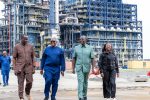
The headline item: the East Africa refinery at Lamu, on which Kenya expected to break ground within the week of his General Debate speech, with capacity to process 700,000 barrels of oil a day and an investment of roughly $16 billion.
He paired it with a shorter domestic record – three credit-rating actions in Kenya’s favour since August 2025, foreign exchange reserves of about $15 billion, more than six months of import cover, and the Kenya Pipeline listing, which raised Sh112.4 billion, about $868.5 million, at 105.7 per cent subscription and ended an eleven-year drought on the Nairobi bourse.
The National Infrastructure Fund, signed into law in March, is designed to mobilise up to $40 billion for roads, ports, power and water through capital that shares in the returns rather than new public debt.
Kenya, he told the roundtable, is not asking pension funds and development finance institutions to lend to it; it is asking them to own the assets alongside it.
As proof the model builds things, he pointed to the Affordable Housing Programme’s 270,000 units currently under construction, worth Sh500 billion.
The Same Logic, Smaller Scale
The argument showed up at a smaller register too, in venues that had nothing to do with sovereign debt. At the Accra Reset gathering, Ruto framed Kenya’s leadership of the MasterKey digital-skills corridor in identical terms.
African talent is not scarce, but a qualification issued in Nairobi currently has no trusted way to travel to Accra or Kigali, so the missing piece is not people but a system of verification,
MasterKey’s actual purpose, in his words, being to hold and share trusted records rather than to award jobs or visas itself.
At the clean cooking event the same day, he priced the continent’s entire universal-access gap at about $2 billion a year through 2040 – under a tenth of one per cent of annual global energy investment – and named the real constraint as fragmented demand and risk left on households, not a shortage of capital.
Kenya’s own $600 million Institutional Clean Cooking Investment Pack was offered as the kind of aggregation instrument that turns need into something investable.
Even the child-safety coalition speech fit the pattern: the ask there was for design standards and age-assurance rules built with African realities in mind, not for money.
Reform Advocate, Investment Courter
The tension in Ruto’s week is not that the two tracks – the institutional-reform argument and the capital-courting pitch – contradict each other; on his own logic they are the same argument made twice, once about global rules and once about Kenya’s own compliance with them.
The open question for Nairobi is whether the international side of that bargain moves as fast as the domestic side.
Whether Ruto’s argument moves the institutions he spent the week addressing, or simply gets logged as another UNGA speech inside a seventeen-year Security Council negotiation, is the test worth watching for at the 2028 Pact for the Future review.
And, closer to home, whether the teacher in Eldoret’s pension fund holds any more than two hundredths of one per cent in infrastructure the next time Kenya publishes the numbers.