





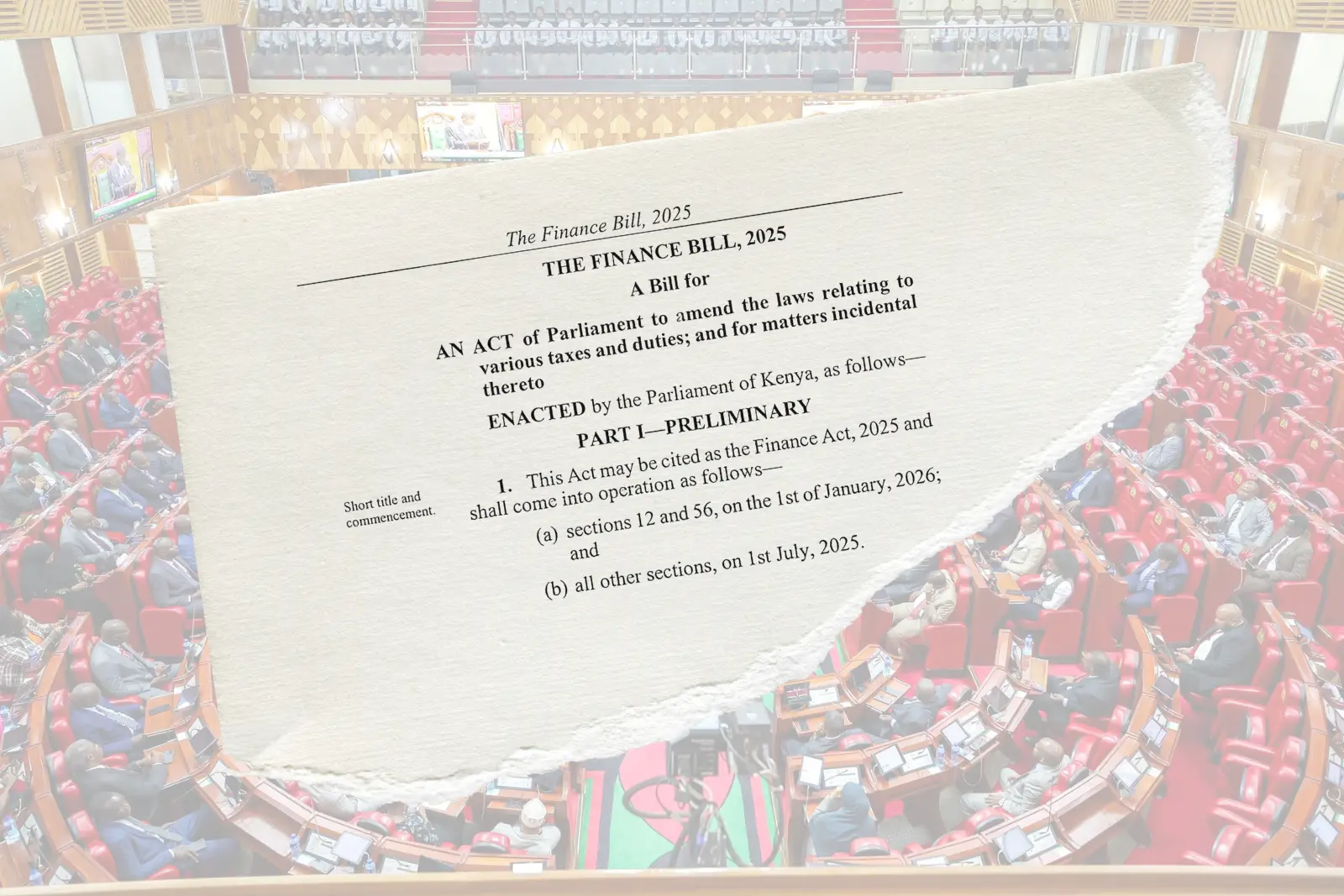
The Finance Bill 2025, tabled in the National Assembly on Wednesday has sparked widespread interest across the nation, as it proposes significant amendments to the country’s tax framework.
Coming on the heels of the contentious Finance Bill, 2024, which ignited nationwide protests and forced the government to reconsider its approach, this latest Bill is under intense scrutiny from Kenyans eager to understand its implications for their livelihoods and the economy.
The Finance Bill, 2024, was a lightning rod for public discontent, primarily due to its proposed tax hikes on essential goods and services, including bread, cooking oil, and mobile money transactions. These measures were perceived as burdensome for ordinary Kenyans already grappling with a high cost of living.
The Bill triggered unprecedented protests, led largely by the youth, under the banner of the “Gen Z movement.” Demonstrators stormed Kenya’s Parliament in June 2024, leading to a violent clash that resulted in several deaths and hundreds of injuries.
The public outcry forced President William Ruto to withdraw the bill and dissolve his cabinet in a bid to restore calm. The 2024 protests underscored a growing demand for transparency, public participation, and accountability in Kenya’s legislative processes.
The government’s subsequent commitment to engage citizens in shaping fiscal policy has set the stage for the Finance Bill, 2025, to be a litmus test for its responsiveness to public concerns.
Kenyans are keenly watching to see if the new Bill addresses the grievances of 2024 while balancing the government’s need to raise revenue for debt servicing and development.
The Finance Bill, 2025, proposes amendments to several tax-related laws, including the Income Tax Act, Value Added Tax Act, Excise Duty Act, Tax Procedures Act, and Miscellaneous Fees and Levies Act. Let us look at some of the standout provisions.
Income Tax Reforms
The Bill introduces an advance pricing agreement (Section 18G) to regulate transactions between related entities, aiming to curb tax evasion by multinational corporations. This move is seen as an effort to align Kenya with global tax standards reducing transfer pricing disputes and provide certainty for multinational corporations.
The Bill expands the scope of taxable income to include the supply of goods to public entities and the sale of scrap (Section 10), potentially increasing revenue from previously untaxed sectors.
Companies certified by the Nairobi International Financial Centre Authority (NIFCA) will benefit from reduced tax rates—15 per cent for the first 10 years and 20 per cent for the next 10 for firms investing at least Sh3 billion in Kenya, and similar concessions for startups. These measures aim to attract foreign investment and bolster Kenya’s position as a regional financial hub.
The Bill exempts gains from securities traded on licensed exchanges and dividends from NIFCA-certified companies reinvesting at least KSh 250 million in Kenya. It also increases deductions for certain expenditures, such as public sports facility construction, while eliminating outdated provisions like compensating tax and venture company definitions.
The Bill redefines “royalty” to include software distribution with regular payments, ensuring digital transactions are taxed. It also introduces new taxable income sources, such as the supply of goods to public entities and the sale of scrap, reflecting an intent to capture previously untaxed economic activities.
However, the removal of several deductions, such as those for specific implements and utensils, and the shortening of loss carry-forward periods from ten to five years, may increase the tax burden for some businesses, particularly small and medium enterprises (SMEs).
The Bill is also providing for an increase in tax free per diem for private employees from Sh2,000 to Sh10,000 which comes as a relief on employees’ expenses when travelling for work.
Value Added Tax (VAT) Changes
The Bill also deletes exemptions for various goods and services, including certain medicaments, aircraft spares, and project-specific inputs, with a transitional period until June 30, 2026, for previously approved exemptions. This move aims to broaden the VAT base and increase revenue but also has the potential to increase costs for consumers (First Schedule, Section A).
However, it introduces exemptions for inputs used in manufacturing pharmaceuticals, animal feeds, and locally assembled mobile phones, motorcycles, electric bicycles, solar batteries, and electric buses signal strong government support for green energy and local industries. The transportation of sugarcane to milling factories and packaging materials for tea and coffee also gain exemptions, bolstering agricultural value chains.
A new section (66A) imposes VAT liability on exempt or zero-rated goods if used inconsistently with their intended purpose, aiming to prevent tax loopholes.
The definition of “tax invoice” now includes electronic invoices, aligning with modern tax administration practices. Additionally, VAT refund claims must now be lodged within 12 months, tightening compliance requirements.
Excise Duty Adjustments
The Bill broadens the definition of a “digital marketplace” to include online platforms for goods and services, subjecting more digital transactions to excise duty (Section 2, Excise Duty Act). This reflects the government’s focus on taxing the growing digital economy.
The Bill imposes a 25 per cent excise duty (or Sh 200 per kilogram, whichever is higher) on imported plastics, printed polymers, and paper products, excluding those from East African Community (EAC) states meeting origin rules. Imported float glass now faces a 35 per cent duty or Sh 200 per kilogram. These measures protect local manufacturers but may raise costs for consumers.
The definition of “digital marketplace” is introduced, and excise duties now apply to services consumed in Kenya via the internet or electronic networks, regardless of the supplier’s location. This targets non-resident providers, ensuring fairness in taxing digital services.
Imported eggs, onions, and potatoes are removed from the excise duty list, potentially lowering food prices. However, undenatured spirits for beverage manufacturing now face a Sh500 per liter duty, which could impact the liquor industry.
Tax Procedures and Compliance
The Finance Bill, 2025 allows waivers for penalties or interest caused by electronic tax system errors, acknowledging the challenges of digital tax platforms. Electronic tax invoices are further streamlined, excluding certain payments like emoluments and imports.
Non-residents subject to Kenyan tax are now explicitly included in agency notice provisions, ensuring tax collection from foreign entities. This aligns with global trends in taxing cross-border transactions.
The Commissioner must now provide reasons for amended assessments, increasing transparency. Additionally, taxpayers who fail to withhold tax are relieved from paying principal tax if the recipient has already accounted for it, reducing double taxation risks.
The Bill seeks to repeal Subsection 1B of Section 59A of the Tax Procedures Act which currently prohibits the Kenya Revenue Authority (KRA) from requiring businesses to integrate their systems with the Authority’s systems in cases where such integration would compromise trade secrets or personal and private data held on behalf of customers or collected during the course of business.
Repealing this provision would grant the KRA significantly broader access to personal and sensitive data under the pretext of tax compliance thus violating the country’s data protection laws.
Why Kenyans Are Interested
The Finance Bill is more than a fiscal document; it is a political and social touchstone. The 2024 protests revealed deep-seated frustrations with policies perceived as disconnected from the realities of ordinary Kenyans. Many citizens, particularly the youth, are now more engaged in governance, demanding a say in how tax policies are crafted.
Public interest is also driven by economic realities. Kenya’s public debt, estimated at over 70 per cent of GDP, necessitates robust revenue collection, but citizens are wary of measures that could further strain their finances.
The 2024 bill’s failure to balance revenue needs with public welfare has made Kenyans skeptical of new tax proposals. For instance, the removal of VAT exemptions on food supplements has sparked concerns about rising healthcare costs, while the excise duty on digital marketplaces could affect small-scale online entrepreneurs.
Civil society groups and business associations, such as the Kenya Private Sector Alliance (KEPSA), have called for broader consultations to avoid a repeat of last year’s unrest. The government has promised to hold public participation forums, but skepticism remains, given the limited engagement during the 2024 bill’s formulation.
Read: Wetang’ula: Debate Finance Bill in Parliament, not at funerals
The Finance Bill, 2025, aims to modernise Kenya’s tax system, boost investment, and close revenue leakages. However, its success hinges on implementation and public acceptance.
The incentives for green technology and local manufacturing are positive steps, aligning with global sustainability goals and Kenya’s Vision 2030. Yet, the increased tax burden on certain goods and services could exacerbate inflationary pressures, a concern for a population already facing high living costs.
The government faces the challenge of restoring public trust. The 2024 protests highlighted the power of collective action, and any misstep in communicating or implementing the 2025 bill could reignite tensions. Analysts suggest that transparent dialogue, clear explanations of tax benefits, and targeted relief for low-income households will be critical.