




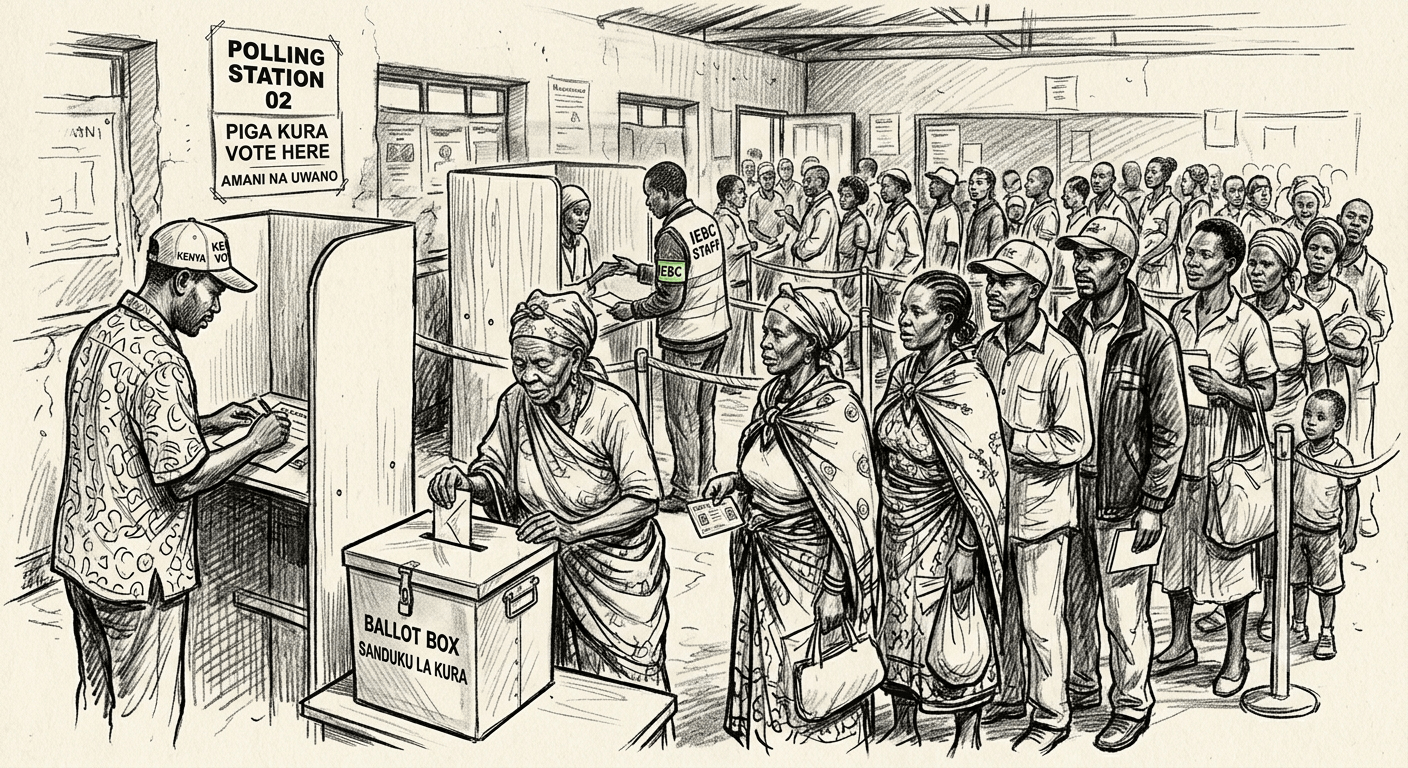
The Independent Electoral and Boundaries Commission (IEBC) has made it official: Kenyans will return to the polls on Tuesday, August 10, 2027.
The announcement, carried in a public notice signed by IEBC Chairperson Erastus Edung Ethekon, invokes Article 88(4) of the Constitution, the Elections Act and the Elections (General) Regulations, 2012.
That is the mechanism, not the headline. A gazetted date is a legal fact, binding on the Commission and every political actor who intends to be on a ballot.
It is not, by itself, evidence that the election it describes will be adequately funded, administered on unchanged boundaries by design rather than by default, or run to the standard the Constitution demands. Those three questions are where this story actually lives.
What The Notice Triggers
The gazettement is not merely ceremonial. It brings the Electoral Code of Conduct and the Election Offences Act formally into force for the election period, placing political parties, candidates and their agents under binding rules on conduct, campaigning and nomination well before a single ballot is printed.
Ethekon has already used that authority once — ordering political actors improperly using the IEBC’s logo to remove such material within five days, because it risks implying Commission endorsement of a candidate or party.
Campaign financing will run under the Election Campaign Financing Regulations 2026, gazetted separately on August 7, 2026, which set contribution and spending limits intended to cap the financial distortion of political competition.
The timetable itself follows the Election Operations Plan 2025–2027, developed under the IEBC’s own Strategic Plan 2024–2029 — in other words, a schedule the Commission set for itself, now converted into statutory deadlines.
The Calendar Political Actors Now Face
The notice starts a chain of dates that will structure party and candidate behaviour for the next eleven months. Political parties must submit the names and specimen signatures of their authorised persons by October 15, 2026.
The Registrar of Political Parties must certify party nomination rules by 30 October, with certified rules due back at the IEBC by November 6. Candidates face an early integrity test: anyone participating in public fundraising or harambees after 9 December 2026 risks disqualification.
Party lists for parliamentary and county assembly seats are due by June 25, 2027, and national and constituency chief election agents must be named by July 27, 2027.
Campaigning ends on August 7, 2027, forty-eight hours before polls open. After the vote, parties and candidates face their own deadlines — a report on surplus campaign funds by November 8, 2027, and full campaign expenditure returns by November 22, 2027.
None of this is unusual by Kenyan electoral standards. What it does is convert 2027 from a political talking point — the subject of speculation, coalition manoeuvring and early campaign posturing since 2022 — into a formally administered process with legal consequences attached to missed dates.
The Money Question
Ethekon has separately stated that the IEBC requires Sh67.07 billion to conduct the 2027 election, of which the National Treasury has released Sh41.50 billion, leaving a funding shortfall of roughly Sh24.57 billion.
Ethekon has warned that a gap of this size, if unresolved, threatens voter education, election technology, staffing and security arrangements — the operational layer that determines whether a well-gazetted timetable translates into a credible poll on the day.
The 2027 election will be run on the same electoral map used in 2013, 2017 and 2022: 290 constituencies and 1,450 wards, unchanged.
This is not an oversight so much as an admission. Ethekon has said a comprehensive boundary review would require at least two years and would have needed to be completed by August 10, 2026, to be ready for this cycle — a deadline the Commission itself says it could not meet, citing limited time and cost constraints.
The result is that Kenya heads into its seventh General Election under the current constitutional dispensation, and Ruto’s second as incumbent, without the constituency and ward-level rebalancing that population shifts since 2012 would ordinarily justify.
A published notice, a signed chairperson, seven gazette numbers and an eleven-month countdown make for a clean, well-documented procedural story.
The Commission has done what the law requires of it at this stage, on time and in the correct form.
What remains open — the size of the funding gap, whether it closes before ballots are printed, and whether an unreviewed electoral map holds up to scrutiny as candidates declare — is the part no gazette notice settles.
The date is fixed, but the delivery record on the mechanics behind it is still being written.