



The easiest way to describe the Kenyan economy under William Ruto is to ask whether it grew. It did. The more consequential question is who benefited from that growth – and it is there that the record becomes revealing.
The Ruto administration inherited an economy under fiscal pressure and responded with an agenda built around revenue mobilisation, agricultural productivity, infrastructure, housing, digital services and private-sector investment.
Four years later, the country has more houses under construction, more electricity connections, more digital government services, higher agricultural output in key areas, and larger tax collection.
But an economy does not distribute its gains equally simply because government announces an ambitious programme. Some Kenyans benefit as employees, others as contractors, farmers, landlords, financiers or investors – and some experience the same changes primarily as higher taxes and higher costs.
The real scorecard therefore requires a different question from “Is the economy growing?” It requires asking who captured the value created.
State Became A Bigger Economic Player
KRA revenue has risen from approximately Sh2.0 trillion in 2021/22 to Sh2.8 trillion in 2025/26, giving the government greater capacity to finance services and development. The state has also become a more aggressive participant in the economy through the Affordable Housing Levy, expanded taxation, agricultural subsidies, digital infrastructure and large public construction programmes.
This is an unusual paradox where the government is simultaneously more financially demanding of households and more important as a source of economic activity in its own right. That matters because public spending becomes contracts, wages, construction activity, procurement and payments to private companies.
About 230,000 units are reported as completed or under construction, and whatever the shortcomings against the original target, a programme at that scale creates demand for cement, steel, transport, labour, land and finance. The immediate beneficiaries are not necessarily the families occupying the houses but the businesses supplying the programme – a dynamic equally true of roads, markets and other infrastructure.
The more interesting question is whether that activity has produced a durable expansion of private economic opportunity, or merely a temporary one built around the state’s own spending cycle.
Construction Has Had A Good Four Years
If one sector can say government policy has materially expanded its market, it is construction. Affordable housing, road rehabilitation, market construction, electricity infrastructure, and preparations for major sporting facilities have created multiplier effects well beyond the headline project, boosting demand for engineers, truckers, quarry operators, masons, and financial institutions.
That is the strongest economic argument for the government’s delivery strategy, but it also exposes its central weakness: construction activity is not the same as a transformed economy.
A project can create jobs while it is being built without creating a permanent income stream for the community; a road can improve connectivity without guaranteeing that businesses along it will survive.
The question is whether public investment is generating a self-sustaining private economy or temporary islands of activity around government expenditure.
The financial sector has remained structurally important throughout the Ruto years. A high-tax, high-debt economy creates risks for banks, but also opportunities. Government borrowing provides a large market for financial institutions, while households and businesses rely on credit.
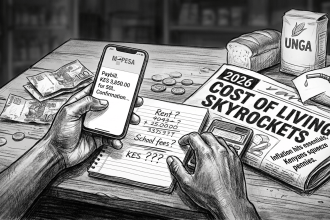
Digital lending has expanded dramatically through products such as the Hustler Fund. The difficulty is that access to finance does not mean affordable finance – for a bank, lending is an asset; for a household, the same loan is a liability, a distinction that matters most in an economy where incomes have struggled to keep pace with living costs.
Credit can help someone expand a business or buy food until the next payday — the statistics count both as financial inclusion even though a household experiences them very differently.
Farmers Among Clearest Winners
Agriculture offers the strongest evidence that the bottom-up argument can work when interventions connect directly to production. Since 2022, approximately 33.5 million 50kg bags of subsidised fertiliser have been distributed to approximately 1.98 million farmers.
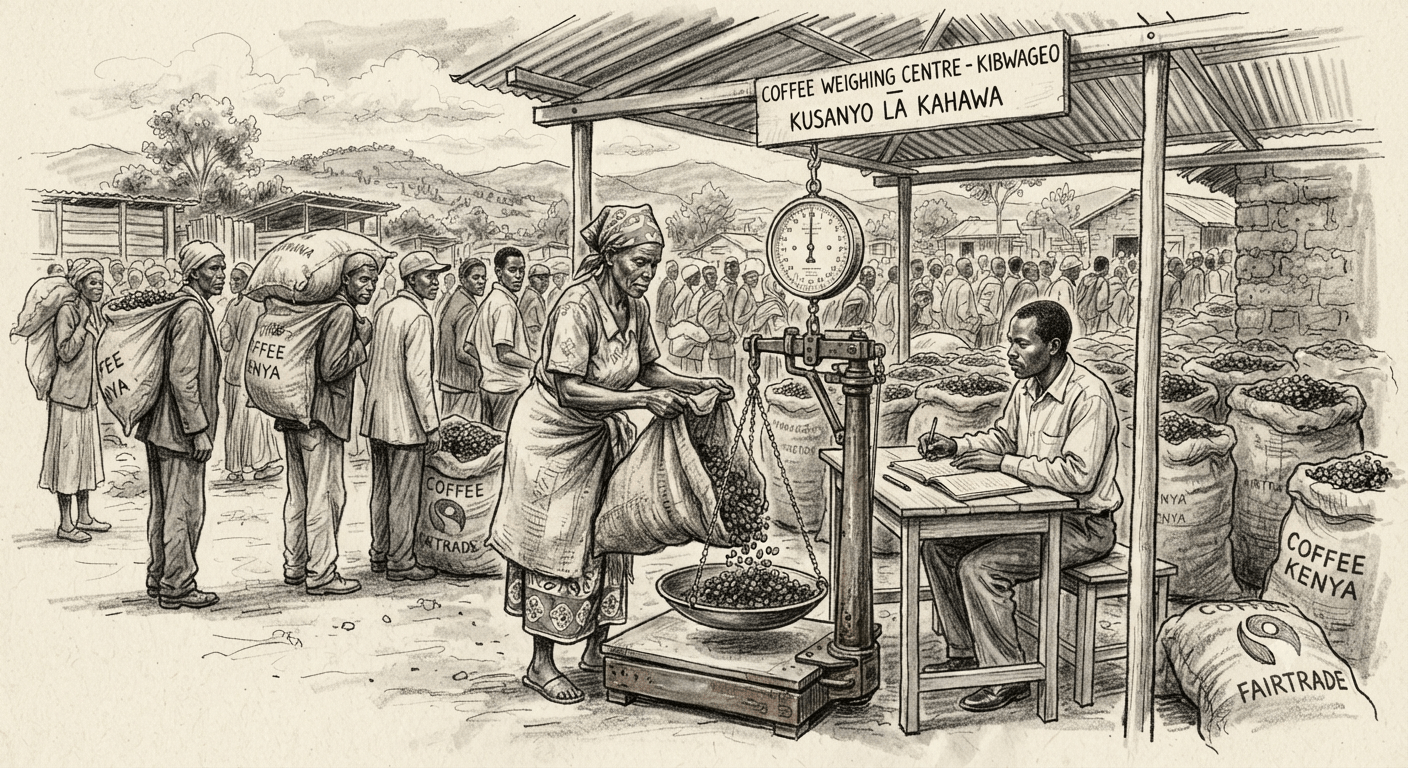
Maize production increased from 61.7 million to 85.7 million 50-kilogramme bags, and coffee farmers in some areas have seen farmgate prices rise from roughly Sh50–60 per kilogramme to around Sh158.
These affect production rather than consumption. Yet the story is not uniformly positive: agricultural prices remain vulnerable to global markets and weather, coffee reforms have faced institutional resistance and legal challenges, and sugar-sector restructuring remains a work in progress.
The farmer may be better positioned in some commodities, but that is not a blanket transformation; even so, agriculture is where the Ruto presidency’s economic philosophy has produced its clearest measurable results.
For established businesses, the record is more complicated. A more stable currency, lower inflation and stronger macroeconomic credibility benefit companies that need to import machinery, manage foreign exchange exposure or borrow, and the shilling’s recovery from its worst lows has mattered considerably for businesses hit by imported inflation.
The same businesses face an increasingly demanding tax environment, with the Finance Act 2026 again exposing the tension between the Treasury’s revenue needs and the private sector’s demand for predictability.
The debate is not simply whether businesses are winning or losing, but how well-equipped each is to absorb the cost of the new tax state.
Large, formal businesses are better positioned than informal enterprises to absorb compliance costs, employ tax specialists and pass costs through to consumers.
Informal Economy Still Carrying The Contradiction
The hustler was supposed to become the central character of the new economy, yet the informal economy remains caught between opportunity and pressure. Small traders benefit from improved roads, electricity and digital payments, but also face taxation, regulatory requirements, expensive credit and weak consumer purchasing power.
The informal worker experiences the economy as a bundle of contradictions – government infrastructure improves the environment even as government taxation makes operating harder; digital tools expand opportunity even as digital credit deepens indebtedness.
The question of who has won cannot be answered by naming a single sector; the answer depends on where a Kenyan sits in the economic chain.
There is a danger in framing the answer entirely as winners and losers. Kenya’s economy has not been zero-sum during the Ruto years; some interventions have expanded the size of economic activity rather than simply transferring wealth – agricultural production, infrastructure, digital services, housing construction, electricity access and government revenue have all grown.
But the political promise was never simply to increase activity – it was to change who benefits from it, a much higher standard.
If growth’s rewards remain concentrated among businesses with capital, political access or government contracts, Bottom-Up Economics has not achieved its central purpose.
If today’s investments allow millions of households to earn more and build assets over the next decade, the verdict may eventually look different. The difficulty is that 2027 arrives before that experiment matures.
Distribution Question Will Decide The Verdict
This is why the economic debate will matter in the next election. The government will present a country with lower inflation, stronger revenue collection, resilient GDP growth and significant intervention in agriculture and housing.
Its opponents will present a country in which taxes are higher, debt has grown, and many young people still struggle to find stable work. Both pictures contain truth, but neither answers the question that matters most: who is actually better off? The answer appears uneven.
Farmers in some sectors have gained. Construction and infrastructure businesses have gained from public investment. Formal companies have benefited from macroeconomic stability while absorbing heavier taxation.
Banks remain central beneficiaries of an economy in which both government and households require financing. But many households, informal workers and young people continue to experience the economy primarily through high costs, precarious incomes and debt.
That is the paradox of the Ruto economy: it has generated more activity without yet generating a convincing sense of shared prosperity, and that may be the most consequential distinction of all.
The 2027 election will not simply ask whether Ruto’s economic policies worked – it will ask for whom they worked. That is a much harder question, and one the government’s scorecard has not yet fully answered.