




Download Your Copy: The Chronicle Weekly September 21, 2026
Some weeks, a country seems to announce itself to the world several times over. This was one of them.
Nairobi will host the 2029 World Athletics Championships, giving Kenya the chance to stage one of the sport’s biggest events and, for the first time, bringing the championships to Africa. At almost the same time, the Competition Authority of Kenya cleared the proposed $2.3 billion transfer of East African Breweries’ controlling stake from Diageo to Japan’s Asahi Group.
The Recording Academy was in Nairobi as Kenya pursued a bid to host its first African hub, while the country prepared to access roughly $400 million in emergency World Bank financing. At the UN, Martin Kimani was named Assistant Secretary-General for Africa.
Then came another piece of the same puzzle: Zaria Group’s planned sports and entertainment district at Nairobi Railway City, anchored by a 10,000-seat indoor arena, a hotel, serviced apartments, restaurants, retail and public spaces.
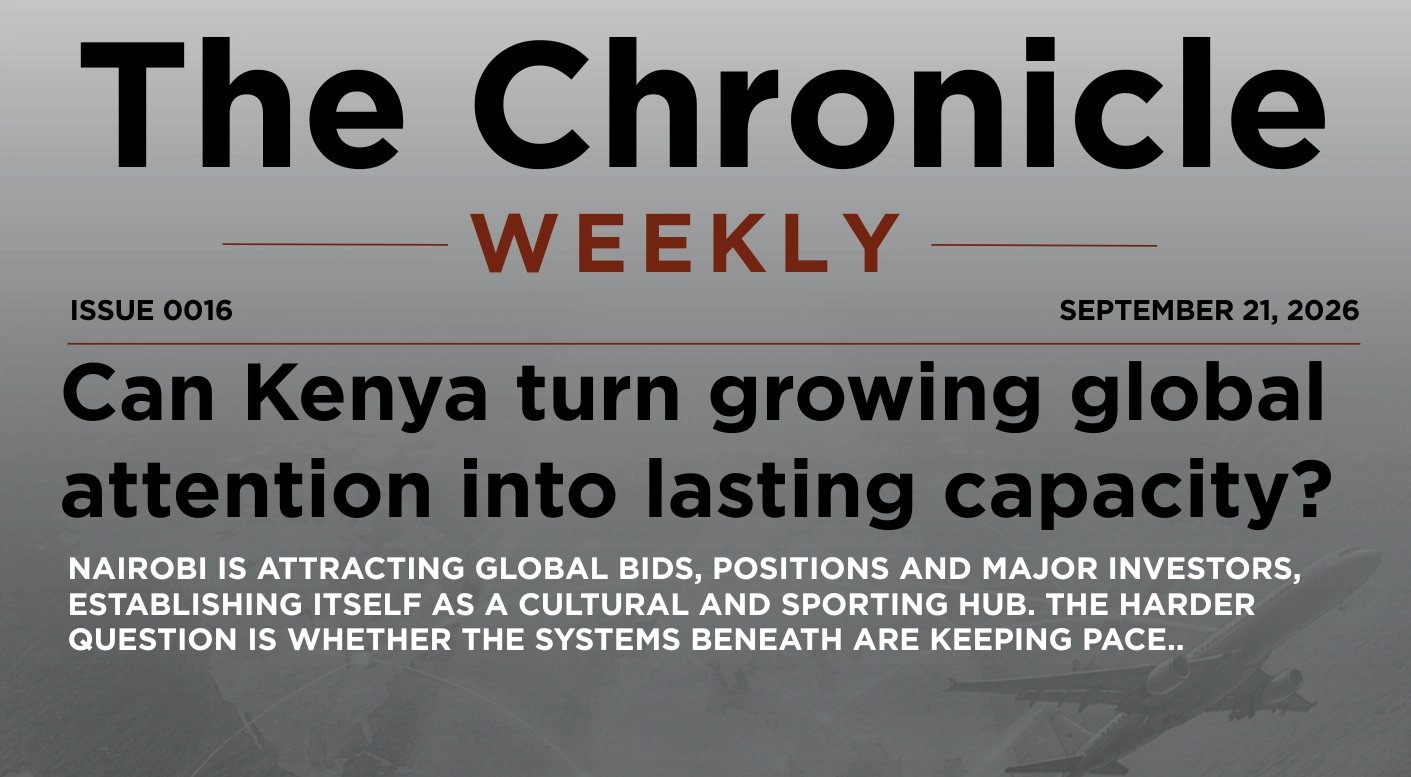
These are very different stories. One is about athletics, another about corporate ownership, another about the creative economy, another about public finance and another about urban development. Yet together they point towards the same question: what happens when international recognition arrives faster than institutional capacity?
Our cover piece looks at Kenya’s growing international profile and asks what lies beneath it. That includes a less comfortable question about the World Bank’s emergency financing: whether Kenya is simply navigating an unusually difficult year, or whether its fiscal buffers have become too thin to absorb shocks comfortably.
Our diplomacy story examines what Kimani’s appointment says about a diplomatic pipeline Kenya has built over decades, and what, if anything, the country can convert that recognition into.
Our Nairobi 2029 Perspective asks what the next three years owe the bid, from hotels and transport to an AFCON 2027 that will compete for the same contractors.
In Sports, we look at the doping question that arrived almost as fast as the announcement, and whether Kenya can turn an athletics country into an athletics industry.
Our Zaria story looks beyond the arena itself to the wider economic ecosystem it is intended to create. Our Business story asks what changes for Kenyan farmers, distributors and retailers when a familiar brand gets a new global owner, in a deal that remains proposed, not completed.
And in Life & Culture, the same test appears again: can musical talent and international recognition become an ecosystem that lets creators capture more of the value they generate?
The point is not to argue that Kenya is failing. It is to resist the easier assumption that every announcement is an achievement in itself.