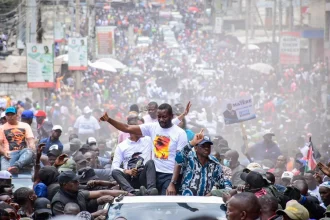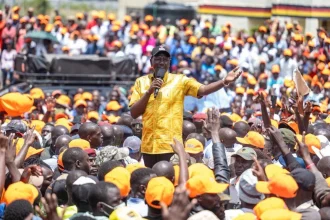




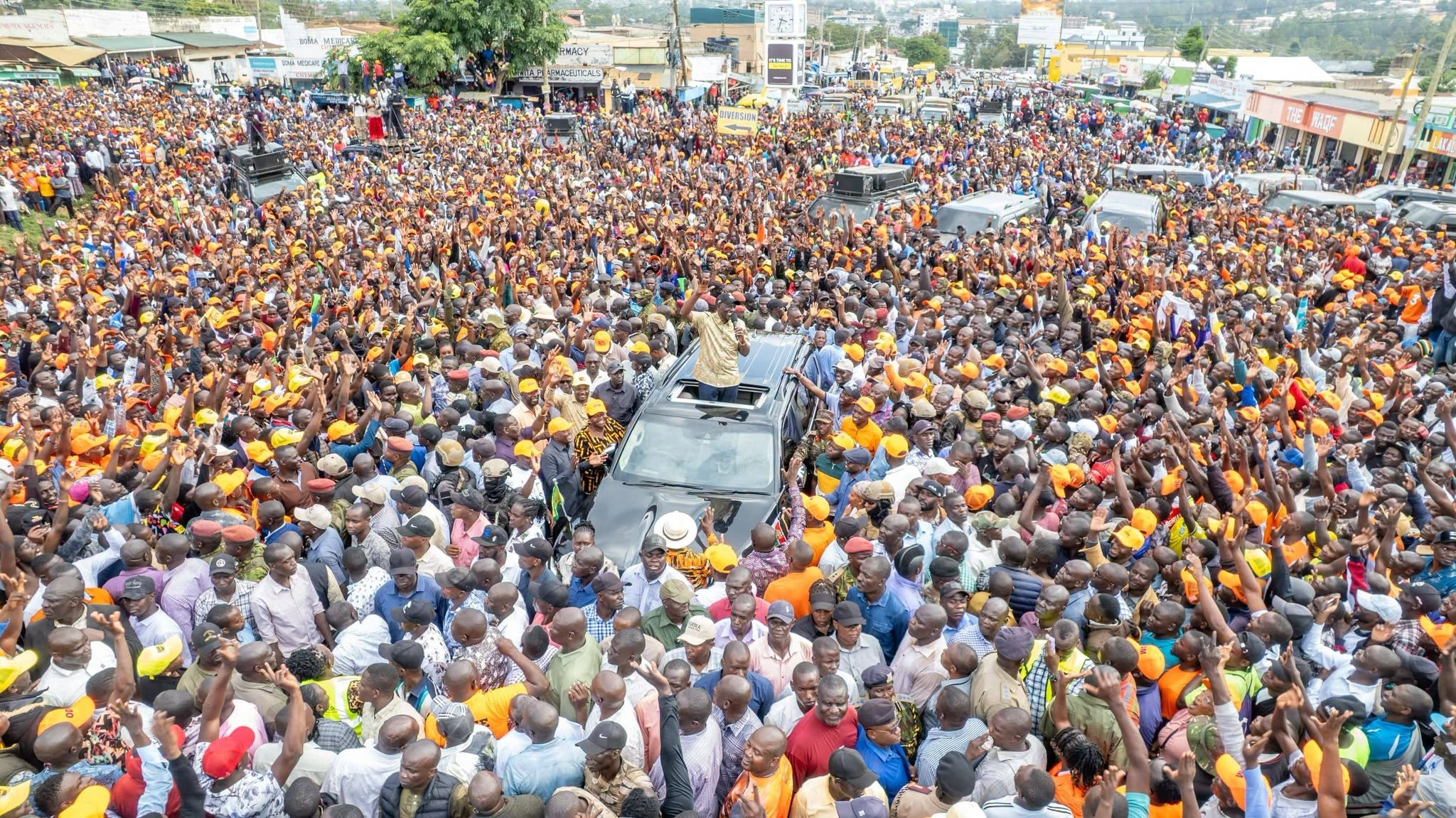
This week, William Ruto was in Nyanza — Raila Odinga’s home region, and the historical core of ODM’s vote — on a tour that ran across Kisumu, Siaya, Homa Bay and Migori counties over four to five days, meeting, by some counts, in the order of 10,000 local leaders.
In Kisumu, he defended his record four years into the presidency and took direct aim at the opposition’s politics. The timing is not incidental.
Nyanza has been without its dominant political figure since Odinga’s death from a cardiac arrest in Kerala, India, on October 15 last year — a loss that left, in the words of one wire report at the time, “a significant leadership vacuum within the country’s political opposition ahead of elections in 2027.”
The first anniversary of that death falls in three weeks. Ruto’s tour landed in the middle of the gap Odinga’s absence created, not after it had been resolved.
Government Moving On Two Fronts
The Nyanza tour isn’t Ruto’s only mobilisation push this month, and taken together the two fronts describe a president moving faster and more visibly than the coalition trying to unseat him.
While Ruto himself worked Nyanza directly, senior allies — Prime Cabinet Secretary Musalia Mudavadi, Energy Cabinet Secretary Opiyo Wandayi, and Kakamega Deputy Governor Ayub Savula, among them — were simultaneously campaigning in Western Kenya, another traditionally opposition-leaning bloc.
At the same time, Ruto’s camp has been working to consolidate his own base in Nairobi, the capital where Sifuna’s Linda Mwananchi rally was explicitly designed to test the strength of exactly that consolidation.
The strategic logic is straightforward: lock down urban and regional strongholds before the opposition can convert its own mobilisation into anything more durable than a series of well-attended rallies.
Ruto retains real structural advantages in this race that the opposition does not — incumbency, the state’s administrative machinery, and a nationwide party network that doesn’t need to be assembled from scratch the way an opposition coalition does every cycle.
What the Nyanza tour adds to that list is something more specific: a head start into territory that, on paper, still belongs to the opposition, at a moment when the opposition’s own claim to that territory no longer has the one figure who anchored it for four decades.
The Opposition Play
The opposition side is not standing still, and it would be wrong to describe it that way. Rigathi Gachagua has spent the same period consolidating a diaspora base of his own, while publicly praising Sifuna, Kalonzo Musyoka and Babu Owino for their rally activity.
Kalonzo, together with Eugene Wamalwa and Jubilee’s Fred Matiang’i, has been touring Tana River County, arriving in Hola to press the unity message despite recent unrest in neighbouring Garissa — a different region from Nyanza, with its own distinct political arithmetic, but organised on the same underlying logic of showing up in person before someone else does.
There is also evidence, not previously public in earlier reporting on this cycle, that coordination is happening behind the rallies rather than only being promised in front of them: Sifuna, Siaya Governor James Orengo, and Matiang’i met privately in Karen on September 11, following earlier meetings on August 24 and September 1.
That is a real process, running on its own clock, distinct from the public rally circuit. Separately, Ruto has himself moved to ease tensions between ODM and his own UDA, vowing publicly to protect Odinga’s legacy — a signal that the president is not simply exploiting the vacuum from outside, but actively managing his own relationship with the party it left behind.
Comparison That Actually Matters
Set side by side, the difference in this cycle is not that the opposition lacks a coordination process — it has one, quietly, in Karen, three meetings deep.
The difference is pace and visibility. Ruto’s mobilisation is happening in public, on a published four-to-five-day itinerary, covering four counties, with thousands of local leaders in the room and a president’s office backing the logistics.
The opposition’s coordination is happening in private, in a sequence of meetings that has produced no public timeline, no joint statement, and no visible commitment to when — or on what terms — Sifuna’s Nairobi base, Gachagua’s diaspora network, and Kalonzo’s Tana River organising are meant to actually merge into a single candidacy.
Both sides are mobilising. Only one side is doing it with a machine built to move immediately and a rival’s absence to move into.
The anniversary of Odinga’s death, on October 15, is the nearest fixed point worth watching. ODM has already ceded its October 10–15 schedule to the Odinga family for memorial events, culminating at Kang’o Ka Jaramogi in Bondo, with commemorations shifting north to a memorial rally in Garissa on October 17 for Northern Kenya counties.
That is opposition territory, symbolically, for those five days — the one moment on the calendar when Nyanza’s political attention is guaranteed to return to Odinga rather than to whoever is trying to succeed him.
Whether the opposition uses that window to convert grief into an actual coordination announcement, or whether it passes as commemoration only, while Ruto’s tour keeps its momentum into the new year, is the more precise version of the question this piece opened with.