




Rigathi Gachagua didn’t need a triumphant airport reception to announce his return to Kenya’s opposition politics, but what followed was loud enough for everyone to notice.
After nearly two months in the United States, the former Deputy President arrived home on October 20 and returned to Wamunyoro, where he met Nairobi Senator Edwin Sifuna and leaders associated with the Linda Mwananchi movement.
Six days later, Wiper leader Kalonzo Musyoka and Eugene Wamalwa also visited him, bringing the search for opposition unity back into the political spotlight.
The significance of the homecoming lay less in the reception he received than in the political traffic that followed. While Gachagua was away, other opposition figures had been building their profiles, exploring alliances and positioning themselves for the 2027 General Election.
His return put him back at the centre of these negotiations, reviving the question of whether the opposition could organise around a shared political project or would keep revolving around the ambitions of its most influential personalities.
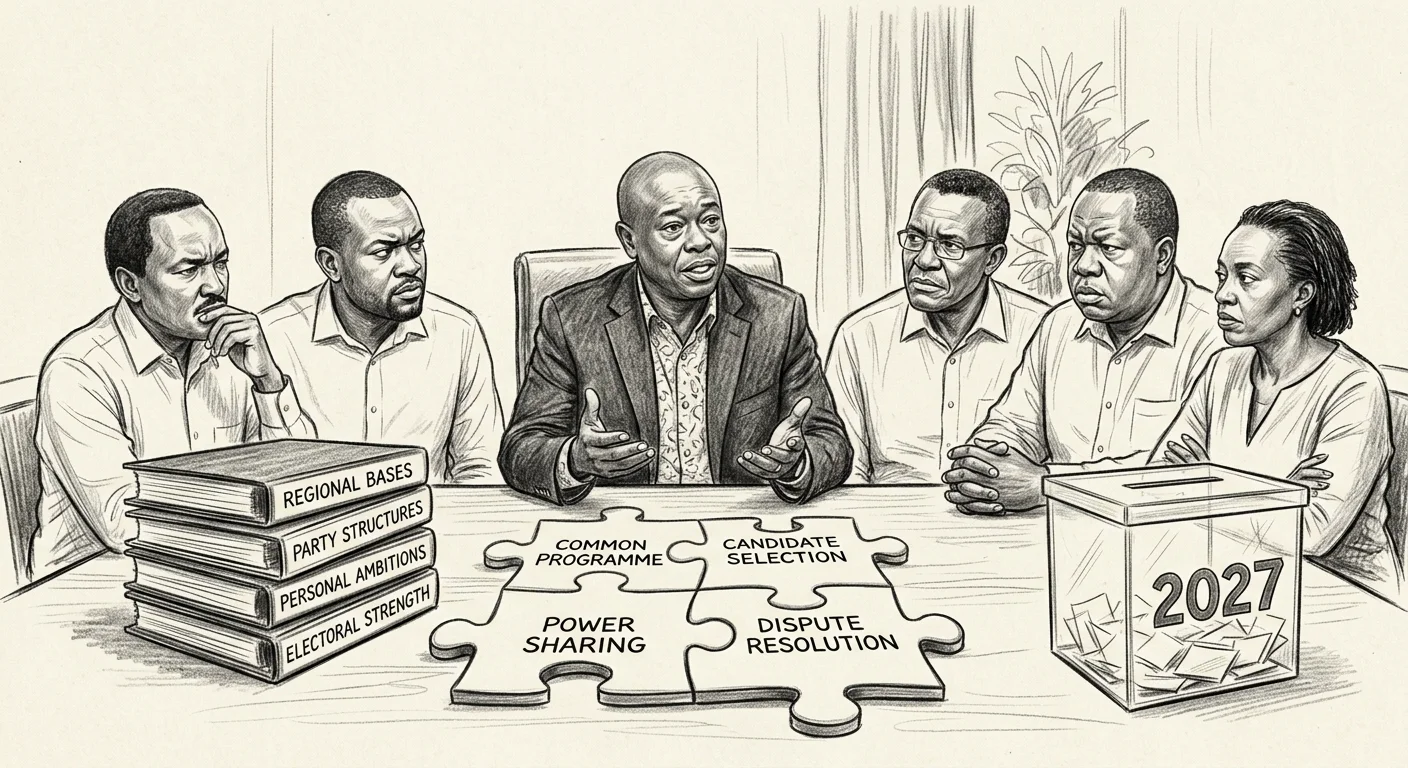
That is the paradox confronting the movement seeking to challenge President William Ruto. Its leaders insist that unity is essential to defeating the incumbent, yet negotiations repeatedly return to who should lead, whose political base matters most and who must make way for whom.
The opposition is trying to build a winning coalition while struggling to agree on the rules that should govern it, and Gachagua’s influence makes him an important part of the equation.
His rupture with Ruto and subsequent impeachment helped establish him as a prominent voice of discontent in Mount Kenya, giving him leverage that extends beyond the formal structures of his Democracy for the Citizens Party (DCP).
But there is a difference between being an indispensable coalition partner and becoming the figure around whom every other leader must organise their political future.
His return has exposed that distinction. The question is not simply whether Gachagua can help the opposition win, but whether a collective arrangement can incorporate his influence without letting the struggle for leadership overwhelm the alliance’s purpose.
The Opposition Was Not Standing Still
Gachagua’s absence did not leave a fully formed opposition coalition waiting for his return. It did, however, create room for other politicians and movements to establish their own political identities, test their influence and explore possible alliances.
In Mount Kenya, Ndindi Nyoro emerged as one of the figures associated with the contest over the region’s political future. Gachagua’s absence also raised questions about how effectively DCP could consolidate its structures and maintain momentum without relying heavily on its leader’s personal mobilisation.
The contest was therefore not only about who could command the region, but whether Gachagua’s political vehicle could develop an institutional life of its own.
Beyond Mount Kenya, the opposition landscape included Kalonzo Musyoka, Fred Matiang’i, Martha Karua, Eugene Wamalwa, Justin Muturi and Sifuna, among others.
Their political bases and ambitions differ, but their presence reflects a reality that no single figure can comfortably claim to command every constituency needed to defeat an incumbent president.
Sifuna and the Linda Mwananchi movement offered a distinct source of political energy. Their October 20 meeting with Gachagua was significant because it brought together political actors whose profiles had developed along different paths.
This distinction between political activity and tangible progress is essential. Other leaders becoming more visible during Gachagua’s absence does not prove that they had resolved the opposition’s deeper problems.
No agreement existed on a presidential candidate, a common programme, or a binding mechanism for resolving disputes. Equally, Gachagua’s return to the centre of the conversation does not by itself prove that he dismantled what others had built.
It reveals how fragile the opposition’s collective space remains. Leaders can cultivate their own followings and negotiate independently, but when the conversation turns to combining their political strength, personal influence and regional bargaining power quickly reassert themselves.
Gachagua’s absence provided an opportunity to demonstrate that opposition politics could develop several centres of leadership. His return has tested whether those centres can coexist within a durable arrangement.
Wamunyoro and the Battle for the Ticket
Gachagua’s political strength lies partly in his ability to link national opposition politics to Mount Kenya’s grievances and electoral importance. That makes him a valuable partner to leaders seeking a broader coalition, but it also gives him considerable leverage in negotiations where the other principals are reluctant to surrender their own ambitions.
The meetings at Wamunyoro illustrate this tension. Other opposition figures are not hosting Gachagua; they are going to his residence, making him a key cog in opposition politics. This also elevates him as the opposition’s most important figure, with others going to him rather than the other way around.
There is nothing inherently wrong with a politician acting as a broker. Coalitions need people who can bring competing interests together. The danger arises when the broker’s personal influence becomes the alliance’s organising principle, leaving other leaders to negotiate their place in a process whose rules remain unclear.
That danger is most apparent in the contest over the presidential ticket. Before Gachagua returned, opposition leaders were already divided over when to name a joint candidate.
Gachagua favours delaying the decision until around May 2027, while other figures preferred an earlier announcement. While he was away, DCP was also dealing with internal disputes and the challenge of strengthening its party structures ahead of nominations.
The disagreements continued after his return. On October 26, DCP Deputy Leader Cleophas Malala said the party had settled on Sifuna as its preferred presidential candidate and wanted Kalonzo to support him.
Wiper rejected the suggestion that Kalonzo’s meeting with Gachagua was intended to persuade him to back Sifuna, underscoring how contested the coalition’s direction remains.
Kalonzo has his own political organisation and ambitions, while other principals may believe their experience, regional support or party structures warrant consideration. The unresolved issue is how they will assess these competing claims and how those who lose the contest will accept the eventual decision.
The opposition’s difficulty is that its leaders need one another electorally but have incentives to preserve their individual bargaining power. They want to avoid splitting the vote, yet each must consider the political cost of stepping aside. They promise unity while leaving the mechanism for achieving it unsettled.
Gachagua is not solely responsible for this impasse. The other principals also choose how to negotiate, what concessions to demand and whether to accept a common set of rules.
But his regional influence and renewed prominence mean that the opposition risks treating his participation not as one essential component of a wider agreement, but as the starting point around which the agreement itself must be designed.
The coalition must therefore move beyond consultations and public declarations. It needs an accepted candidate-selection process, clear terms of cooperation, and a way to resolve disputes without letting every disagreement become a contest over personal standing. Otherwise, the negotiations intended to prevent fragmentation could become its principal cause.
Beyond the Presidential Contest
The opposition’s leadership struggle matters because it threatens to consume the political space in which an alternative governing programme should be taking shape.
Kenyans need more than an agreement on who should replace Ruto. They need to know what an alternative administration would do about the cost of living, employment, taxation, public debt, healthcare, education and accountability.
They need a credible explanation of what would change, what could realistically be delivered and how a new government would be held to its commitments.
These questions cannot wait until the presidential candidate is selected. A coalition that spends its political energy negotiating positions without defining shared priorities risks presenting voters with a change of personnel rather than a convincing change in the direction of government.
The opposition must also avoid confusing regional mobilisation with national electoral strength. Gachagua’s influence in Mount Kenya is significant, but it does not automatically establish how voters elsewhere will respond to him, a candidate he endorses or an alliance in which he plays a leading role.
The same applies to the other principals: party structures, public visibility and political experience are assets, not substitutes for demonstrating that a candidate can build a national majority.
A durable coalition would turn these different sources of political capital into a shared advantage. It would agree on how to choose its candidate, establish the programme that candidate must defend, and define the responsibilities of the parties supporting the alliance.
Such an arrangement would also give leaders a reason to stay committed even when they don’t get their preferred outcome.
Without those safeguards, opposition politics will continue to be shaped by whoever has the strongest immediate leverage. Meetings will generate headlines, declarations of unity will follow, and the presidential ticket question will return whenever one leader believes the balance of power has shifted in their favour.
Gachagua did not create every weakness in the opposition, and his absence did not leave behind a finished alternative that he has now dismantled. His return has instead exposed how little the movement has institutionalised its cooperation.
Other leaders had room to develop their profiles while he was away, but the coalition still lacks an agreed framework to turn those profiles into a common political project.
The test now is whether Gachagua can use his influence to help build that framework, and whether his colleagues can negotiate with him without letting the leadership contest define the entire opposition.
The answer will be found not in the number of meetings held at Wamunyoro, but in whether the leaders emerge with rules they accept, a programme they share and a credible commitment to work together.
A coalition that cannot agree on how to share political power before an election will struggle to convince Kenyans that it is ready to exercise that power afterwards.