





Ol Kalou has reignited a long-held belief in Kenyan politics: that Mt. Kenya votes as a unified political entity, where the region’s political loyalty is reflected in the performance of a single candidate. The notion suggests that whoever loses the support of the Mountain effectively forfeits the presidency.
It is an argument that sounds persuasive because it is built on a genuine political reality. Central Kenya has, at various moments, delivered enormous electoral margins to presidential candidates. Still, it becomes considerably less convincing when the country is viewed through the less romantic and more unforgiving lens of the voter register.
On July 16, Ol Kalou constituency gave Rigathi Gachagua’s Democracy for the Citizens Party an emphatic victory, with DCP’s Sammy Kamau Ngotho Waweru securing 35,440 votes against UDA’s Samuel Muchina Nyagah’s 5,450, a margin of almost seven to one, on a turnout of 57 per cent among the constituency’s 73,480 registered voters.
Within hours, the result had hardened into a familiar political shorthand, repeated across newsrooms, television panels and social media timelines: Ruto has lost the Mountain, and a president cannot win Kenya without it.
One analyst told The Star that the result left President William Ruto with “no way of winning the Presidency”, a conclusion that captures the confidence with which Kenyan political debate often converts a by-election into a national referendum.
The claim has the texture of common sense because Kenyan elections have historically rewarded candidates who dominate particular regional strongholds. Yet the register tells a more complicated story, and that complication matters because the phrase “Mt Kenya” itself is rarely as precise as the political conclusions drawn from it.
The real question, therefore, is not whether Mt Kenya matters. It plainly does. The more consequential question is which Mt Kenya we are talking about, how many votes it actually contains, and what a candidate must win outside it to build a national majority.
Download Your Copy: The Chronicle Weekly July 27, 2026
What “Mt Kenya” Actually Means
The phrase is used so casually that it has become almost meaningless as an analytical category. Depending on who is speaking, MtcKenya can refer to the five traditional Central counties of Nyeri, Nyandarua, Kirinyaga, Murang’a, and Kiambu, or the much broader political geography that encompasses Meru, Embu, Tharaka Nithi, Laikipia, and sometimes Nakuru.
That distinction is not academic. It changes the electoral mathematics considerably.
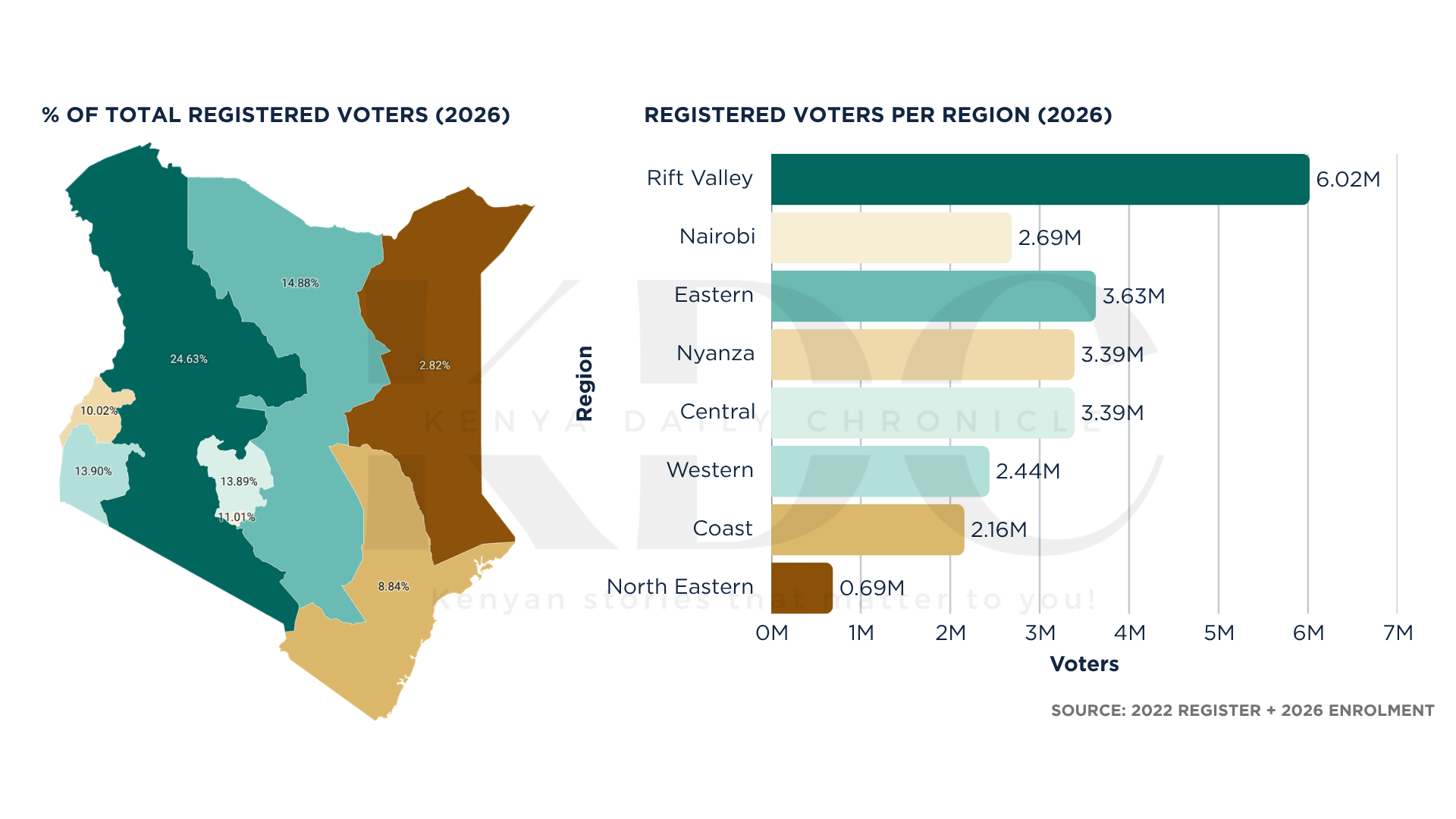
Take the five counties most Kenyans would immediately associate with Central Kenya. Together, Nyeri, Nyandarua, Kirinyaga, Murang’a and Kiambu account for 3,397,835 registered voters, or approximately 13.9 per cent of the national register of 24,455,491 voters.
Even in the most implausible scenario, in which a presidential candidate secured every vote cast in all five counties, that candidate would still have to find 41.9 percentage points of the national vote from the remaining 86.1 per cent of the electorate to cross the constitutional 50 per cent threshold.
That is not to minimise the region’s importance. It is to put its importance in perspective.
The argument becomes stronger when ‘Mt Kenya’ is expanded into the ten-county bloc often used in political reporting. Together, these counties account for approximately 6.3 million registered voters, or 25.8 per cent of the national register. That is unquestionably a formidable electoral constituency.
A candidate who sweeps this entire bloc would begin the national race with more than a quarter of all registered voters behind them, but would still need to secure another 24.2 per cent from the remaining 74.2 per cent of the country.
In other words, even a perfect performance across the broadest conceivable definition of the Mountain leaves a candidate needing roughly one-third of the vote elsewhere. This is where the mythology of regional kingmaking begins to collide with the mathematics of a national election.
No region, however politically influential, can elect a Kenyan president on its own. The Constitution requires not only more than half of all votes cast nationally, but also at least 25 per cent of the vote in more than half of the 47 counties. The electoral system, therefore, makes a one-region strategy structurally impossible.
What Mt Kenya can do, and what it has historically done, is something more subtle and perhaps more important: it can make a winning coalition easier or harder to construct.
A candidate who loses the region does not automatically lose the election. But that candidate must compensate elsewhere, often by winning more decisively in other regions or by broadening the coalition sufficiently to absorb the deficit. The Mountain is therefore not a presidency but a multiplier.
Why The Bloc Story Refuses To Die
The instinct behind the bloc narrative is not entirely irrational, and Kenya’s political history provides ample evidence supporting it. Since 2002, Central Kenya has repeatedly demonstrated the ability to move in a relatively coordinated fashion behind dominant political formations. Mwai Kibaki’s political rise was anchored in the region. Uhuru Kenyatta inherited much of that political infrastructure.
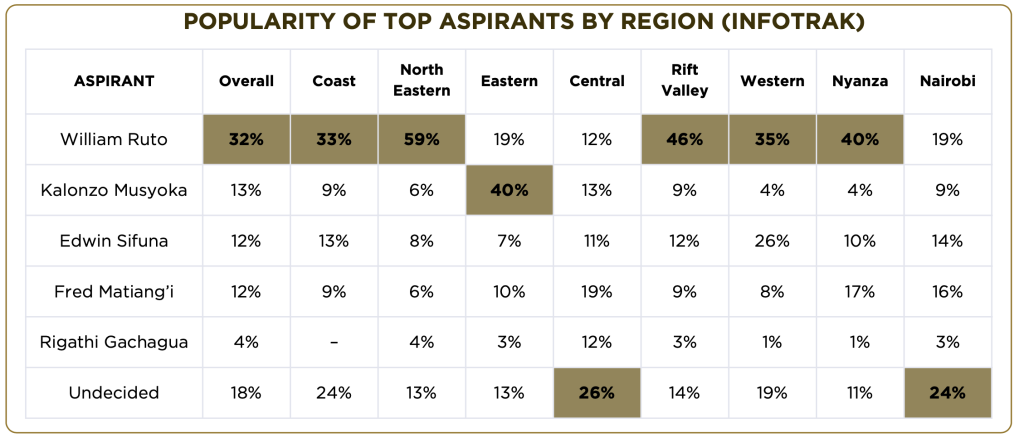
In 2022, William Ruto successfully persuaded large sections of the same electorate that his political and economic interests were more closely aligned with theirs than those of the incumbent administration. The difference between these moments, however, is often overlooked.
The region did not move because voters possessed some permanent and immutable political loyalty. It moved because political coalitions, elite bargains, local networks, candidate perceptions and national grievances converged at particular moments. That distinction is crucial.
The 2022 election is described as a case in which Ruto’s coalition treated Mt Kenya as one of the most important pillars of its national strategy.
The region delivered, and its contribution helped make the Kenya Kwanza arithmetic viable. However, the lesson from 2022 is not that Mt Kenya is permanently attached to whoever wins its political leadership.
It is that a presidential candidate who can secure a large share of the region’s vote gains a substantial advantage in constructing a national coalition. The political mistake is to confuse importance with inevitability.
Ol Kalou, therefore, matters, but perhaps not for the reason being assigned to it. The by-election is a powerful indicator that Gachagua’s political machine has established genuine electoral traction in parts of Central Kenya and that UDA’s dominance in the region cannot simply be assumed. A seven-to-one margin is not a statistical footnote; it is a political message.
The danger in treating it as a national verdict is that it encourages a kind of political determinism in which the future is assumed to be contained entirely within the past. If Gachagua wins Central Kenya, the argument goes, Ruto loses. If Ruto loses Central Kenya, the presidency is lost. The election is therefore reduced to a regional tug-of-war, with the rest of Kenya functioning as an afterthought.
But the register does not work that way. Nairobi alone accounts for roughly 11 per cent of the national register, nearly as much as the five traditional Central counties combined. Kiambu, by itself, represents approximately 5.7 per cent. Nakuru, which is frequently included in the broader Mt Kenya electoral calculation, accounts for about 4.7 per cent.
The political symbolism of the Mountain may be enormous, but the numerical reality of the Kenyan electorate is distributed across a much larger and more complicated map.
A strategist interested in winning an election rather than a political argument would therefore have to look beyond the Mountain to Nairobi, Nakuru, the Rift Valley, the Coast, Western Kenya and the emerging urban vote. The question would not be who owns Mt Kenya, but who can construct the broadest coalition after the regional arithmetic has been exhausted.
The Other Myth
There is another political shorthand that deserves the same scrutiny, and it has become increasingly fashionable since the 2024 anti-Finance Bill protests: the idea of “the Gen Z vote”.
The phrase has entered political commentary in almost the same way as “the Mt Kenya vote”, as though millions of Kenyans born into a particular age bracket constitute a single political constituency with a shared worldview, a common candidate and an instinctive hostility to the political establishment.
The polling data suggests otherwise. Infotrak’s July 2026 numbers show that among voters aged 18 to 26, President Ruto records 28 per cent support, his weakest showing across the age groups, while Edwin Sifuna records 20 per cent, his strongest performance among the cohorts measured.
Yet among those aged 27 to 35, Sifuna’s support falls to 14 per cent while the undecided share rises sharply. The undecided among the 18 to 26 cohort is 4 per cent, while among the 27 to 35, those yet to make their mind up are at 21 per cent.
The difference matters because it exposes the danger of treating “youth” as an electoral bloc when the people within that category are at different stages of life, exposed to different economic pressures and forming political opinions through divergent experiences.
The 20-year-old university student confronting unemployment, the 29-year-old navigating the informal economy and the 35-year-old supporting a young family may all be classified as young voters, but they do not necessarily approach an election with the same priorities or political incentives.
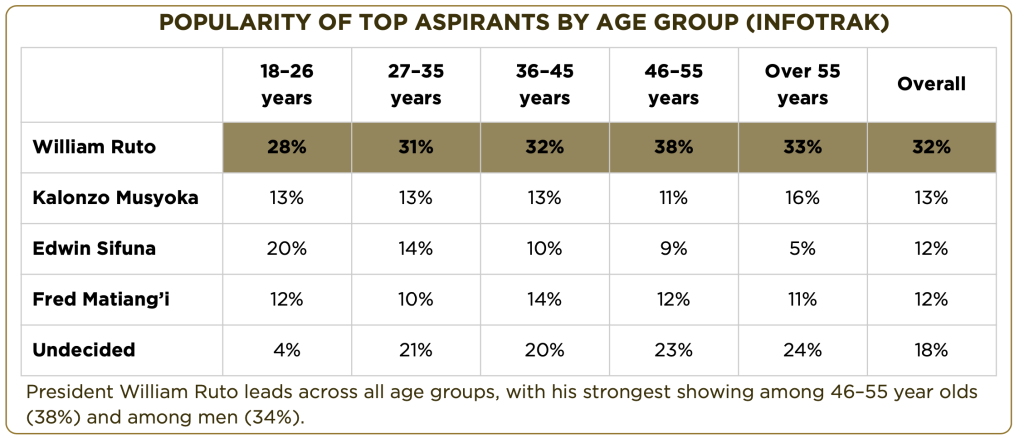
Kalonzo Musyoka’s numbers reinforce the point from another direction. His support remains relatively stable across most age brackets before rising among voters aged over 55, suggesting a political base that is not primarily being driven by the younger generation.
The more interesting conclusion from the data is therefore not that young Kenyans are uniformly anti-establishment, nor that they are naturally predisposed towards reform candidates. It is that the category itself is too blunt to explain how young voters will behave.
The same is true of Mt Kenya; a region is not a voter, a generation is not a voter, a county is not a voter. Individual citizens are. They vote according to a combination of identity, economic interests, local politics, candidate appeal, political memory, ethnic affiliation, generational experience and, increasingly, the immediate question of whether they believe their vote can make a difference.
The political narratives that overlook this complexity are often the most attractive because they make elections easier to understand, but they are also the narratives most likely to be wrong.
Where The Math Actually Bites
The real significance of Ol Kalou, then, is not that it proves Gachagua has “won” Mt Kenya or that Ruto has “lost” it. Its significance lies in what it reveals about the evolving intensity of political competition.
A 57 per cent turnout combined with a seven-to-one margin is evidence of a highly energised local electorate. It suggests that Gachagua’s political project has moved beyond elite declarations and acquired the capacity to translate sentiment into votes.
That is consequential, but the leap from “Gachagua can win in Ol Kalou” to “Ruto cannot win Kenya” is precisely the kind of analytical shortcut that makes political commentary entertaining while making it less useful.
The result demonstrates that the voter is “king” captures a key lesson from the by-election: political endorsements do not automatically translate into votes. Yet the deeper lesson may be that the Kenyan electorate is increasingly difficult to organise into the neat regional and generational blocs that political elites prefer to imagine. This is where the 2027 contest could become genuinely unpredictable.
The election will not be decided by whether Mt Kenya is “with” Ruto or “with” Gachagua in the abstract. It will be decided by how many votes each candidate can actually garner from specific counties, constituencies and demographic groups, and by whether those votes are sufficient to build a coalition that satisfies both the national threshold and the county threshold.
The same applies to the youth vote. The question will not be whether Gen Z is for or against the government. It will be which young voters turn out, which issues mobilise them, which candidates they trust, and whether their political enthusiasm translates into actual votes on election day. That distinction between political mood and electoral behaviour may ultimately be one of the most important questions of 2027.