





For most of its history, the Nairobi Securities Exchange had a stubborn arithmetic problem: over 1.4 million Kenyans nominally owned shares, but only about 200,000 of them ever traded.
A market meant to channel household savings into productive investment was instead a small, static club. Eighteen months of policy talk about “deepening capital markets” had barely moved that number. One mobile app feature moved it in a week.
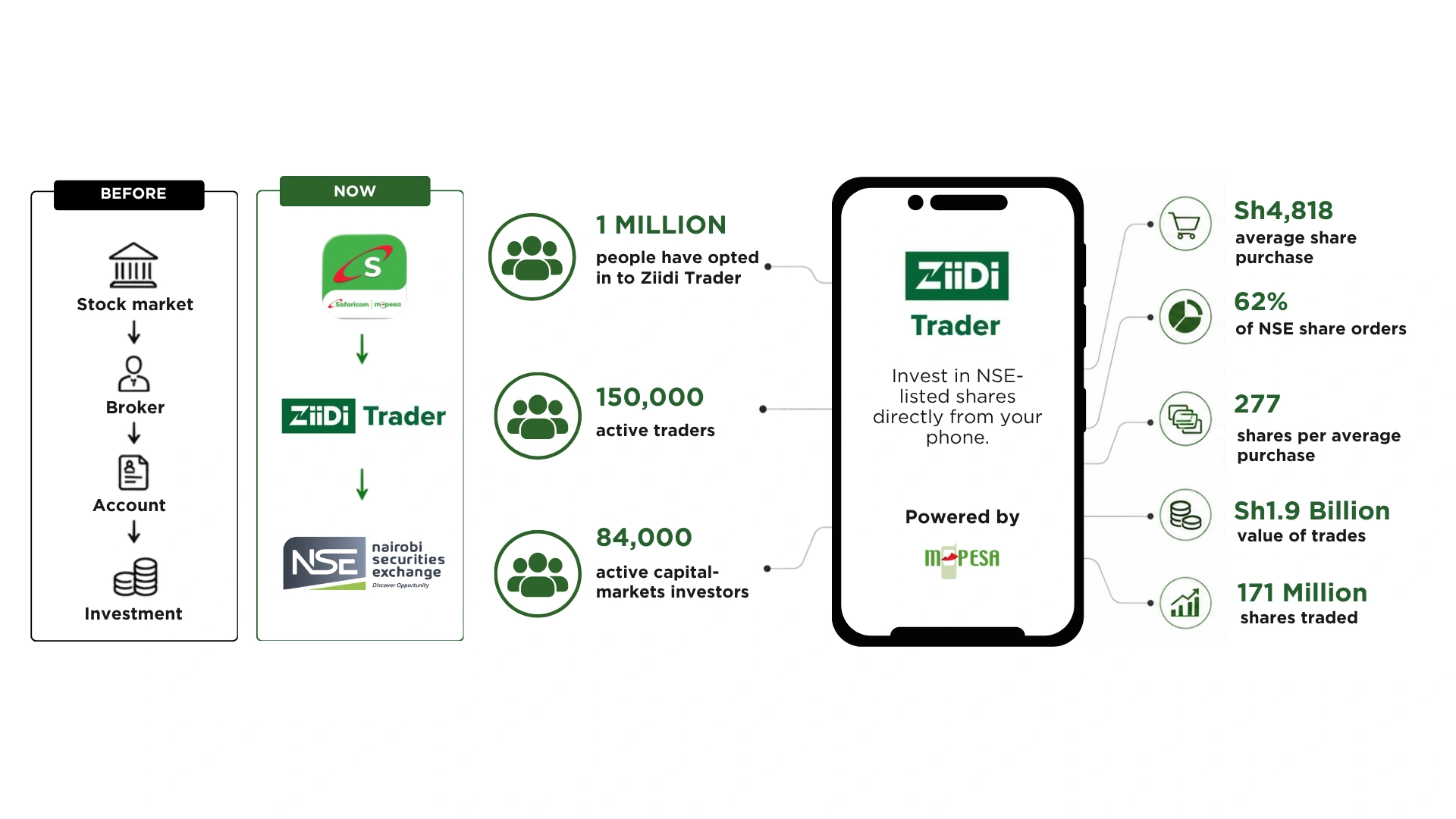
Ziidi Trader, launched in February by Safaricom in partnership with the NSE, lets M-Pesa users buy and sell listed shares without opening a traditional brokerage or Central Depository account.
On its highest-volume day at launch, the platform processed 25,773 equity trades – the most ever recorded on the bourse in a single session, more than triple the 4,000–7,800 daily trades that had been the market’s baseline for months prior.
Nearly one million users have opted into the platform since, with the average order size climbing from roughly Sh2,872 at launch to about Sh4,818 by August, a sign that early curiosity is settling into steadier, if still modest, investing behaviour.
In its first four and a half months alone, the platform processed over 351,000 transactions worth more than Sh1billion – and when Kenya Pipeline’s IPO opened this year, roughly half of all retail applications came in through Ziidi Trader.
The NSE needed nine years to reach 200,000 active investors. Ziidi Trader’s most-cited approximation of that milestone arrived in weeks.
What It Actually Is
The mechanics matter more than the marketing suggests. Ziidi Trader is not a personal brokerage account and not a stock exchange in itself – it is a trading interface embedded inside Safaricom’s My OneApp, executing orders through licensed intermediary Kestrel Capital under a pooled, omnibus custody arrangement.
Users retain dividend and voting rights, but they do not hold shares the way a conventional CDS account holder does; the shares sit in Safaricom and Kestrel’s custody on their behalf.
That distinction rarely surfaces in the coverage of the platform’s growth, and it is the kind of detail that only becomes visible to users if a dispute, a platform outage, or a custody question ever arises. None of this is happening in a political vacuum.
At the February launch, President William Ruto framed the platform in explicitly redistributive terms, telling the audience it represented “a decisive turning point in how citizens engage with the stock exchange” and singling out mama mbogas and boda boda riders as the intended beneficiaries of wider market access.
That framing fits neatly into the broader 2027 economic-delivery narrative this administration is building – alongside energy transition and tourism revenue, financial inclusion is one of the few metrics the government can point to that moved sharply and visibly within a single term.
The NSE’s own ambition – nine million active retail investors by the end of 2029 – extends well past the next election, which makes Ziidi Trader’s trajectory a preview of a promise rather than its fulfilment.
The Gap
The platform ships trading access without much trading education built into the flow itself. There is no risk-tolerance assessment at onboarding, no volatility warning attached to a buy order, and no contextual nudge distinguishing a long-term holding from a same-day flip.
Safaricom has instead handled investor protection largely as an after-the-fact messaging exercise. Since mid-2026, it has run repeated public warnings about fraudulent websites and WhatsApp schemes impersonating the platform, at one point publicly disowning a lookalike site, ziiditrader.com, that had no relationship to the company.
“Take one minute to verify first just so you don’t lose money in vain,” the company urged customers in one such advisory. It is unclear whether the Capital Markets Authority has issued its own Ziidi Trader–specific investor alert, separate from Safaricom’s social media warnings and the regulator’s general fraud advisories.
For a platform operating under CMA oversight, the burden of real-time consumer protection appears to be falling more on the telco’s communications team than on the regulator.
Turnover data reinforces the same picture from a different angle: even as Ziidi Trader dominates the NSE’s daily deal count, it accounts for only a small share of total traded value, evidence of a platform driving many small, low-risk trades rather than large speculative ones – reassuring for financial stability, but not proof that users understand what they are buying.
Kenya’s National Financial Inclusion Strategy 2025–2028 explicitly shifts the country’s policy goal from access to financial health – capability, protection, and quality of use, not just uptake.
Ziidi Trader is the first real stress test of that shift applied to capital markets. The door to the NSE is now open wider than at any point in the exchange’s history.
Whether that becomes a generation of long-term investors or a generation of habituated small speculators depends on choices – by Safaricom, by the NSE, and especially by the CMA – that have not yet been made as visibly as the platform’s growth numbers have been publicised.