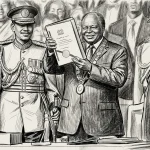




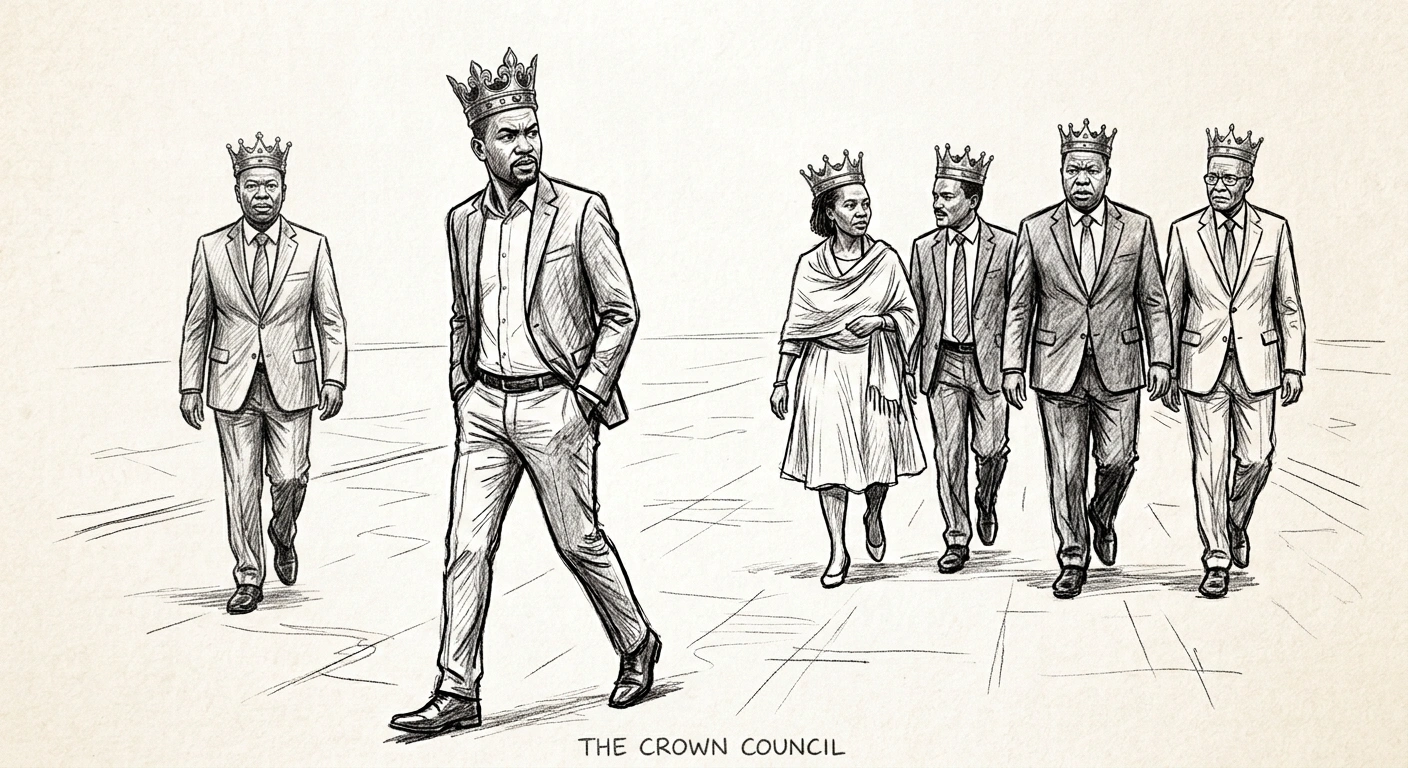
On Monday, at the Windsor Golf Hotel in Kiambu County, nine opposition principals sat down and signed two documents: a Personal Unity Pledge and a Coalition Unity Agreement, each committing its signatory to accept whoever eventually emerges as the United Alternative Government’s presidential candidate.
Kalonzo Musyoka signed. So did Martha Karua, Fred Matiang’i, Justin Muturi, Peter Munya, Eugene Wamalwa, Lenny Kivuti and Omingo Magara. Rigathi Gachagua did not attend; Democracy for Citizens Party deputy leader Cleophas Malala signed in his place.
That same day, at his Wamunyoro residence, Gachagua was telling a different room a different story. Asked whether he would settle for the role opposition strategists have quietly assigned him – uniting Mt Kenya’s vote behind whomever the coalition eventually fields – he rejected it outright.
“Riggy G is not a kingmaker,” he said. “Riggy G is king.” He went further, declaring himself the preferred presidential candidate of the very coalition whose unity pact he had just skipped signing in person.
Two rooms, one afternoon, two entirely different theories of what the opposition is for. That is not a new observation about Kenyan coalition politics.
What is new is that there is now enough public polling to test both theories against actual numbers – and the numbers do not flatter the man who stayed away.
- Counties owe billions; who is paying the price?
- Kenya has put public procurement online; has it made it cleaner?
- Beyond Maize and Tea: The agricultural transformation Kenya rarely talks about
- The Chronicle Explainer: What a “Balanced Budget” actually means
- One Quarter in, the deficit is almost twice the plan
What The Arithmetic Says
Recent opinion polls have suggested that there is no way a divided opposition can beat President William Ruto, despite his rating being below the Constitutional threshold. Despite the bravado, Gachagua still polls poorly when compared to the other opposition luminaries – Kalonzo, Matiang’i and Edwin Sifuna.
An Infotrack tracking poll released in July put Gachagua at just 4 per cent nationally, down from 5 per cent in December, while Kalonzo climbed from 8 to 13 per cent over the same period and Sifuna moved from negligible visibility to 12 per cent in a single wave.
A TIFA survey conducted in June, sampling just over 2,000 respondents across nine regions, asked Kenyans directly what role Gachagua should play. Sixty-two per cent said he should back the strongest available opposition candidate.
Only 14 per cent thought he should lead the ticket himself. Five per cent thought the outcome would not matter because Ruto would win regardless.
None of this means Gachagua’s Mt Kenya support is fictional – Infotrak puts him at 68 per cent in Mt Kenya East and 62 per cent in Mt Kenya Central, genuinely formidable regional numbers, and TIFA data suggests roughly seven in ten Kikuyu respondents still name him as their political leader.
The problem is scale, not existence: a leader who commands a region convincingly can still be, nationally, the weakest of the plausible principals. Refusing the kingmaker label is a legitimate political choice.
Refusing it while the public polling keeps returning the same verdict is a choice made against the arithmetic, not around it.
The Absentee Riser
Sifuna’s position is the more interesting anomaly, because unlike Gachagua’s, his absence from Windsor cannot be read as defiance.
He was not offered a seat at that table in the same way the others were, because his own party is not, formally, part of the opposition he keeps polling well within.
ODM’s institutional position changed after Raila Odinga’s death in October 2025. Party leadership under Oburu Odinga has kept ODM inside the broad-based government arrangement with Ruto, with senior figures including Homa Bay Governor Gladys Wanga and Minority Leader Junet Mohamed describing that as consistent with Odinga’s final instructions.
Sifuna, as ODM secretary-general, spent the months since publicly opposing that arrangement through the Linda Mwananchi faction – to the point that the party’s leadership formally removed him from the position.
That contradiction – an opposition-minded secretary-general inside a governing-coalition party – is a structural reason, not a personal one, for his absence from a unity pact signed by principals whose parties sit outside government altogether. It does not show up in a quote or a press statement but in the polling instead.
By the poll numbers, Sifuna is the fastest-rising opposition figure among anti-Ruto voters, second only to Kalonzo – and TIFA data shows public sentiment running 52 per cent against the broad-based government he nominally served.
He may currently be the opposition figure with the most support and the least standing to claim it formally.
Why Ruto Sits Easy, For Now
Ruto has not had to comment on any of this, because the same tracking polls that expose the opposition’s arithmetic problem also show his own position steadily strengthening regardless of it.
Infotrak has him rising from 21 per cent in August last year to 28 per cent in December and 32 per cent by June – a net gain of eleven points achieved almost entirely while his opponents were arguing about seating arrangements rather than mounting a joint campaign.
TIFA’s own analysts are careful to note that a quarter to a third of the country is not a majority, and that a genuinely consolidated opposition ticket would immediately turn 2027 into a competitive race.
This is especially telling because the undecided numbers according to the polls are almost a quarter of the voters.
The arithmetic of opposition unity is not a mystery. It has been published, repeatedly, by separate polling organisations over the past year. What has not happened is anyone acting on it.
The house instinct on this election cycle has always been to take the opposition’s ambition seriously while holding its record to account.
Applied to this week’s events, that means crediting Windsor’s nine signatories with doing something genuinely difficult – committing, on paper, to accept a result they cannot yet predict – while asking a harder question of the man who did not sign in person.
On what basis does Gachagua believe his national claim is stronger than a national polling average built from three independent surveys says it is?
It also means not mistaking Sifuna’s polling momentum for political weight until the contradiction at the heart of his position – opposition-minded leadership inside a governing partner party – is resolved one way or another.
A politician can be the fastest-rising name in the polls and still have no coalition willing to put his name on a ballot. Kenya’s opposition has spent much of this year being told it suffers from too many presidents and not enough presidency. Last week supplied a sharper version of that diagnosis.
It now has a polling consensus about who its strongest candidates actually are, a signed agreement among most of its principals to abide by whatever process produces one, and a man with the weakest national numbers among the group refusing to accept either.
The arithmetic has already answered the question the politics keeps avoiding. Whether the opposition lets it, rather than ego, decide the ticket may be the single biggest determinant of whether 2027 is competitive at all.