





President William Ruto has put Kenya’s debt record back into the political argument, comparing the pace at which his administration has accumulated debt with those of Mwai Kibaki and Uhuru Kenyatta.
This argument deserves attention because it is not simply how large Kenya’s debt has become, but how quickly it has grown under different governments and what successive administrations have done with the fiscal space they inherited.
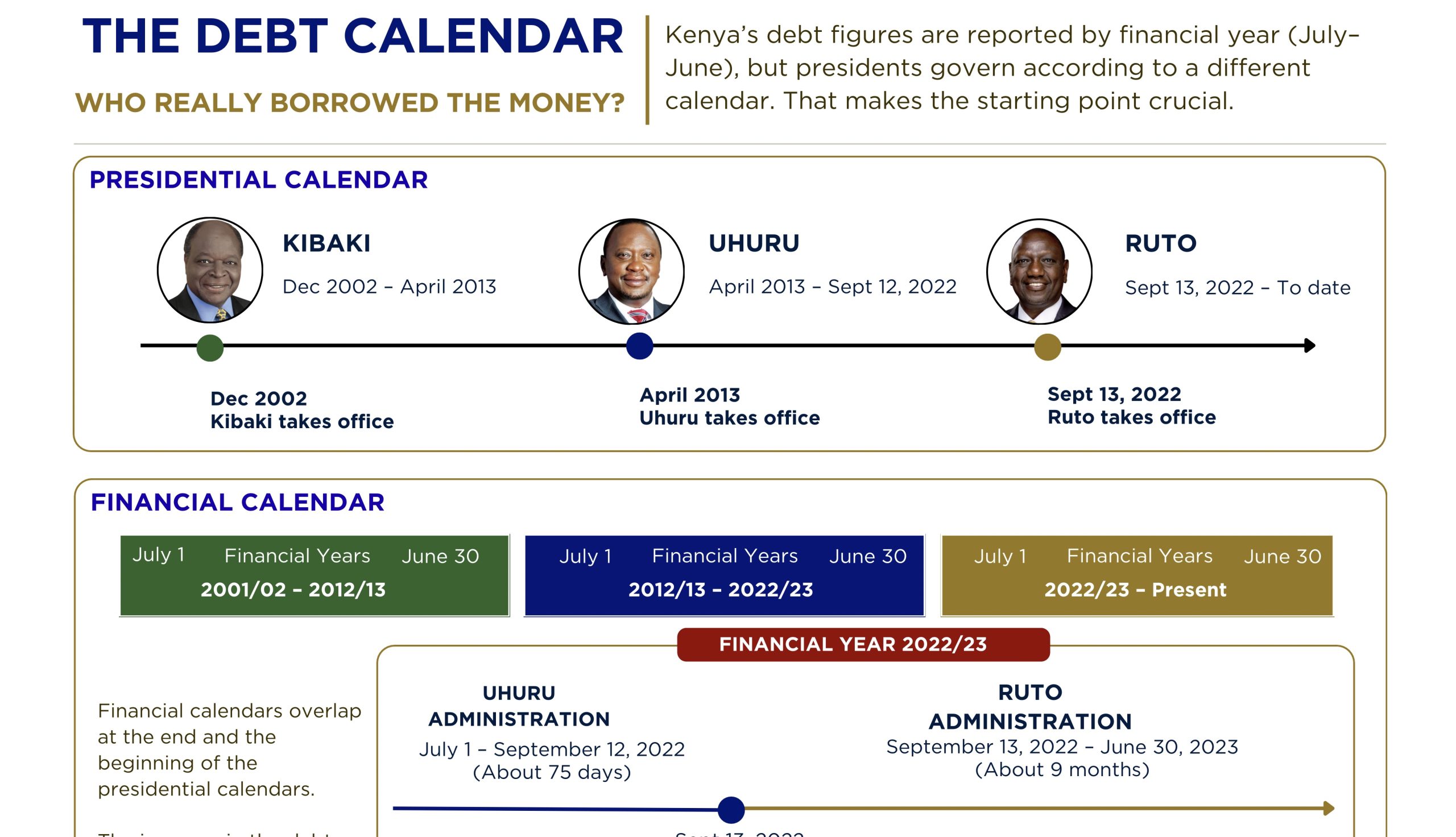
However, there is a problem with the way such comparisons can be presented. It is a problem of timing. Kenya’s financial year runs from July 1 to June 30, while presidential administrations begin and end according to the electoral calendar.
Ruto took office on September 13, 2022, more than two months after the beginning of the 2022/23 financial year. The debt figure reported at the end of June 2023 therefore covers a fiscal plan that began under Uhuru Kenyatta and ended under Ruto.
That distinction may be technical, but it is important when a June 2023 figure is presented as evidence of what the Ruto administration did with Kenya’s debt.
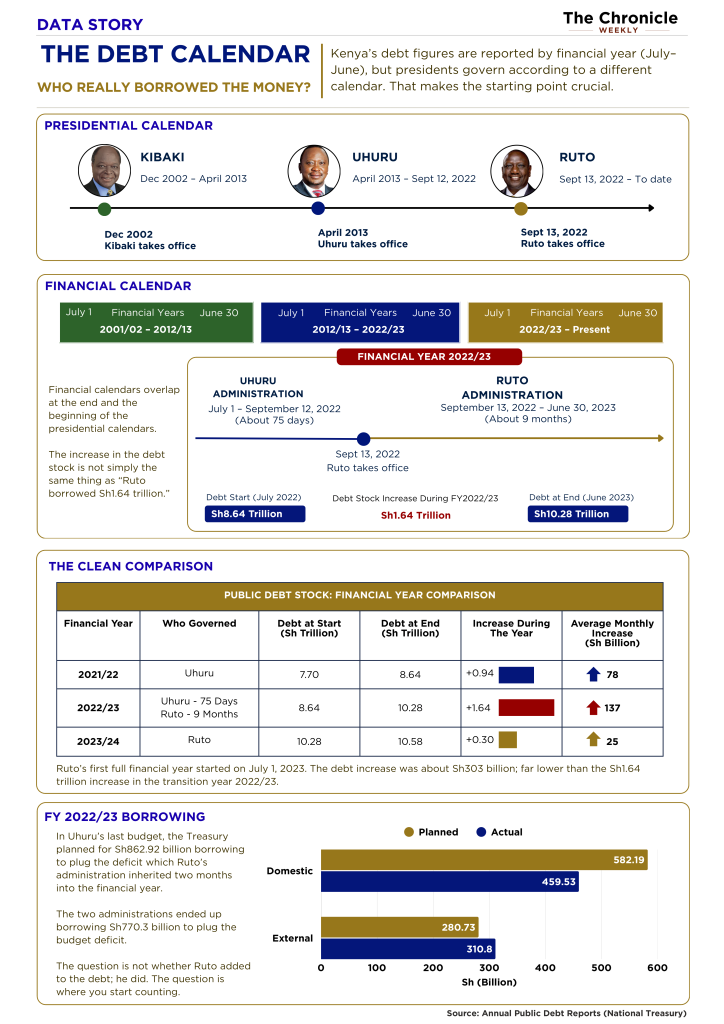
Treasury’s debt report puts Kenya’s total public debt at Sh8.635 trillion at the end of June 2022. By June 2023, it had risen to Sh10.279 trillion, an increase of about Sh1.644 trillion. On the face of it, that is a very large increase, and it is perfectly reasonable to ask what happened during that year.
But it would be inaccurate to treat the entire increase as having occurred under Ruto. For the first 75 days of the financial year, Kenya was still under the Kenyatta administration. The budget, borrowing requirements and much of the fiscal programme for 2022/23 had already been established before the change of government.
Indeed, Treasury’s Annual Borrowing Plan for that financial year had targeted Sh862.92 billion in borrowing, comprising Sh280.73 billion in net external borrowing and Sh582.19 billion in net domestic borrowing. By the end of June 2023, Treasury had raised Sh740.33 billion.
This does not mean that the Ruto administration bears no responsibility for the outcome. It governed for most of the financial year and made its own decisions on taxation, expenditure, borrowing and debt management. The point is narrower and more important: June 2023 is a transition-year number, not a clean Ruto-year number. That distinction should matter whenever presidents are compared using annual debt figures.
Cleaner Test Start in July 2023
If the objective is to assess Ruto’s fiscal management rather than his ability to inherit a particular starting point, the better benchmark is his first complete financial year that begins on July 1, 2023.
Treasury’s figures show that public debt stood at Sh10.582 trillion at the end of June 2024, compared with Sh10.279 trillion a year earlier. The increase was therefore about Sh303 billion, dramatically smaller than the Sh1.644 trillion increase between June 2022 and June 2023.
That does not, by itself, prove that the Ruto administration has solved Kenya’s debt problem. Nor does it mean that the government should receive credit for every movement in the debt stock.
Debt management is affected by borrowing, repayments, exchange-rate movements, disbursements and other factors. But it does demonstrate why the choice of starting point matters.
A comparison that begins with June 2022 and ends in June 2023 combines the final months of one administration with the first nine-and-a-half months of another. A comparison between June 2023 and June 2024, by contrast, captures Ruto’s first complete financial year.
The latter is a much cleaner test of the claim that his government changed the pace of debt accumulation.
Debt Stock ≠ Borrowing
There is another distinction that tends to disappear in political arguments about debt. The increase in the public debt stock is not necessarily identical to the amount of new borrowing undertaken by a government during a particular period.
Treasury explains that government borrowing is undertaken both to finance fiscal deficits and to repay maturing debt.
It also comes from domestic and external sources, while movements in the value of foreign-currency debt can affect the stock even when the government has not contracted an equivalent amount of new debt.
This means that three questions should be kept separate. How much did the government borrow? How much net financing did it raise after taking repayments into account? And by how much did the total public debt stock increase? They are related questions, but they are not interchangeable.
This is particularly important when comparing administrations because governments inherit debt obligations contracted by their predecessors. A president may spend part of a year raising money to meet obligations created years earlier, just as a government may inherit projects whose financing requirements were already committed.
Debt therefore has both a stock problem and a flow problem. The stock tells us what Kenya owes at a particular point. The flow tells us what happened during the period in question, and a serious assessment of an administration needs both.
Fair Comparison Is About Trajectory
There is a legitimate political argument to be made about the scale of borrowing under each administration.
Kibaki inherited a much smaller debt stock than the one Uhuru inherited. Uhuru, in turn, handed Ruto a substantially larger debt burden.
Ruto’s government has since taken the debt stock beyond the level it inherited, with Treasury reporting Sh13.08 trillion at the end of June 2026, up from Sh10.582 trillion a year earlier.
The question, therefore, is not whether Ruto has added to Kenya’s debt. He has.
The more useful question is whether the rate, composition and purpose of borrowing have changed, and whether the government has managed to prevent debt from growing faster than the economy’s capacity to service it.
Ruto can reasonably argue that his administration has attempted to slow the pace of accumulation, and the first full financial-year comparison provides some evidence for that argument.
But it would be equally reasonable to challenge a comparison that uses the entire June 2022-to-June 2023 increase as though it represents nine or ten months of decisions made by his government.
The same principle should apply to every president. If we want to know what Kibaki did, we should isolate the years he governed. If we want to judge Uhuru, we should separate what he inherited from what he added.
And if we want to judge Ruto, we should distinguish the fiscal inheritance of September 2022 from the decisions made by his administration after it had established its own budget and borrowing framework.
The danger of using financial-year numbers as presidential scorecards is that the numbers look precise while the comparison is not.
Kenya needs a better way of measuring political performance: not simply asking how much debt a president left behind, but how much debt he inherited, how much additional debt his government contracted, how much of it went towards refinancing old obligations, how much financed new expenditure, how the debt-to-GDP ratio changed, and whether the economy grew quickly enough to carry the additional burden.
The debt debate should therefore be less about whose number is bigger and more about where the starting line is drawn.
Ruto’s argument may survive that scrutiny. In fact, it may become stronger when measured against his first full financial year rather than the transitional year of 2022/23. A financial year is not a presidential term.
And June 2023 was not the end of Ruto’s first year in office; it was the end of a financial year that had begun before he became president.