





Two regions refuse to let go of newspapers, for reasons the income and geography numbers can’t fully explain. Everywhere else, the story is the same: fewer buyers, thinner stacks at the kiosk, a slow bleed that shows up in every quarter.
Nationally, newspaper readership opened the 2025/26 financial year at 19 per cent, sank to 15 per cent by Q3, and limped back to 17 per cent by Q4.
Then there’s Lake and Rift, which are pulling in the opposite direction from the rest of the country, and the Q4 numbers make the divergence hard to miss.
Who’s Still Buying
Start with the obvious divide: money. Among LSM 12+, the top income bracket, 35 per cent read a newspaper in Q4. Among LSM 8-11, that’s 20 per cent. Among LSM 1-4, it’s close to nothing (roughly 1 per cent). Urban readership (20 per cent) still comfortably beats rural (15 per cent), which is exactly what you would expect from a medium that has always skewed middle-class and city-based.
Age adds a second layer: readers aged 25-34 are the most engaged of any group, while teenagers and those over 45 read least. Newspapers, in other words, have settled into a specific professional, mid-career audience — not a generational habit, and not a mass one.
The Holdouts
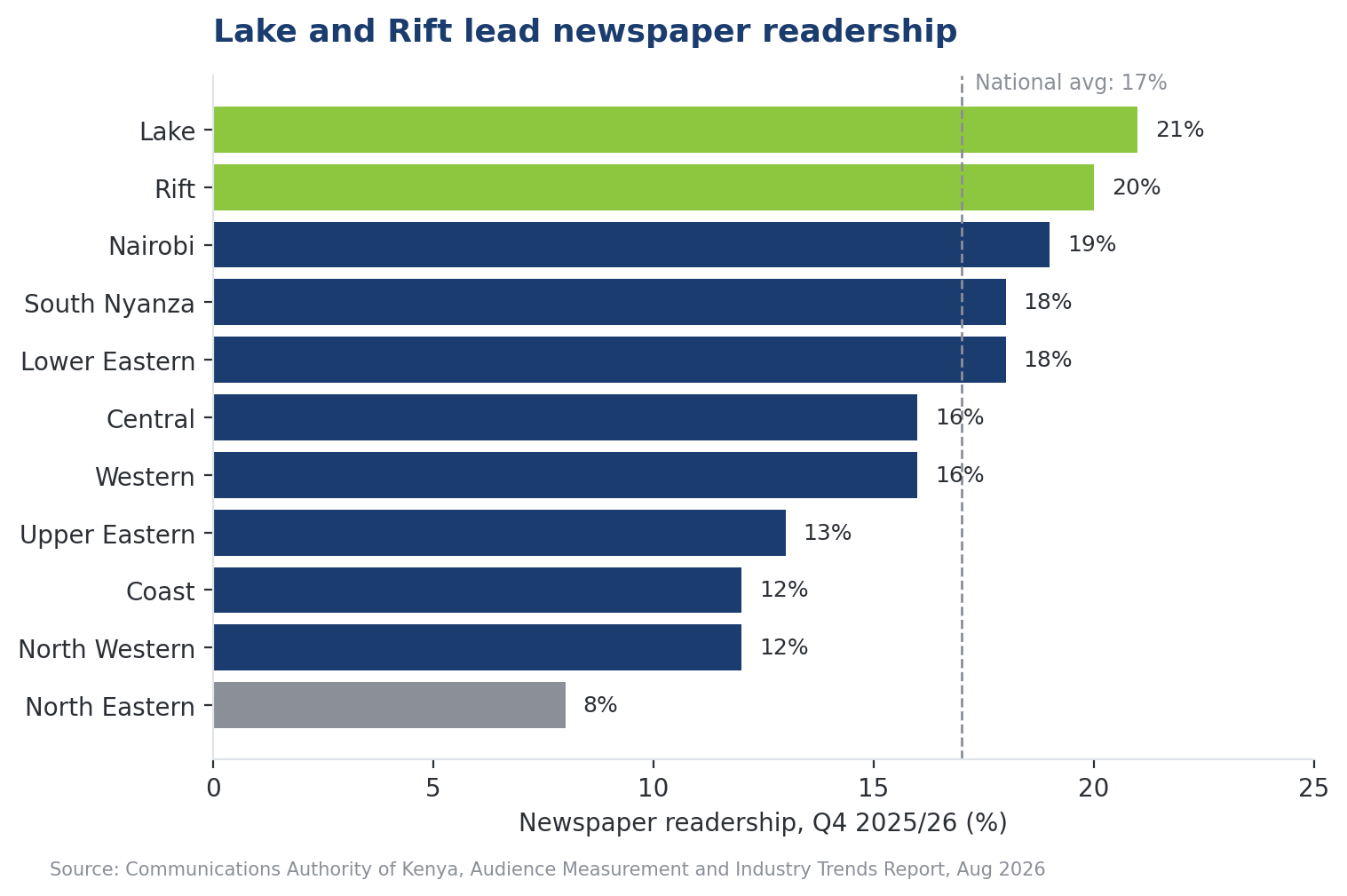
In Q4 2025/26, Lake posted the highest newspaper readership in the country at 21 per cent, and Rift came second at 20 per cent. Both are comfortably above the national average of 17 per cent, and both held their ground through Q3, the exact quarter when national readership cratered.
At the other end, North Eastern recorded just 8 per cent, the lowest in Kenya, even after a modest recovery from earlier in the year.
What makes Lake and Rift genuinely odd is that neither region tops the country on income or urbanisation; the two factors that predict newspaper readership almost everywhere else in this dataset.
Something more local is holding the line: distribution networks that never broke down, titles with real loyalty, reading habits that haven’t been swallowed by radio and mobile the way they have on the Coast or in North Western.
What Publishers Should Do With This
The data doesn’t say “print is dying.” It says something useful: print is retreating into specific, identifiable territory, and the smart move is to treat that territory differently from everywhere else.
Lake and Rift proved more durable in the one quarter that hurt the rest of the country. Distribution spend and regionally relevant content here likely returns more than a Nairobi-first strategy ever will.
With LSM 1-4 readership near zero and youth readership the weakest cohort nationally, print’s remaining growth story belongs to the urban, LSM 8+, 25-44 professional reader. That’s a niche, not a market, and pricing, coverage, and distribution decisions should say so.
The CA’s own industry analysis backs the read: it flags “pressure on credible journalism” as a sector-wide risk, but also notes that “vernacular and regional broadcasters can strengthen their competitive position by focusing on local news, culture… and community issues.”