

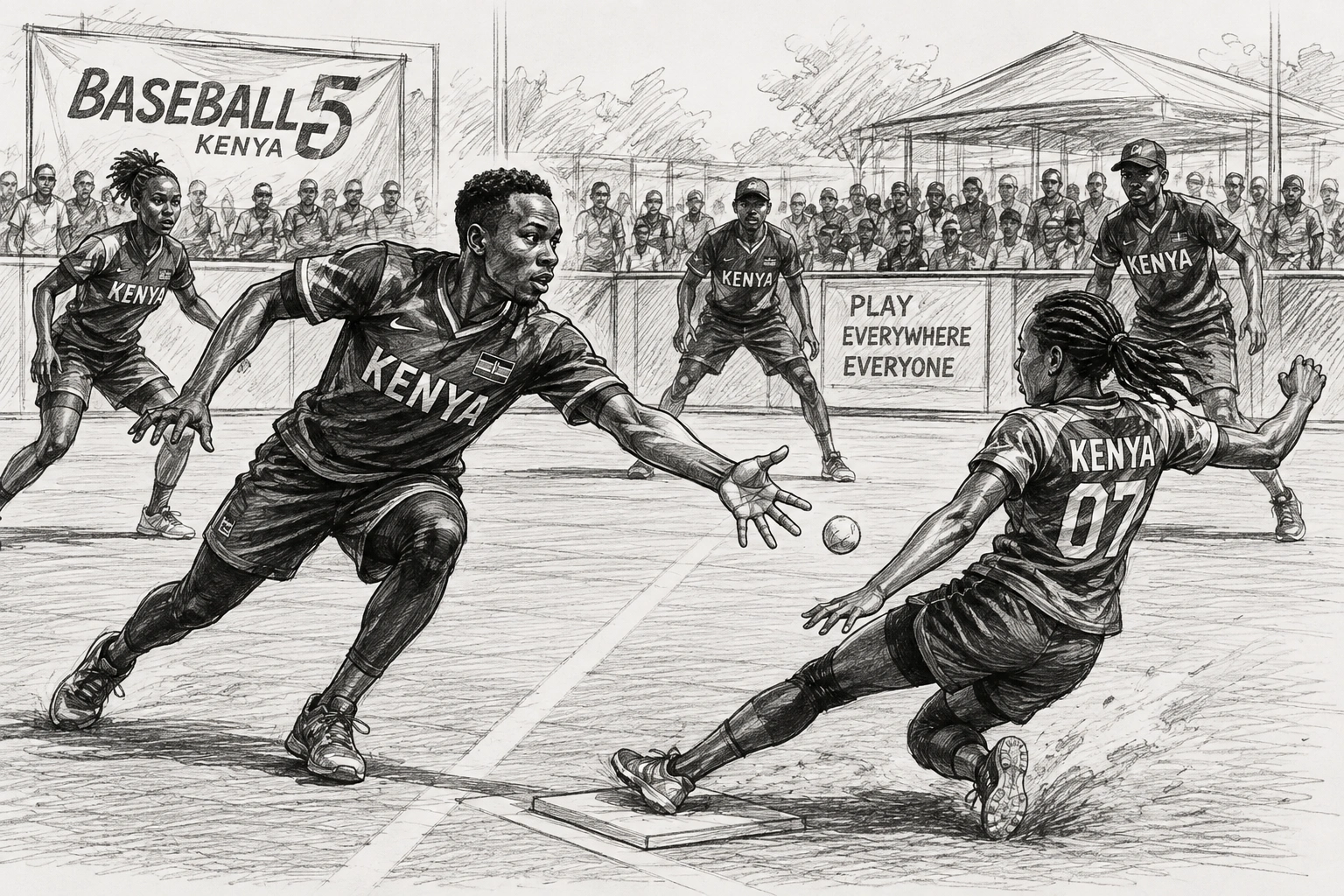
Kenya is going to the Youth Olympic Games in Dakar carrying something unusual for a country accustomed to celebrating success in sports only after decades of investment: a young national team competing in a sport that has barely had time to establish itself at home, yet has already placed Kenya among the world’s leading nations.
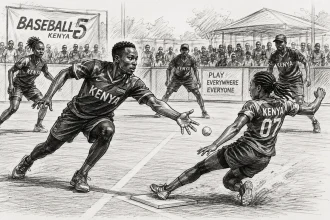
Baseball5, the fast, mixed-gender urban version of baseball and softball, will make its Olympic debut at Dakar 2026, with Kenya representing Africa alongside hosts Senegal.
Kenya’s youth team finished fifth at the 2025 Youth Baseball5 World Cup in Mexico, while the country was ranked ninth in the world in May 2026, ahead of countries with considerably deeper baseball and sporting infrastructure.
That achievement deserves recognition, but it also raises a more uncomfortable question: what happens to Kenyan Baseball5 when the international programmes helping to build it move on?
Baseball5 was designed precisely for countries that cannot afford traditional baseball infrastructure. There are no bats, no gloves and no pitchers; five players take the field, games run for five innings, and the sport can be played on almost any suitable surface with a rubber ball.
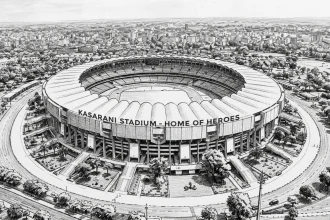
In other words, Kenya does not need to build a baseball stadium to build a Baseball5 system.
It does, however, need something much harder to provide: a sustainable institutional pipeline of teachers, coaches, competitions, equipment, talent identification, national-team preparation and predictable financing.
Weight of External Support
The Baseball Federation of Kenya was founded in 1997 and registered in 2002 as a non-governmental organisation, with a stated ambition of taking baseball to schools and higher institutions.
Its own development goals include training coaches and officials, providing equipment and developing playing facilities across the country. That model has produced results, but much of the story of Kenyan baseball has historically involved outside assistance.
Meru University of Science and Technology, for example, describes its baseball diamond as the country’s only standard baseball field and records equipment support from American Friends of Kenya.
Elsewhere, organisations such as American Friends of Kenya and international baseball bodies have supported equipment, coaching and grassroots development. For Baseball5, the dependence on external development partners is even more visible.
In August 2024, the WBSC launched a programme in Kakuma Refugee Camp and Kalobeyei Integrated Settlement with the African Higher Education in Emergencies Network, supported by Olympic Solidarity.
The initiative recruited 60 young people, divided between the two settlements, and combined sport with education, nutrition, coaching and life-skills development.
The first year produced more than 240 training sessions, seven friendly tournaments and a national event, while 23 participants emerged as high-performance players.
The programme was successful enough to be renewed, but the renewal itself tells the story of the underlying challenge: the agreement runs through December 2026.
Under the renewed arrangement, the WBSC finances the initiative with support from Olympic Solidarity, working with the National Olympic Committee of Kenya, the country’s baseball and softball federations and AHEEN.
There is nothing wrong with international development support. Indeed, without it, many young Kenyan athletes would probably never have encountered Baseball5 in the first place.
The accountability question is what comes next.
A programme that reaches 60 young people, trains coaches and produces elite players is a development success. A programme whose future depends on the next grant cycle is not yet a domestic sports system.
Building a School-Based Pipeline
In February, the Baseball Federation of Kenya, working with the Kenya Secondary Schools Sports Association, began training physical-education teachers ahead of the introduction of Baseball5 into the secondary-school games calendar.
This is arguably the most important development in Kenya’s sporting history because schools are where Baseball5 can become more than an Olympic project.
The economics make sense. Unlike traditional baseball, the game can be introduced without constructing expensive diamonds, while its mixed-gender format creates an opportunity to bring boys and girls into the same sporting pathway.
The WBSC explicitly promotes Baseball5 as a way of taking baseball and softball into communities where conventional facilities and equipment are barriers to participation.
But the Kenyan school rollout still needs to answer the questions that accompany every ambitious sports programme.
Who trains the teachers after the initial clinics, who supplies equipment, who organises competitions, who pays for officials and travel, and who makes sure that a promising player from Kisii, Kakuma or Meru can progress from school competition into county, national and international sport?
Those questions matter because the country’s public sports budget is not small. The State Department for Sports has a total 2026 allocation of about Sh32.25 billion, including Sh28.76 billion in development expenditure.
Within the broader sports architecture, the Sports, Arts and Social Development Fund is expected to finance sports programmes, talent development and facilities.
Yet a broad sports budget is not the same thing as a Baseball5 development budget.
In the 2026/27 budget material reviewed, there is no clearly identifiable dedicated allocation for Baseball5 or a specific national school Baseball5 rollout.
That does not prove that the sport receives no public support, but it does highlight the difference between being included in Kenya’s sporting ambitions and having a clearly financed development pathway.
The Pressure of Success
The ninth-place world ranking is not a publicity gimmick. It reflects genuine competitive progress, and Kenya’s fifth-place finish at the 2025 Youth World Cup demonstrated that the country can compete with established Baseball5 programmes.
The WBSC’s January 2026 review also identified Kenya as one of the biggest improvers in its five global rankings, with Baseball5 contributing 1,508 points during 2025. The danger is therefore not that Kenya will fail in Dakar but that it will succeed.
A medal, a strong finish or another breakthrough performance could create another familiar Kenyan sports moment in which athletes demonstrate that the talent exists while institutions scramble to catch up with the achievement.
Baseball5 offers Kenya a rare opportunity to get ahead of that cycle because the sport is cheap to start, easy to take into schools and naturally suited to urban and underserved communities.
The country does not need a massive stadium programme to exploit the opportunity. It needs a modest but reliable system that connects schools, clubs, counties, federations and national teams.
By November, Kenyan teenagers will walk onto an Olympic field in Dakar as one of Africa’s leading Baseball5 nations. The more important question for Kenyan sport will be what happens when they come home.
If the answer is another grant application, another foreign-funded clinic and another scramble for national-team travel money, then Dakar will have been a brilliant sporting moment but a weak governance story.
If, instead, the country uses the momentum to put Baseball5 permanently into the school sports system, finance the coaching pipeline, support competitions and give the federations a predictable development framework, then the ninth-ranked team will have done something much bigger than win games.
It will have exposed what Kenya can achieve when a sport is built around accessibility rather than expensive infrastructure.
And that may be Baseball5’s real Olympic opportunity for Kenya: not simply to prove that Kenyan athletes can compete with the world, but to prove that Kenyan sporting institutions can build something that survives after the applause ends.