



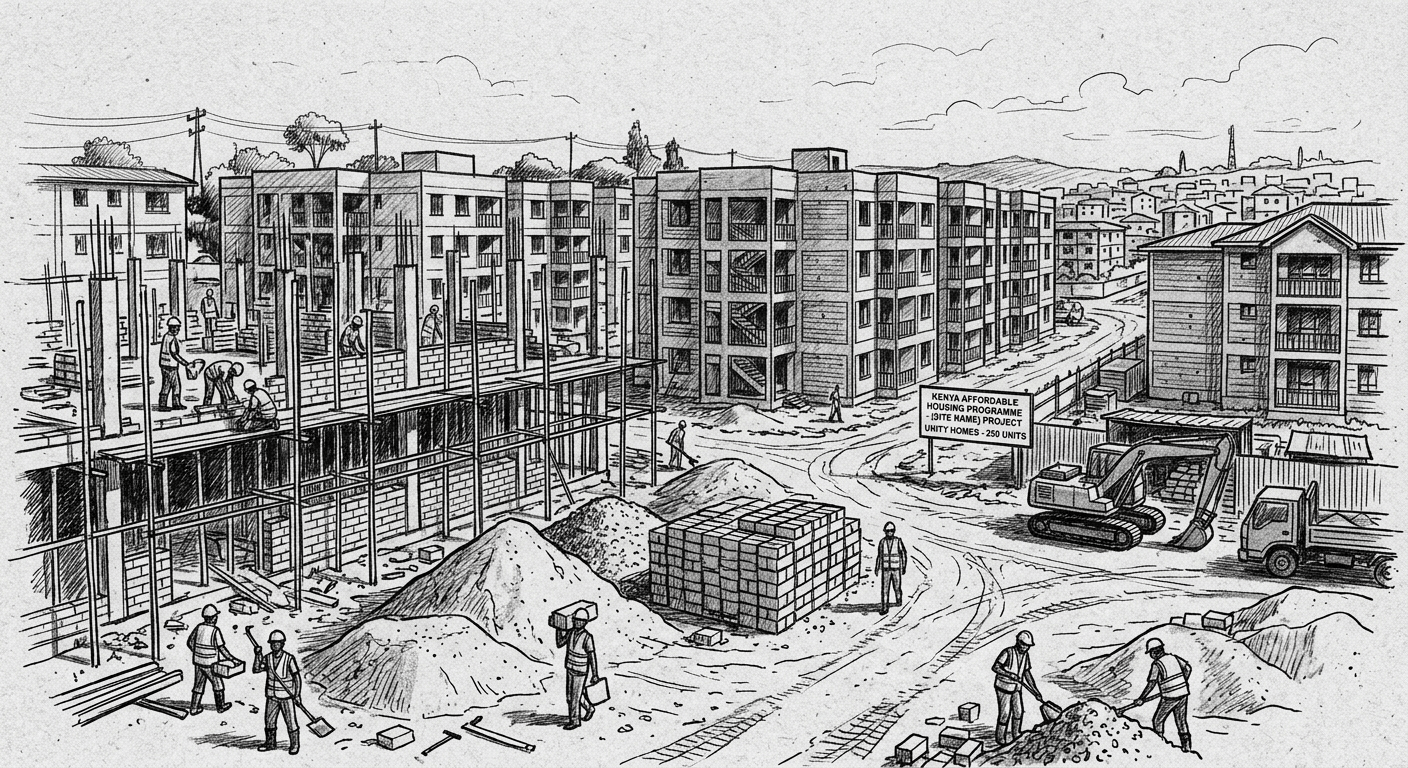
Kenya’s affordable housing programme is now judged not only by how many homes it builds, but by whether intended households can afford to buy them. Construction figures may look impressive while completed units remain unsold or unoccupied, limiting funds for future building.
The Parliamentary Budget Office’s November 2026 expenditure report highlights this shift from construction to helping households purchase homes, and the gap between stated demand and actual purchasing power.
By mid-2026, about 1.26 million prospective beneficiaries had registered on Boma Yangu, where applicants save, select units and take part in allocation and financing. They had saved Sh5.47 billion, including Sh1.76 billion converted into purchase deposits. This shows strong interest, but not that all registrants can afford a home.
More than 260,000 units were under construction, up from 8,872 in 2022; the wider pipeline was nearly 300,000. The report anticipates about 45,000 completed units by December 2026 and another 15,000 by June 2027.
The challenge is moving these homes from construction sites to households. A home is affordable only when its price, deposit, financing and ongoing payments fit the buyer’s means.
Yet mortgage-financed purchases account for just 3– 5 per cent of housing acquisition, according to estimates cited by the PBO.
Rent-to-own represents 10–15 per cent, short-term instalments 8–12 per cent, and renting 55–65 per cent nationally and 80–90 per cent in urban areas. With ownership mortgages limited and renting widespread, registrants cannot be treated as guaranteed buyers.
Assess Affordability Before Allocation
Applicants can currently select units before their ability to pay is assessed. They may choose homes beyond their means, resulting in failed allocations, late payments and vacancies.
The PBO recommends assessing finances before matching applicants to units. With consent, the Affordable Housing Board could work with banks, SACCOs and other regulated institutions to review income, transaction records, savings, obligations and repayment capacity.
Applicants could still choose locations, while unit size and price would reflect what they can afford.
The Affordable Housing Act, 2024, sets three income bands: social housing for those earning below Sh20,000 monthly; affordable housing for Sh20,000– Sh149,000; and affordable middle-class housing for incomes above Sh149,000.
At Sh20,000 a month, the 30 per cent benchmark implies payments of about Sh6,000. A conventional mortgage may still be unaffordable once interest, insurance and other costs are included. Financing therefore matters as much as construction.
Match Financing To Household Needs
The report proposes different pathways rather than one financing model for all. Households eligible for bank or SACCO loans could use mortgages for affordable and middle-class units.
The Government could work with the Kenya Mortgage Refinance Company and lenders to expand long-term products, improve credit guarantees for irregular-income borrowers and explore pension-fund financing for mortgage refinancing.
For lower-income social housing beneficiaries, especially those earning below Sh20,000, tenant- purchase schemes and deposit assistance may offer more manageable monthly payments. Encouraging cash purchases of affordable and middle-class units could also speed the return of funds to the Affordable Housing Fund.
Faster sales and repayments could help finance future construction. The PBO estimates these measures have no additional quantified budgetary cost, assuming they use existing Fund resources.
This does not make them administratively costless or guarantee results; it means they are expected to fit within current resources. Ultimately, the programme must be judged by whether it matches diverse household incomes with genuinely accessible homes.
A household earning Sh18,000 a month, a salaried worker earning Sh70,000 and a professional earning Sh200,000 do not face the same housing market. They do not have the same ability to raise deposits, qualify for credit or sustain monthly payments.
A programme that builds units without accurately matching them to these financial realities risks confusing supply with access.
The next phase therefore requires a more transparent account of what happens after registration. How many applicants have been assessed for affordability? How many have received allocations? How many have paid deposits?
How many have completed purchases? How many units remain unsold or unoccupied? What are the monthly payment obligations across the different housing categories, and what proportion of intended beneficiaries can meet them?
These numbers will reveal whether the programme is moving beyond construction into actual housing access.
Kenya needs more adequate and affordable housing. The constitutional right to accessible and adequate housing cannot be realised through construction figures alone. It requires homes that people can afford to occupy, maintain and, where intended, own.
The programme’s success will ultimately be measured not by the number of people who register their interest or the number of units announced, but by the number of households for whom the promise of affordable housing becomes a sustainable reality.