




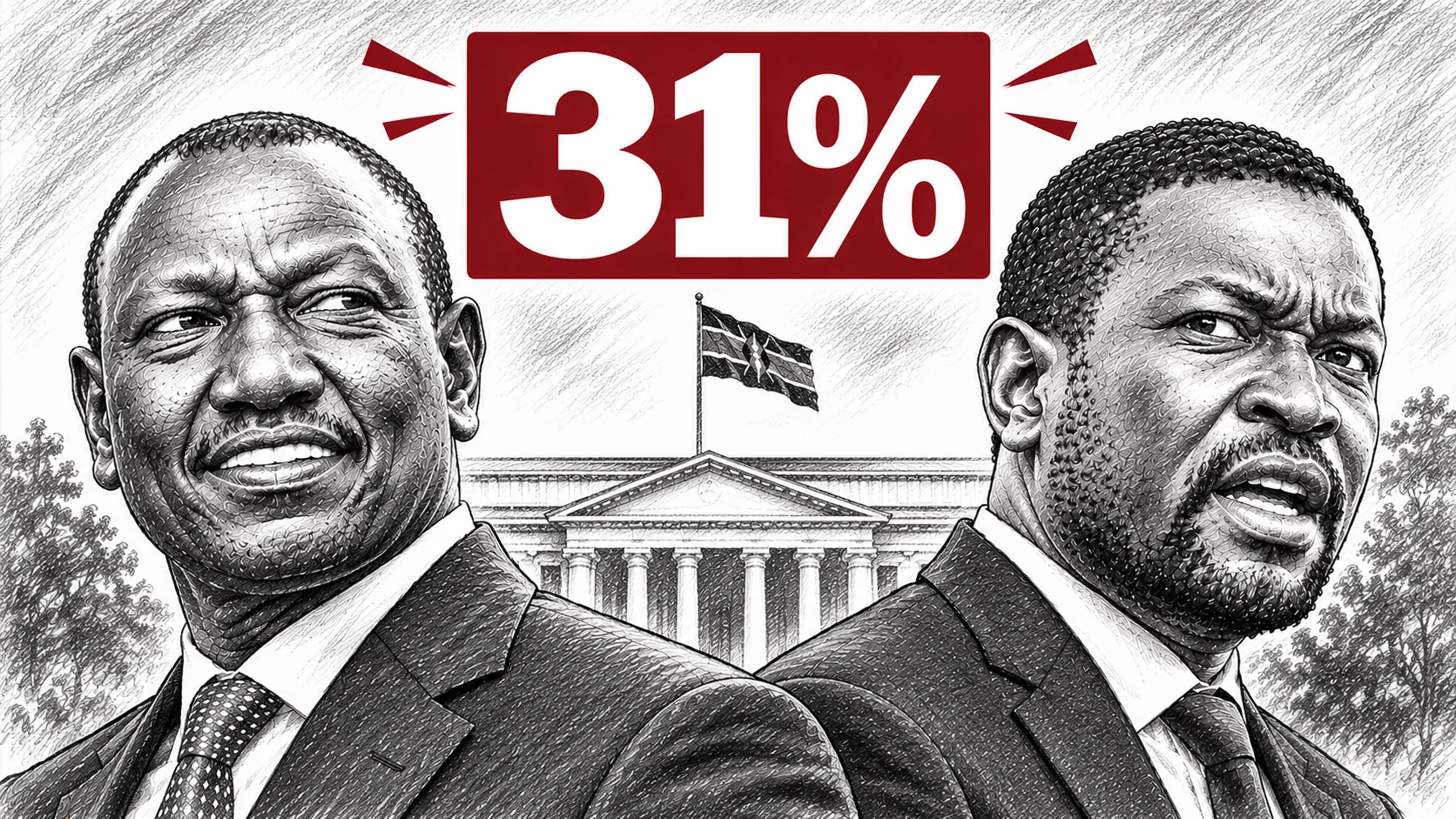
In June, President William Ruto and Nairobi Senator Edwin Sifuna together accounted for 39 per cent of Kenyans’ preferred winners of the 2027 election in a TIFA poll.
In the survey TIFA Research released on November 12, they account for 62 per cent. Each now stands at 31 per cent, a tie within the poll’s ±2.16-point margin of error.
The tie is the headline, but the mechanism behind it is the story.
The two men have reached the same number by routes that share almost nothing, and the difference decides which of them is better placed to assemble what Article 138 of the Constitution demands of a first-round winner: more than half of all votes cast, and at least a quarter of the vote in more than half of the counties.
Between June and November, Ruto rose from 24 per cent to 31 per cent and Sifuna from 15 per cent to 31 per cent.
Over the same months, Kalonzo Musyoka slipped from 13 per cent to 9 per cent, Fred Matiang’i from 14 per cent to 5 per cent, Rigathi Gachagua from 7 per cent to 4 per cent, and the undecided from 20 per cent to 15 per cent.
Ruto and Sifuna gained 23 points between them; those four columns shed 21.
TIFA reads Sifuna’s rise as coming at the expense of his opposition colleagues rather than the President, and the series supports that reading: nothing in it shows Ruto losing ground to him. What it shows is a field consolidating around two poles before either has a running mate.
Ruto’s Bloc, And Its Ceiling
Ruto polls 59 per cent in Central Rift and 62 per cent in Northern, and above 30 per cent in Coast and Nyanza as well. In Mt Kenya he polls 11 per cent and in Nairobi 13 per cent, two zones that together make up 32 per cent of TIFA’s sample.
That is the Broad-Based Government’s geography. Support for the BBG is 68 per cent in Northern and 57 per cent in Central Rift, but 12 per cent in Mt Kenya and 13 per cent in Nairobi.
At the individual level, the coupling is tighter still. Among respondents who support the BBG, 83 per cent prefer Ruto; among those who oppose it, 3 per cent do. Opponents outnumber supporters 43 per cent to 32 per cent.
His 31 per cent is, in effect, the BBG’s constituency plus a slice of the indifferent, and his room to grow lies in the 25 per cent who have no view on the arrangement or have not heard of it, and in the 15 per cent who are undecided. His running-mate question is the visible edge of the same problem.
Among Ruto’s own supporters, 55 per cent want Kithure Kindiki to stay on the ticket, against 12 per cent for Gladys Wanga and 9 per cent for Hassan Joho. TIFA’s own framing is whether Ruto would trade a loyal deputy for someone certain to bring in more votes, and nothing in the poll answers that.
Sifuna’s Map, And Where It Came From
Sifuna’s 31 per cent is spread rather than stacked. He leads in Western at 55 per cent, and polls 39 per cent in Nairobi, 36 per cent in Coast, 33 per cent in Nyanza, 32 per cent in Mt Kenya and 31 per cent in South Rift: six of nine zones at 30 per cent or more, against four for Ruto.
In Mt Kenya, he outpolls both Ruto and Gachagua, who stand at 11 per cent each.
In Nairobi, Linda Mwananchi stands at 26 per cent, against ODM’s 9 per cent and UDA’s 8 per cent. Ninety per cent of its supporters want Sifuna as president.
The soft spots are visible too. ODM’s remaining supporters still prefer Ruto to Sifuna, 42 per cent to 33 per cent. And among BBG opponents, Sifuna holds 56 per cent, leaving a large remainder scattered among other aspirants and the undecided.
The Arithmetic Trap
Add Sifuna’s 31 per cent to the 19 per cent held by Kalonzo, Matiang’i, Gachagua and Ndindi Nyoro, and the sum reaches 50 per cent. TIFA itself warns against the sum, citing competition inside the opposition and the advantages of incumbency.
The negotiation has no agreed calendar. Among opposition supporters, 45 per cent want a joint ticket named in early 2027, 35 per cent before the end of this year and 16 per cent in mid-2027.
A clear majority, 57 per cent, call unity “very likely”, though TIFA’s own gloss is that this is as much hope as belief. The harder puzzle is the second slot.
TIFA observes that Kalonzo seems unlikely to accept running under Sifuna, while Sifuna accepting the deputy’s role would look like a sell-out to his keenest supporters.
The reason is mechanical: each of those percentages has a custodian. Kalonzo’s 9 per cent is concentrated, with 55 per cent in Lower Eastern and 80 per cent of Wiper supporters behind him. Matiang’i’s base is thin even at home, with only 57 per cent of Jubilee supporters backing him. Votes held that way do not transfer by arithmetic; they transfer by negotiation.
The party numbers explain the engine. The Linda Mwananchi Movement, registered shortly before fieldwork began, now draws 17 per cent and is second to UDA’s 25 per cent, while ODM has halved from 20 per cent to 10 per cent.
Gachagua’s Party, Sifuna’s Voters
The poll’s most awkward finding for the opposition concerns Gachagua. Among opposition supporters, 43 per cent name him as the person most responsible for the opposition’s disagreements.
The next answer, Ruto and the UDA government, draws 15 per cent, and Sifuna 7 per cent. Nationally, Gachagua’s own presidential rating is 4 per cent, and 11 per cent in Mt Kenya, his home ground.
That sits oddly beside Ol Kalou. On 16 July, Gachagua’s Democracy for the Citizens Party won the constituency by-election with 35,440 votes to UDA’s 5,450, about 85 per cent of ballots cast.
Critics, including law professor Makau Mutua, noted that it was one win in ten by-election contests and cautioned against reading too much into it.
The poll suggests a distinction the by-election cannot: DCP can win a Mt Kenya seat while its leader is, for now, not the presidential choice even among his own party’s supporters. Among DCP supporters, 34 per cent prefer Sifuna and 25 per cent Gachagua.
TIFA frames the opposition’s selection debate as Gachagua’s emphasis on ethno- regional “vote-basket” numbers against Ndindi Nyoro’s emphasis on experience and capacity to perform.
The poll is the sharpest available test of the first argument, and the numbers do not flatter it. A vote-basket argument assumes the basket can be delivered.
In Mt Kenya, those polled prefer Sifuna to Gachagua almost three to one, 32 per cent to 11 per cent. Preferring a winner is not the same as refusing a ticket, but it is the evidence the argument must address.
What The Poll Cannot See
Three limits matter. First, TIFA asked whom respondents would like to win “whether or not you have ever voted or intend to vote”, so 31–31 describes adults’ preferences, not voters’.
The release’s outline promises a registered versus non-registered breakdown, but it does not appear in the deck. It is the cut that would test every number above.
Second, the undecided are not evenly spread. Only 5 per cent of BBG supporters and 8 per cent of its opponents are undecided about the next president; among those with no view on the BBG, the figure is 36 per cent, and among those unaware of it, 43 per cent.
The 15 per cent undecided are concentrated among the politically disengaged, who may also be the least likely to turn out.
Third, time. Fieldwork ran from 26 October to 5 November, and the opposition’s unity talks have continued since. TIFA says as much, and promises further releases from the same survey.
What to watch is therefore specific: whether a registered-voter cut preserves Sifuna’s geographic spread, whether Ruto can move in Mt Kenya and Nairobi without the BBG moving first, and whether the opposition names its ticket before the year ends or after it.
The tie says the race is open. The maps say how.