



There is a peculiar argument taking shape around the Kenyan economy as William Ruto approaches the end of his first term.
The government can point to falling inflation, a more stable shilling, stronger revenue collection and economic growth that has remained relatively resilient, while millions of households can simultaneously insist that life has not become meaningfully easier.
Neither side is necessarily wrong; the problem is that the two sides are measuring different things.
At the level of the national economy, Kenya in 2026 is in a more stable position than it was during some of the most difficult moments of the first half of Ruto’s presidency. Inflation, which reached about 9.6 per cent during the earlier cost-of-living crisis, had fallen to 6.6 per cent by August 2026.
GDP growth has remained around 5 per cent, compared with approximately 4.8 per cent in 2022, while KRA revenue has risen from roughly Sh1.9 trillion to Sh2.7 trillion. The shilling, after its severe depreciation and foreign-exchange pressures, has also regained some ground.
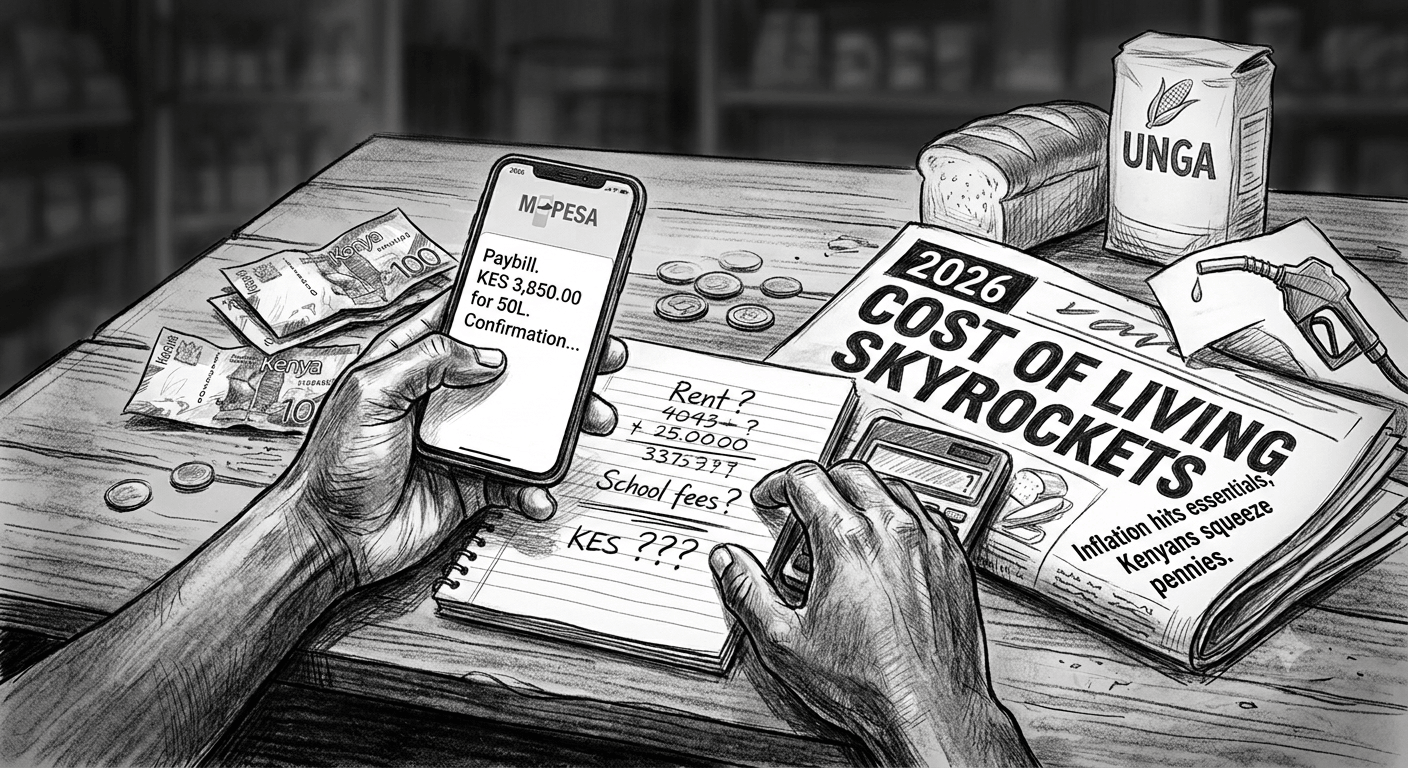
The government’s argument is therefore not imaginary, as the macroeconomic patient is more stable. But the household is not a macroeconomic patient, and a family does not consume GDP growth. It pays rent, buys food, pays school fees, fills a matatu, buys electricity, services a loan and tries to keep something aside for an emergency. That is where the Ruto economic story becomes considerably more complicated.
Lower Inflation Is Not Lower Prices
The single most consequential distinction in this debate – and the one most easily lost in political argument – is that a falling inflation rate does not mean falling prices.
If the cost of unga rises by 10 per cent one year and by 5 per cent the next, inflation has technically halved. Unga is still considerably more expensive than it was two years earlier. The same arithmetic applies across the household budget.
By August 2026, even as headline inflation moderated to 6.6 per cent, food prices were still rising by 9.0 per cent year-on-year, and transport costs were up 15.7 per cent. Those are precisely the categories that consume the largest share of lower- and middle-income household budgets, which means the lived inflation rate for most Kenyan families remains well above the number in the government’s press briefings.
Households remember the level of prices, not the rate of change in them. A statistical improvement is not the same thing as a felt one.
The government can legitimately say that it has helped stabilise the economy. The citizen can just as legitimately respond that stability has not restored the purchasing power lost during the years of rapid price increases.
That gap explains why the economic message from government can sound convincing in a Treasury presentation but less convincing at the supermarket, petrol station or school-fees counter.
The administration inherited a difficult economic environment, including high public debt, elevated interest rates and a fiscal position that constrained the room for new spending. Its decision to prioritise revenue mobilisation was therefore not without logic.
A state that cannot raise enough revenue eventually has to borrow more, cut services or both. But the politics of taxation are different from the arithmetic of taxation.
For a household already struggling to meet its monthly obligations, an additional deduction from income or an increase in the price of a product is experienced immediately, while the benefits of fiscal consolidation are usually indirect and delayed.
Growth Does Not Automatically Become Prosperity
GDP provides another example of the same problem. Kenya’s economy has continued to grow at around 5 per cent, which is hardly an economic collapse. Yet aggregate growth tells us very little about how evenly the benefits of that growth are distributed.
An economy can expand while households remain financially constrained if population growth is substantial, productivity gains are concentrated in a few sectors, employment growth is weaker than output growth or the cost of essential goods rises faster than incomes.
This is particularly important in Kenya because so much economic activity takes place outside the formal wage economy.
For a salaried employee with predictable income, economic stability can provide some protection against shocks.
For an informal trader, casual worker, boda boda operator or young person moving between temporary jobs, the same national growth rate can feel remarkably distant. That is why the government’s record on jobs remains mixed.
There are real interventions: 391,000 Ajira trainees have been recorded, digital work has become a central plank of the administration’s employment strategy, overseas labour opportunities have expanded and manufacturing investments continue to be presented as part of the employment solution.
But the question is not how many programmes exist.
It is how many young Kenyans have moved from precarious economic survival into stable and rising incomes. That is a much harder number to produce.
The Tax State Outgrows the Household
Perhaps the most politically significant economic development of the Ruto years is the growing role of the state in extracting revenue from the economy. KRA collections have risen from approximately Sh2.0 trillion to Sh2.8 trillion.
From the government’s perspective, this is evidence of improved tax administration, a broader revenue base and stronger fiscal capacity. From the taxpayer’s perspective, however, the question is what that additional extraction produces.
The issue is not whether Kenya should collect taxes. It must. The issue is whether citizens can see a sufficiently strong connection between what they surrender to the state and what they receive from it. That connection becomes especially important when debt remains high, which creates a difficult political equation.
The government needs more revenue partly because the country has substantial obligations. Citizens are being asked to contribute more because those obligations must be financed. But households can reasonably ask why increased taxation has not yet produced a correspondingly dramatic improvement in their everyday economic security.
This is the legitimacy problem at the centre of the Ruto economic model. Fiscal consolidation is an economic necessity. It is not automatically a political success. The household has a longer memory than the inflation rate
Another reason the government’s economic recovery narrative has struggled to resonate fully is that households remember price levels, not inflation rates.
An economy can expand at 5 per cent a year while a large share of households remain financially constrained, if population growth is substantial, if productivity gains concentrate in a handful of sectors, or if the cost of essentials rises faster than incomes across the rest of the economy. Kenya’s growth has features of all three.
This matters more in Kenya than in many peer economies because so much activity happens outside the formal wage system.
A salaried worker with a predictable paycheck can absorb a stabilising economy in a way that shows up in their monthly budget.
An informal trader, a casual labourer or a graduate cycling through short-term contracts experiences the same 5 per cent growth rate as an abstraction – a number reported on the news, not a change in what is left over at the end of the month.
Foundation, Not Destination
None of this should be read as a dismissal of what the government has achieved. Macroeconomic stability matters enormously, and a collapsing currency, runaway inflation or an uncontrolled deficit would have hurt households far more severely than current conditions do. The administration is right to argue that some difficult decisions were necessary to restore confidence in the economy.
But stability is the foundation prosperity is built on. It is not prosperity itself. The 2027 test will not turn on whether GDP grew by 5 per cent or whether KRA hit its collection targets.
It will turn on a narrower and much harder question: whether an ordinary Kenyan has more disposable income after buying food, can pay school fees without borrowing, and can absorb a medical bill without financial panic.
That framing cuts both ways heading into 2027. It gives the government a genuine, defensible record to run on – a currency that no longer collapses by the month, a tax base that no longer relies on ever-larger borrowing, a growth rate that has held up against regional headwinds.
It also gives the opposition a genuine, defensible line of attack: none of that has yet reached the level most Kenyans actually live at, and the administration’s own campaign promise was to change that level specifically, not the national average around it.
Governments write policy for economies. They are elected by households. That is the gap the Ruto administration had four years to close – and, on the evidence assembled here, has not yet closed.