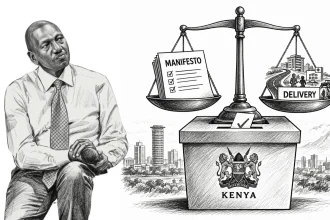







Kenyans have fixed their attention on a single date: August 10, 2027, when the country returns to the polls to elect a President, Governors, Senators, Members of the National Assembly, Woman Representatives and MCAs.
But the election that matters for party survival begins nearly a year earlier — on October 7, 2026, when political parties must start submitting the names and specimen signatures of their authorised signatories to the Office of the Registrar of Political Parties (ORPP).
That deadline is the opening move in a regulatory sequence that runs for roughly nineteen months, drawn from the Political Parties Act Cap. 7D and the Elections Act Cap. 7, and set out by ORPP following the Independent Electoral and Boundaries Commission’s Gazette Notice of August 20, 2026.
It is the kind of compliance architecture that rarely makes headlines but quietly decides who gets to appear on the ballot at all.
Four Tracks, One Clock
ORPP’s timeline runs across four parallel tracks, each with its own cadence, and the heaviest track is party nominations. Parties have from October 7 to 15, 2026 to submit signatory details to ORPP, and until October 15, 2026 to do the same with IEBC.
Election and nomination rules follow close behind — submitted to ORPP between September 28 and October 16, 2026, and certified by October 30, 2026, before being filed with IEBC by November 6, 2026.
Then comes the membership question: parties must submit their full membership lists to ORPP between March 16 and 23, 2027, have those registers certified by March 23, 2027, and file the certified registers with IEBC by April 12, 2027.
Beneath these headline dates sits a second layer of procedural obligations that will matter more to campaign teams on the ground.
Parties must notify ORPP of their nomination methods at least ten days before nominating candidates, disclose nomination dates, venues and participating members at least ten days out, publish nomination information on their official websites at least seven days before nomination day, and post eligible-member lists at each nomination venue before the nomination itself takes place.
Parties using direct nominations must supply ballot papers, boxes, membership registers and results slips at every polling venue. Parties using indirect nominations must instead select and submit a list of delegates at least seven days ahead of nomination, and specify the delegates’ meeting date and venue at least ten days out.
Candidates carry their own paperwork. Self-declaration forms under the Leadership and Integrity Act Cap. 185C must be submitted before the party conducts its nominations, and parties must confirm that prospective candidates meet the constitutional, electoral and party-specific qualification thresholds before submitting their list of nominees to ORPP.
The final party-level deadline falls on May 12, 2027, when every political party must submit to ORPP a full register of its members alongside a statement of the party’s assets and liabilities.
The Separate Clock
Parties seeking to contest as coalitions face two distinct deadlines: a coalition agreement for registering a coalition political party is due to ORPP by April 12, 2027, while a coalition agreement for confirming a pre-election coalition is due by May 9, 2027 — a narrower, later window for parties that decide late to combine forces without forming a single registered entity.
Independent candidates run on a tighter, more compressed calendar concentrated almost entirely in a six-week window. Anyone intending to contest as an independent must resign from their political party by May 8, 2027.
Submission of symbols, certification of those symbols by ORPP, requests confirming a person is not a party member, and certification that intending independents are indeed not party members, all fall within the same March 23 to May 8, 2027 band — meaning a candidate who leaves a party late in that window has very little room to complete the remaining steps.
Parties pursuing mergers face the simplest rule of the four: any merger agreement must be submitted to ORPP within 21 days of signing.
What The Calendar Reveals
Read as a whole, the timeline is front-loaded on party compliance and back-loaded on candidate-facing decisions. The October 2026 window — barely a month away — deals almost entirely with institutional housekeeping: signatories, nomination rules, internal governance disclosures to ORPP.
None of it involves a single voter or candidate directly, and none of it is likely to generate public attention. Yet it is this window, not the March–May 2027 candidate season, that determines whether a party is even structurally eligible to proceed.
A party that fails to file signatories by mid-October, or misses certification of its nomination rules by October 30, is compromised before a single aspirant has picked up nomination papers.
The candidate-facing deadlines cluster far later, in the March-to-May 2027 stretch — membership list certification, independent candidacy steps, coalition confirmations, and the final assets-and-liabilities filing on May 12, 2027, roughly three months before the general election itself.
That compression means the final push before nominations will be procedurally intense for every party, coalition and independent aspirant simultaneously, raising the risk of late filings, disputed membership registers, and ORPP backlogs precisely when scrutiny will be highest.
For a party organising around 2027, the practical read is straightforward: October 2026 is not a preliminary formality. It is the first test of whether the party’s internal administration is functional enough to survive the eighteen months that follow.
Two things are worth tracking as October 7 approaches. First, whether parties — particularly newer or coalition-aligned outfits — have their signatory and nomination-rule paperwork ready, since a slow start here compounds through every later deadline.
Second, whether ORPP’s own certification turnaround holds to the stated windows— roughly two weeks for nomination rules, and up to a week for certified membership registers on request —, since a bottleneck at the regulator would ripple through the entire chain it has set for everyone else.