





On Wednesday, the Dangote East Africa Refinery was presented as an anchor for Lamu Port, LAPSSET, industry, jobs, and a new city. The harder question is whether the investment can connect with the people, infrastructure, security and economy of a county that has spent decades waiting for transformation.
For years, Lamu has occupied an unusual place in Kenya’s development story. It has been both strategically important and economically marginal, with one of the country’s oldest trading settlements, a World Heritage Site, a deep natural harbour, and a location at the intersection of Kenya’s interests in the Indian Ocean and the wider East African economy.
Yet much of the county has continued to contend with weak infrastructure, insecurity, limited public services and an economy heavily dependent on fishing, agriculture and tourism.
That contradiction gives today’s groundbreaking its significance.
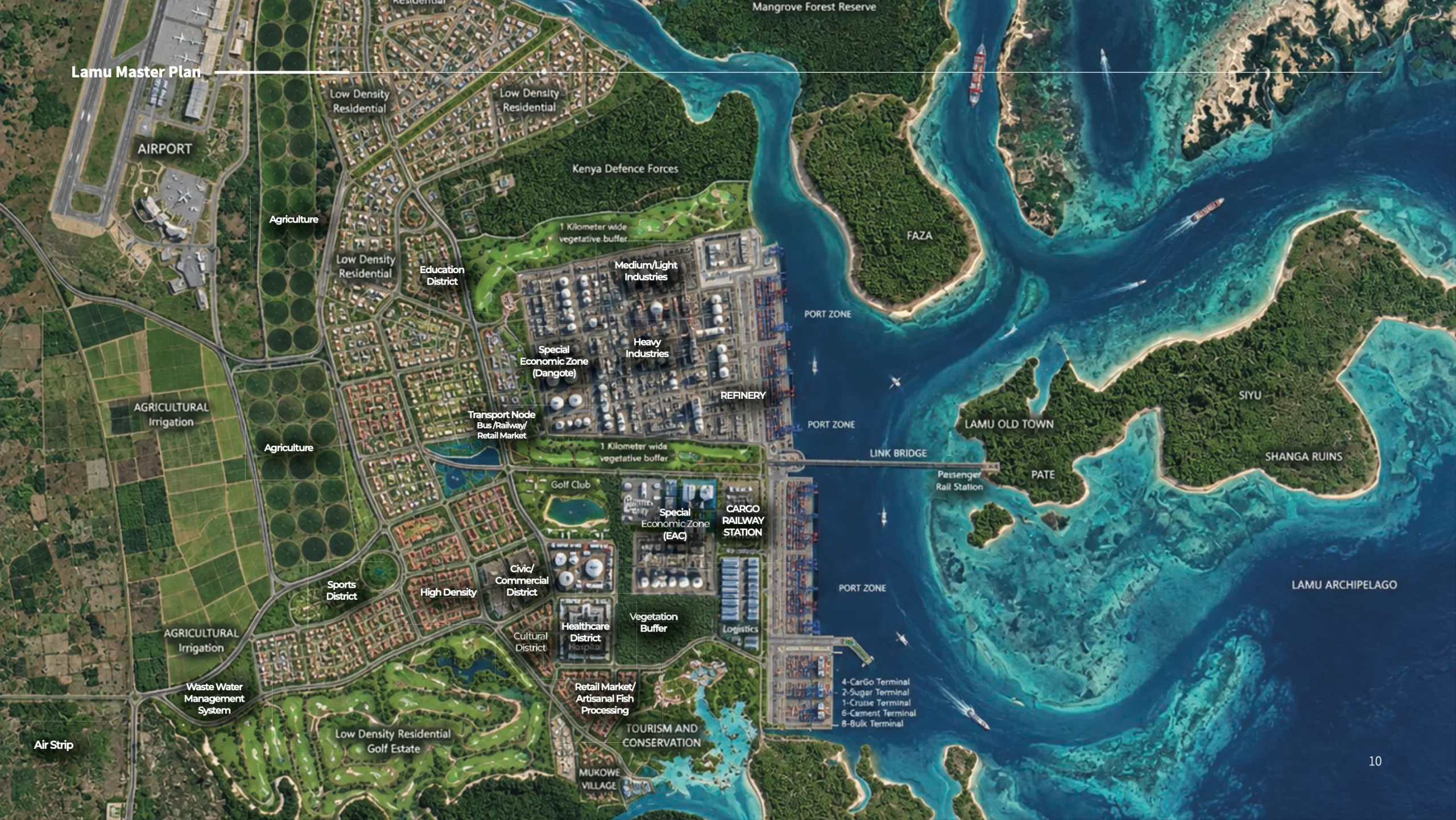
The Dangote East Africa Refinery is not being presented as an isolated industrial plant. The masterplan places it within a much larger transformation of Lamu, connecting the refinery to the Port of Lamu, the LAPSSET corridor, Special Economic Zones, pipelines, manufacturing, agriculture, logistics and a proposed New Lamu City.
The scale is substantial. President William Ruto described the investment as a $16 billion (Sh2.07 trillion) petrochemical complex designed to process up to 700,000 barrels of crude oil a day, with the project also envisaging up to 1,000 megawatts of power generation.
Yet the most revealing part of Ruto’s remarks was his acknowledgement that the ceremony itself is only the beginning. “A groundbreaking is a promise. A refinery is a promise kept,” he said, before listing the work that lies between the two: financing, infrastructure, workforce training, construction, crude supply and securing markets. “Every figure we speak of today is a target. None of it is automatic.”
That distinction matters because Lamu has lived with the language of transformation for years. The refinery now gives the promise a physical starting point, but it also raises a more demanding question: can Kenya convert infrastructure into an economy that produces value locally and regionally?
From Port Project To Economic System
Lamu Port was always intended to be more than a port. LAPSSET, incorporated into Vision 2030, was conceived as a transport and logistics corridor connecting Kenya to South Sudan and Ethiopia while opening a new route into the East African and Great Lakes economies. The 23-berth Lamu Port is the maritime anchor of that vision, with three berths completed according to the masterplan.
The difficulty with mega-projects is that infrastructure can exist without an economy forming around it. A port can handle ships without generating sufficient local industry, while a railway, road or special economic zone can be completed without producing the manufacturing, logistics and services that were supposed to follow.
Ruto acknowledged that problem directly at the groundbreaking, arguing that “a corridor without commerce is just a road” and “a port without industry is just a harbour”, before positioning the refinery as the investment that could give both the corridor and the port a broader economic purpose.
That is the refinery’s central proposition.
The masterplan envisages petrochemicals, fertiliser and steel manufacturing alongside agricultural processing, fishing, storage, logistics and trade. It also provides for the infrastructure of a functioning city, including housing, schools, hospitals, markets, tourism facilities, transport links and a new airport.
Dangote’s own description of the project extends the ambition beyond the refinery itself. He has described the investment as a gateway for further industrial investment into Kenya, presenting the development as the start of an industrial city rather than simply another energy facility.
That framing matters because the project’s economic value will ultimately depend on what develops around the refinery as much as what happens inside its perimeter.
The question, therefore, is whether Lamu can become an economic system rather than simply the location of a very large industrial project.
The Jobs Question Starts Here
The employment promise provides perhaps the clearest measure of whether that wider transformation reaches beyond the project site.
The masterplan estimates 60,000 jobs during construction, with the development expected to take three to four years, while also acknowledging that education, vocational training and skills development will be necessary if local and regional communities are to benefit.
Ruto placed considerable emphasis on that requirement, saying he expected “clear recruitment and training plans” covering welders, technicians, engineers and managers, and insisting that young people from Lamu, neighbouring counties and elsewhere in Kenya should have a fair opportunity to compete for those positions.
The employment question, however, extends well beyond the number of people who eventually appear on the refinery’s payroll.
A project of this scale will require transport, accommodation, food, construction materials, maintenance, logistics and professional services, creating opportunities for businesses that can meet the standards and demands of a major industrial operation.
Ruto said the government expects local businesses to have clear information about those opportunities and to prepare themselves to participate.
That creates a more useful measure of local participation than the headline job figure alone. How many Lamu businesses become suppliers? How many young people acquire skills that remain valuable after construction ends? How much of the procurement is sourced locally? How much of the industrial value chain develops around the refinery?
Those questions will determine whether the investment changes Lamu’s economy or simply operates within it.
The Security Test
Lamu’s transformation must also be understood through the county’s security history.
The masterplan identifies security and anti-terrorism among the elements of the proposed New Lamu City, while proposing a Kenya Navy military base intended to strengthen security around the development.
The document also identifies terrorism, land disputes, and infrastructure deficits as challenges that have constrained parts of the county.
That makes security inseparable from the project’s economics. A refinery, port, pipeline network and industrial zone represent critical infrastructure whose value depends on the ability to secure it and create an environment in which workers, suppliers and investors can operate with confidence.
The challenge extends beyond the project perimeter, particularly given the security concerns associated with the mainland and the Boni Forest area. Economic development cannot be sustained if communities around the investment remain disconnected from the security and economic benefits it is supposed to generate.
The other question is what kind of Lamu will emerge from this transformation, as its value is not only industrial or strategic. Lamu Town is a centuries-old trading settlement and UNESCO World Heritage Site, while the county’s coastline, marine ecosystems, mangroves and cultural heritage form part of what gives the region its identity and economic value.
The masterplan recognises this tension, proposing hotels, residential and leisure facilities while committing to protecting World Heritage Sites and natural and cultural assets.
The environmental dimension is equally important. The plan incorporates a one-kilometre green buffer around the industrial area, alongside waste-management systems, green corridors and sustainable agricultural practices intended to mitigate the impact of industrial development.
Ruto acknowledged that these concerns will be central to the project’s legitimacy, asking publicly who would receive the jobs, whether local businesses would win contracts, what would happen to land and whether fishermen would retain their livelihoods, while also addressing the protection of water, the coastline, mangroves and Lamu’s heritage.
“These questions are not obstacles to development,” he said. “They are questions responsible development must answer.”
That may be one of the most important commitments made at today’s ceremony because it sets a standard against which the project can be measured as construction proceeds. The government promises that land matters will be handled lawfully, environmental and social impacts will be rigorously assessed, and agreed safeguards will be enforced during both construction and operation.
The masterplan itself describes the proposed New Lamu City as an indicative concept subject to further refinement and detailed planning, which means much of the eventual relationship between industry, communities, conservation and urban growth remains to be worked out.
The Hardest Part Begins
Kenya has no shortage of grand development visions. LAPSSET has been part of the country’s development imagination for decades, Vision 2030 provided the overarching framework, and Lamu Port supplied the maritime anchor. The refinery now introduces the possibility of a large industrial economy forming around that infrastructure.
Dangote argues that Africa must capture more of the value generated from its resources instead of exporting raw materials and importing finished products. That proposition sits comfortably alongside Ruto’s argument that Kenya and other African economies need to produce more of what they consume, add value to what they produce and progressively replace imports with locally manufactured goods.
For Kenya, the immediate economic rationale is straightforward. Ruto said the country spent Sh530 billion on petroleum-product imports last year, while cautioning that a refinery would not eliminate that bill overnight because it would still have to purchase crude and deliver refined products at competitive prices.
That caveat is important because it moves the conversation away from the simplistic idea that domestic refining automatically means cheaper fuel. The larger proposition is about where value is created, where industrial capacity develops and whether a regional market can support the investment.
That is also why the refinery’s regional ambition matters. Ruto said the facility is intended to serve not only Kenya but the wider Eastern African market, while the masterplan identifies Kenya, Tanzania, Uganda, South Sudan, Rwanda, Burundi, Ethiopia, Somalia and the Democratic Republic of Congo as potential markets.
The project will therefore be judged on several levels at once: whether the refinery is built, whether it operates competitively, whether the surrounding industrial ecosystem materialises, whether Lamu’s residents participate meaningfully in the resulting economy and whether the infrastructure around it keeps pace with the investment.
Ruto offered perhaps the clearest measure at today’s groundbreaking when he said the refinery’s “scale will be measured in barrels and dollars”, but that its success “must be measured in skills gained, enterprises built, livelihoods protected and public trust earned.”
That is a considerably bigger proposition than building a refinery.
Lamu has long been one of the most ambitious promises in Kenya’s development plans. The groundbreaking gives that promise a physical starting point, but it also removes some of the distance between ambition and accountability.
From today, the question is no longer whether Lamu can be imagined as an industrial and logistics hub. Kenya has now put that ambition on the ground.
The harder question is what the country will build around it, and whether the people who have lived with Lamu’s marginalisation for generations will have a meaningful stake in the economy that follows.