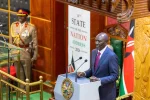



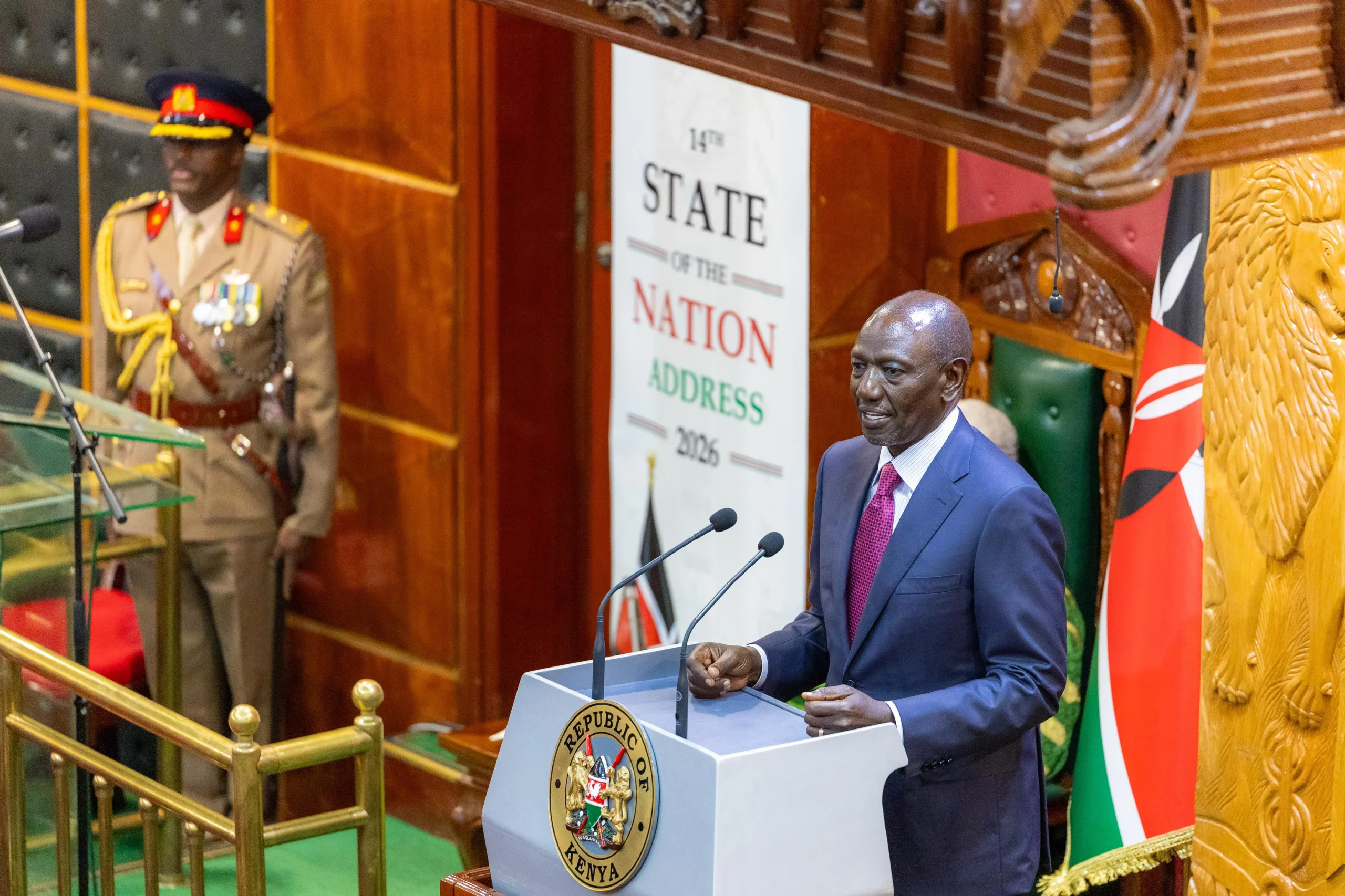
President William Ruto’s fourth State of the Nation address, delivered to a joint sitting of Parliament on November 18, was built on numbers: fertiliser prices, maize bags, lending rates, reserves.
They carry the argument of the closing section, that the transformation agenda must “go on uninterrupted”. So the numbers are the first thing to test.
The result is mixed. Several claims check out against official data. Others hold only once you add context the speech left out. On two of the biggest economic stories of the moment, inflation and public debt, the address gave either no figure at all or none that a listener could use.
The Scorecard
| Claim in the address | What the record shows | Verdict |
|---|---|---|
| Shilling stable around Sh129 to the dollar | CBK weekly bulletin: Sh129.96 on 12 November 12, unchanged from November 5 | Holds |
| Average bank lending rate down from 17.2 per cent (Nov 2024) to about 14.4 per cent (Sept 2026) | CBK’s MPC statement of October 7 gives the same two figures. But August was 14.3 per cent, and bank-by-bank rates range from about 10.6 per cent to 19.1 per cent | Holds, with context |
| Forex reserves peaked at US$15.3bn this year | Reported record of US$15.4bn in the week to 30 July, lifted by privatisation proceeds. CBK now shows US$14.6bn (November 12), or 5.9 months of import cover | Holds, roughly |
| Fertiliser: Sh7,500 a bag in 2022 to Sh2,000 this year | The 2022 price and the Sh2,500 subsidy price match Agriculture Ministry statements. Sh2,000 has applied only since September 1, and only to registered e-voucher holders | Holds, with context |
| Maize output up from 44.3m bags (2022) to 71m (last year); imports down from 9.9m to 3.3m | Earlier official figures for 2022 were 34.3m (Agriculture CS, September 2025) and about 34m (Treasury CS, Budget speech). The 3.3m import figure matches Treasury. The address is silent on the 2026 drought and a planned import of up to 25m bags | Baseline disputed, 2026 omitted |
| Sifted unga: Sh230 (Sept 2022 high) to KSh152 (Sept 2026) | KNBS-reported price for September 2026 is Sh152.00. A year earlier, it was Sh152.28. The 2022 peak is not checked here | Latest figure holds, trend flat |
| Inflation “pushed higher in October” | October inflation was 7.3 per cent, up from 6.8 per cent, the highest reading since July 2023 | Figure not given |
| Debt sustainability | Public debt was Sh13.01 trillion at end-June 2026, or 68.5 per cent of GDP (Treasury). No stock or debt-service figure appears in the address | Not stated |
The Number He Did Not Say: 7.3 Per Cent
Paragraph 30 of the address concedes that “renewed food and energy pressures” pushed inflation higher in October. It gives no figure. KNBS did: 7.3 per cent in October 2026, up from 6.8 per cent in September and the highest since July 2023, according to data released on October 30.
Transport prices were up 17.1 per cent year on year as petrol and diesel climbed. Non-core inflation, which captures food and fuel, stood at 15.1 per cent.
The speech frames its cost-of-living case around falling prices and a stable economy. The latest consumer price data say pressure is building again, with the Central Bank rate held at 8.75 per cent at the October 7 meeting.
KNBS is due to publish November’s reading at the end of the month, which will show whether October was the peak. The package of relief measures announced in the speech, including the proposed PAYE exemption up to Sh32,333, lands against that backdrop. All of it still needs Parliament. The claim that inflation averaged 4.1 per cent in 2025 was accurate to the extent that it was rounded off from 4.07 per cent.
Maize: The Baseline And The Drought
The maize claim is the one that most needs a second look. The address says production rose from 44.3 million bags in 2022 to 71 million last year. In September 2025, Agriculture CS Mutahi Kagwe put the 2022 figure at 34.3 million bags and the 2024 figure at 67 million, with a 70 million target for 2025.
At this year’s Budget Statement reading, Treasury CS John Mbadi cited about 34 million bags in 2022, rising to 67 million in 2025. Kagwe now puts last year’s harvest at about 71 million, revised up from an earlier 60 million estimate, and notes that a separate set of figures in circulation is inconsistent with these.
The base year matters. On our arithmetic, 34.3 million to 71 million is roughly a doubling. 44.3 million to 71 million is about a 60 per cent rise. The Ministry should say which 2022 figure is right.
The bigger omission is this year. Drought hit the North Rift maize belt, and in September, the government was preparing to import up to 25 million 90kg bags against national consumption of 70 to 75 million.
The address cites 3.3 million bags of imports as evidence of self-sufficiency. It does not mention the 2026 shortfall.
Fertiliser: Price Versus Reach
The price claim is accurate but recent. Kagwe said the 50kg bag cost about Sh7,500 in 2022, and the subsidy brought it to Sh2,500. The further cut to Sh2,000 took effect on 1 September, announced alongside a 50 per cent subsidy on certified maize seed as drought relief.
The subsidised price is for farmers registered on the national system with an e-voucher.
The reach figures also need reconciling. The address says 38.5 million bags have been distributed and nearly nine million farmers registered. In August, Kagwe put distribution at 33.55 million bags to about 1.98 million farmers, with Sh78.79 billion in government support.
More bags may have moved since August, but registration is not the same as being served, and the gap between nine million and 1.98 million deserves a clear answer.
Unga: A Fat Year
The Sh152 figure is correct for September. But the price is essentially where it was a year ago (Sh152.28 in September 2025) and above the Sh134.89 recorded in June 2024, according to analysis of KNBS data.
The Sh230 peak in September 2022, the baseline that Ruto’s address chose, is plausible, but we have not verified it. A fairer reading is that unga fell sharply from the 2022 high, then stopped falling.
Reserves And Rates: What Holds
The shilling and lending-rate claims survive scrutiny. The shilling has traded at about Sh129.95 to the dollar through early November. The average lending rate is 14.4 per cent in the CBK’s latest data, well below November 2024. Context: the rate ticked up from August to September, and on 17 September the President himself said banks’ rates remain too high.
On reserves, the address cites a peak of US$15.3 billion. CBK data put the record at US$15.4 billion in late July, helped by privatisation proceeds. The latest CBK figure is US$14.6 billion. That is still above the statutory four-month import cover, but analysts have cautioned that public data do not show how much of the rise is usable, self-funded strength.
The Figure Missing From The Speech: Sh13 Trillion
The address speaks of protecting debt sustainability and avoiding an unsustainable burden on taxpayers, anchoring this on the repayment of the 2024 Eurobond, but it shies away from stating the debt stock.
The Treasury’s provisional June 2026 bulletin puts total public debt at Sh13.01 trillion, or 68.5 per cent of GDP: Sh7.33 trillion domestic and Sh5.68 trillion external.
CBK data show that the debt stock stood at about Sh8.7 trillion when the President took office in September 2022. In the first quarter of the 2026/27 financial year, debt service took Sh490.5 billion against Sh631.8 billion in tax revenue, or 77.6 per cent, according to Treasury figures.
Definitions of the debt-service ratio vary, so the exact percentage depends on the measure, but every version is far above the commonly cited 30 per cent benchmark.
That is the context for the address’s Sh5 trillion, 10-year transformation programme. On our arithmetic, that equals about 38 per cent of today’s entire public debt stock.
The National Infrastructure Fund, capitalised with Sh340 billion, is pitched as a way to finance it without loading taxpayers. How that works, and who carries the risk when pension money is involved, is the question for the next audit.
What we did not check
This audit covers the macroeconomic and agricultural claims only. We have not yet tested the Social Health Authority numbers, housing allocations, job-creation figures, NSSF values, road targets, or the protest-compensation figures in paragraph 194. Each is a story that we will check going forward.