


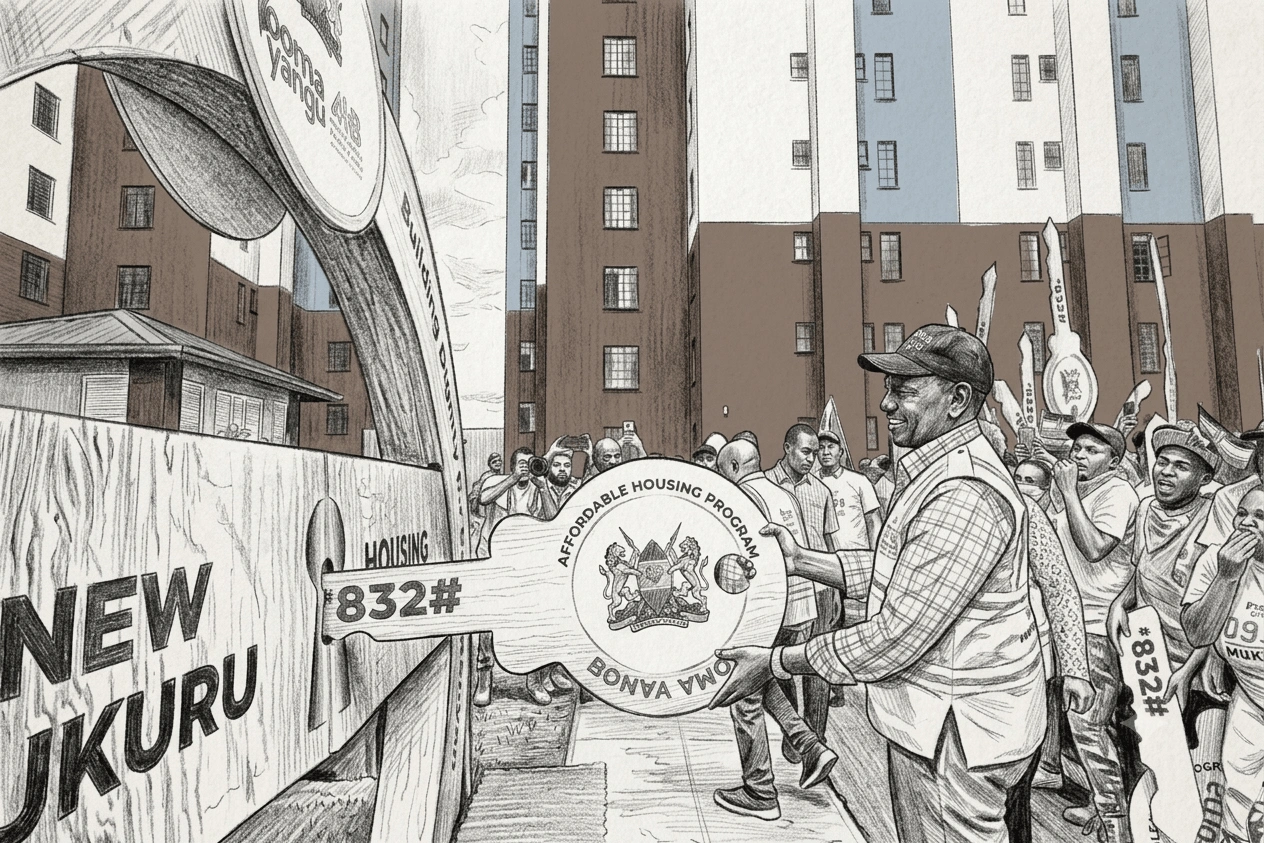
Three years into President Ruto’s flagship Affordable Housing Programme, the government has two numbers it likes to lead with: over Sh170 billion mobilised through the Housing Levy since inception, and more than 1.1 million Kenyans registered on the Boma Yangu portal as of early 2026, up from 500,000 just a year earlier.
Both figures are genuine, and both are regularly cited as evidence that the programme is working. They are also, on their own, close to meaningless as a measure of whether Kenyans are actually getting houses.
Money collected is not houses built. Portal registrations are not completed sales. The number that actually answers the question, how many homes has this programme delivered against its own targets, tells a considerably less flattering story, and it is the number that gets cited far less often.
The programme’s stated annual target, set under the Bottom-Up Economic Transformation Agenda, is 250,000 units a year. Between July 2022 and June 2025, three full financial years, the government completed 2,075 units. That is roughly 0.8 per cent of a single year’s target, spread across three years of implementation.
That statistic has become a favourite of the programme’s critics. Yet it tells only part of the story. Governments rarely build housing in neat annual cycles. Construction projects accumulate over several years before completions begin to accelerate.
The government’s own defence, to be fair, is not that delivery is complete, but that delivery is in the pipeline. By early 2026, the Affordable Housing Board was citing 262,913 units under active development across 111 constituencies in all 47 counties, with a separate disclosure putting 210,446 units at various stages of construction and due for completion by the end of June 2026.
If even a meaningful fraction of that pipeline actually reaches completion on schedule, the programme’s trajectory would look very different a year from now than its historical delivery rate suggests.
That “if” is doing a great deal of work, and it is worth being specific about why. This is not the first Kenyan administration to announce an ambitious national housing pipeline. President Kenyatta’s Big Four Agenda targeted 500,000 units by 2022 under a broadly similar model; it delivered under 10%, roughly 13,500 units, by its own deadline.
A large announced pipeline is not a novel feature of Kenyan housing policy; it is the recurring feature, and the recurring failure has been converting the pipeline into keys handed over.
The Savings Problem Nobody’s Fixing
The delivery shortfall on the supply side is compounded by a demand-side problem the government has been notably quieter about.
Of the 816,780 Kenyans registered on Boma Yangu as of May 2025, 653,182, nearly 80 per cent, had made zero contributions toward the 5 per cent deposit required to trigger a house allocation. Of those who had saved something, 98% had accumulated less than Sh100,000, and only 46 people nationally had saved more than Sh1 million.
Registering on a portal costs nothing beyond an initial Sh200; actually saving toward a deposit is a different behavioural and financial commitment entirely, and the register-to-save conversion rate suggests the programme’s headline registration number substantially overstates genuine demand- side readiness.
This matters because it undercuts a certain kind of criticism as much as it undercuts government messaging. It would be too simple to read the low completion numbers purely as a supply-side failure of government execution.
Even where units are built, evidence suggests a meaningful share of registered applicants are not currently in a financial position to take up the offer when it comes, a problem the 1.5 per cent, deducted regardless of a worker’s ability to separately save a deposit, does not by itself solve.
The programme’s own financing math explains part of the bottleneck. Delivering 250,000 units a year at current unit costs requires an estimated Sh400 billion annually.
The levy and associated financing currently mobilise closer to Sh74 billion a year, leaving an annual shortfall in the region of Sh326 billion that the government is attempting to close through bank, SACCO, pension fund, and development- partner co-investment, much of it not yet secured.
The recently disclosed plan to securitise levy revenue as loan collateral, reported separately, is one direct response to this exact gap.
The Honest Verdict
The comfortable version of this story picks a side: either a transformative national housing programme finally getting built, or a levy- funded failure repeating Kenya’s own recent history. The evidence supports neither clearly.
The financing architecture built under the Affordable Housing Act 2024, a ring-fenced fund, survived a court challenge, expanded levy base, and is more durable than anything the Big Four Agenda had, and the current construction pipeline is real and larger than any predecessor’s.
But durable financing and an announced pipeline are not the same thing as delivery, and on delivery, the programme’s first three years look remarkably similar to the last administration’s housing agenda.
A great deal of money was collected and announced against a small fraction of units actually handed to families waiting for them.
Whether the next eighteen months convert pipeline into keys, or become the latest chapter in a now familiar Kenyan pattern, is the question the completion numbers, not the collection numbers, will answer.