




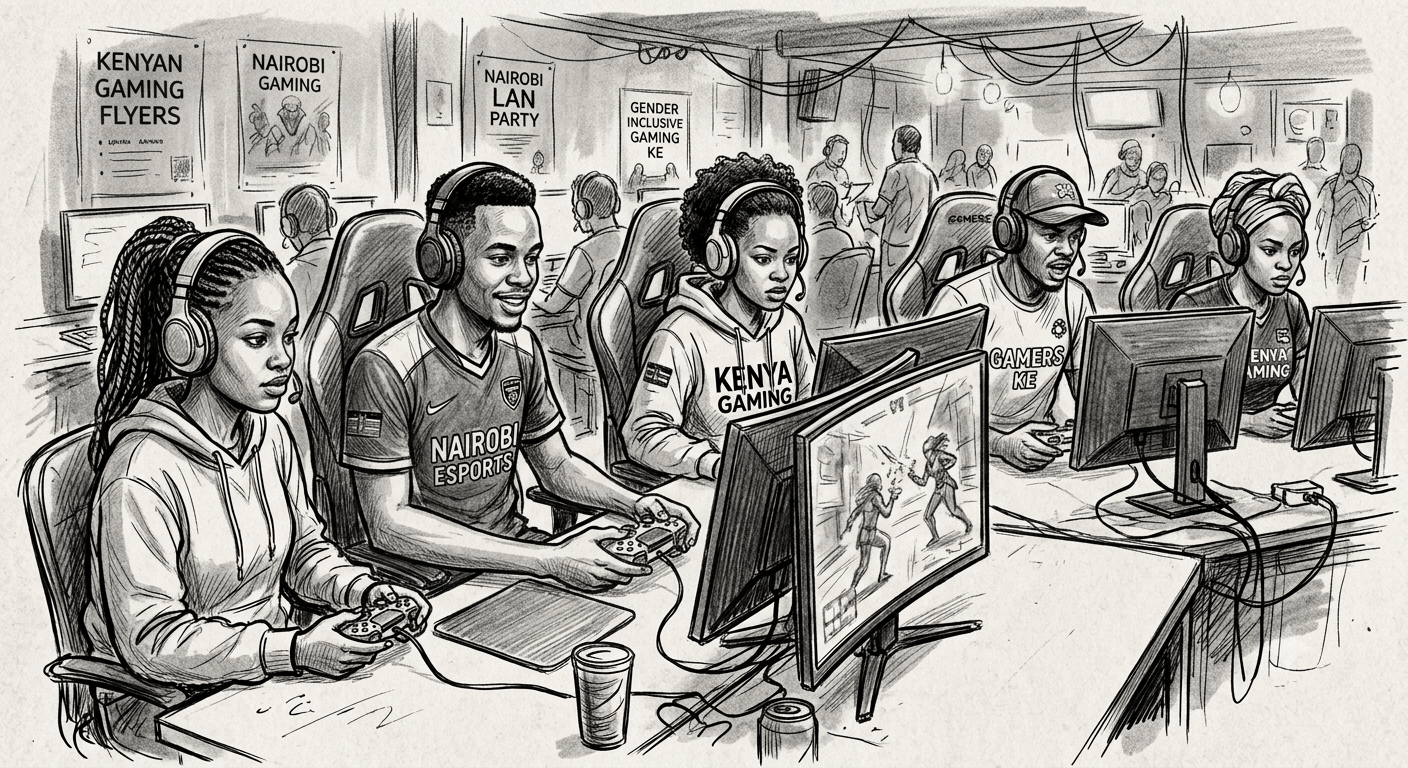
On July 18, a group of Kenyan gamers will sit down at qualifiers across seven titles: eFootball, Rocket League, NBA2K, Clash Royale, Mobile Legends: Bang Bang, iRacing, and Counter Strike 2, competing for 26 slots on a national team. Three disciplines will run dedicated women’s categories.
The winners will travel to Los Angeles in December to represent Kenya at the Global Esports Games, a tournament drawing competitors from more than 180 member federations worldwide, a scale and structure not meaningfully different from how Kenya selects and fields a team for any other international competition it takes seriously.
By most conventional measures, this should read as a straightforward national sporting story. It mostly hasn’t been covered that way, because the industry underneath it occupies an unusual position: simultaneously large, formally organised, seriously regulated, and still not treated as a professional sport in the ways that matter most for the people competing in it.
Federation With Real Institutional Weight
Esports Kenya is not an informal gaming club. It is registered with the Sports Registrar under the Ministry of Youth Affairs, Creative Economy, and Sports, the same formal recognition pathway that other national sporting bodies go through.
In May, the federation issued detailed child-welfare guidelines governing how teams, managers, scouts, and agents may recruit, train, and contract minors, explicitly invoking the Children’s Act 2022’s requirement that competitive schedules not compromise a young player’s education, health, or wellbeing, and the Counter-Trafficking in Persons Act’s transparency requirements around how young players are recruited, transferred, and housed.
Those are not the regulatory concerns of a hobbyist scene. They are the concerns of an industry federation that has recognised its sport now has enough money and enough minors moving through professional or quasi-professional structures to warrant the same protective seriousness applied to junior athletics or football academies.
The scale backing that seriousness is real. Kenya’s esports and mobile gaming market is valued at roughly Sh15 billion, expanding at a compound annual growth rate of 8.7 per cent, a faster trajectory than most of Kenya’s traditional sports economy is currently managing.
Mobile gaming, driven by affordable smartphones and extensive M-Pesa-based payment infrastructure, dominates the base of that market, while competitive esports proper sits at the more organised, tournament-driven end of it.
None of that institutional and commercial weight has translated into the basic professional infrastructure that would let players actually convert their results into a livelihood.
Industry commentary is consistent on this point: esports is still not fully recognised as a professional industry in Kenya, gaming hardware and reliable high-speed internet remain expensive relative to average incomes, and perhaps most tellingly, limited access to international payment platforms makes it genuinely difficult for Kenyan players and streamers to receive prize money, sponsorship payouts, or platform earnings from abroad.
A Kenyan player who qualifies for an international tournament, competes credibly, and wins prize money can find that the hardest part of the achievement is not the competition itself but getting paid for it.
Why The Gap Is The Actual Story
The easy version of this story is celebratory: gaming is having a moment in Kenya, a national team is heading to Los Angeles, and the market is booming.
That’s true, but it undersells what’s actually happening. A sector that is formally federated, growing faster than most legacy sports, disciplined enough to have a serious child-protection policy, and sending an official national delegation to a major international competition has, by any reasonable definition, already met the bar for professional sport status.
What it hasn’t received is the institutional catch-up that status should trigger, the banking and payment rails, the formal recognition that would open government or corporate sponsorship pipelines comparable to what football or rugby receive, the financial infrastructure that turns a qualifying result into an actual career rather than an unpaid achievement.
The question worth asking heading into the July qualifiers is not whether Kenyan esports deserves attention; the numbers already answer that.
It’s why recognition keeps lagging years behind scale, and what that lag is currently costing players who have already done the hard part: qualifying, ranking, and winning, only to find the plumbing underneath their sport hasn’t caught up to what they’ve earned.