

Sometime in the 1980s, in a bar anywhere in Nairobi, a Kenya Breweries employee lined up a dart, released it, and hit the bullseye. Nobody thought much of it.
The Tusker Festival of Darts was a regular fixture in Kenya Breweries’ annual sporting calendar, alongside festivals of golf, horse racing, and fishing, and darts was woven into the company’s culture so deeply that, as one chronicle of the era records, only the armed services produced more international sports stars than Breweries through that period.
Across East Africa, the Tusker Export Cup drew players from Kenya, Uganda, and Tanzania into a regional competition that gave the sport a genuine competitive structure and a corporate face.
That structure did not survive the 1990s intact. As Kenya Breweries restructured, corporate sports sponsorship thinned, and without the financial scaffolding that brewery money had provided, darts retreated from the tournament hall back to the pub wall.
The sport did not die; it is almost impossible to kill a game that requires nothing more than a board, three arrows, and a wall, but it lost its competitive architecture, its prize money, its visibility, and a generation of potential players who simply had nowhere to go.
The Man Who Restarted the Clock
David Munyua, who hails from Murang’a, only took up darts three years ago and needed the help of sponsors to play at the tournament and travel outside Africa for the first time.
That fact, three years from first dart to Alexandra Palace, is less a measure of Munyua’s exceptional talent than of the depth of the Kenyan darts pool he emerged from.
He did not develop in isolation. He developed in a competitive domestic circuit that, though invisible to most Kenyan sports coverage, has been operating continuously since the Tusker era ended.
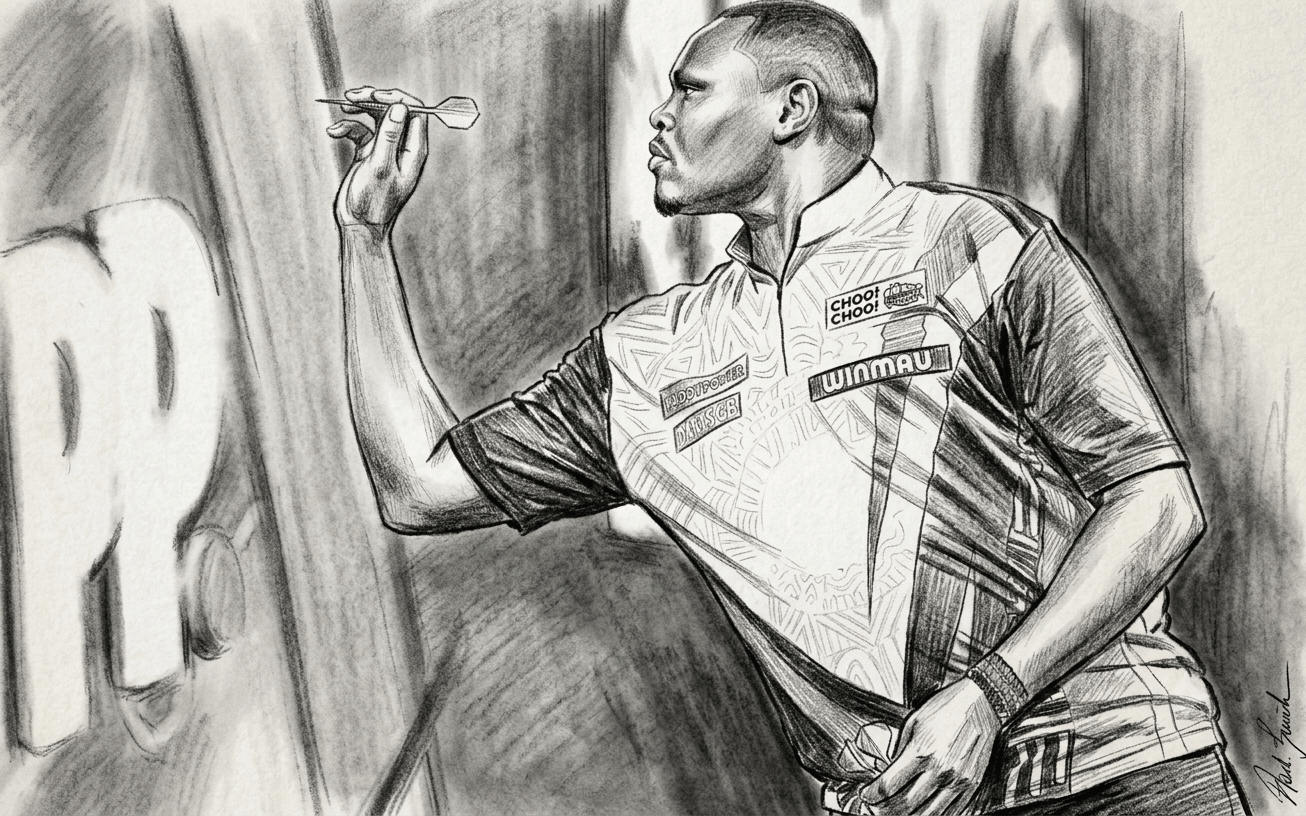
On December 18, 2025, Munyua created history by becoming the first Kenyan to win at the PDC World Darts Championship, stunning Mike De Decker, the reigning World Grand Prix champion, in a 3-2 comeback victory after trailing 2-0. He took out a 135 checkout on the bull in the deciding set to seal his place in Alexandra Palace folklore.
“This is a really big moment for the sport itself and for Africa,” he said from the stage.
The institutional consequence arrived faster than the congratulations. The PDC announced it was expanding Africa’s allocation, South Africa guaranteed a berth, and a second African nation to qualify through a separate continental qualifier, a direct response to Munyua’s performances.
One win, in one first-round match, produced a structural change to how the world’s most prestigious darts organisation allocates global representation. The sport had been waiting for a moment to leverage. Munyua gave it one.
The Infrastructure Behind the Individual
The mistake the national celebration of Munyua made was treating him as an isolated phenomenon. Kenya has hosted high-level competitions, including PDC World Championship Qualifiers, staged outside South Africa for the first time, as well as the African Continental Tour, the first professional darts competition ever held in the country, drawing elite players from across the continent.
These are not footnotes to Munyua’s story. They are the conditions that made his story possible.
Sirua Darts Group, which now has over 500 registered players in Kenya, launched the inaugural Nairobi Darts Masters in December 2025 at Broadwalk Mall in Westlands, the first high-level darts championship ever held in the country, featuring 96 players across four categories with a total prize pool of $10,000.
These are not symbolic figures. They are the signal to a young Kenyan that darts can pay, which is a different and more durable incentive than national pride alone. Sirua Darts aims to monetise the sport and provide opportunities for players to succeed, noting that the competition is designed to attract future players to know they can turn darts into a professional pursuit and to create pathways for future tournaments at the East African stage.
These milestones have been achieved without direct government funding, relying instead on the commitment of the darts community and support from darts manufacturer Winmau.
Nodor, the dartboard manufacturer based at the Athi River Export Processing Zone, produces 80 per cent of the world’s dartboards and employs over 1,000 people, making Kenya, improbably, the global capital of dartboard manufacturing.
The country has been making the world’s darts equipment for decades. It has been doing so while its own competitive darts scene atrophied for want of the kind of corporate backing that Tusker once provided, and no one replaced.
The Players Nobody Knows About
Munyua is the name Kenya knows. The names Kenya should also know tell the fuller story. Peter Wachiuri, a former carpenter and driver from Ngong, became the first Kenyan to play at the Modus Super Series in February 2025, making history by reaching that week’s final before losing 4- 1 to Scotland’s Scott Campbell.
He credits the Stima Darts Club in Ngong with giving him the exposure he needed, taking him to competitions in Tanzania and Uganda before he stood on his own.
Benson Ngari, 45, doubles as a boda boda operator and trains for between three and five hours a day. He discovered darts in a forest in Garissa in 2012 during a camping trip when a friend produced a board.
He is currently ranked 1,345 worldwide, higher than both Munyua and Wachiuri, and on May 2, 2026, he overcame Wachiuri in the Africa Darts Group Challenge Cup final to qualify for the Modus Super Series in July.
Then there is 14-year-old Aryan Khalsa, “The Protégé”, who reached the quarterfinals of the World Darts Federation World Masters in Budapest and is preparing for the International Darts School League Championships in Portsmouth.
A 14-year-old Kenyan in a WDF World Masters quarterfinal is not an accident of nature. It is the product of a junior structure that Sirua Darts and KDA have been quietly building while national sports coverage looked the other way.
The Question the Tweet Didn’t Ask
President Ruto posted congratulations on X after Munyua’s win. The gesture was genuine and the recognition merited. What the congratulations did not address was the funding gap that preceded the historic moment: Munyua needed the help of sponsors, specifically Winmau, to play at the tournament and travel outside Africa for the first time.
The Sports Fund, which exists to support athletes competing at major international events, was not mobilised. The amount required was reportedly in the range of Sh500,000, a fraction of what a government delegation to a regional summit costs before the first handshake.
The Kenya Darts Association has called for increased financial backing, while acknowledging the government support it has received on issues like visa applications for international competitions.
The ask is not extravagant. It is: treat darts the way you treat athletics. Send the qualifier properly equipped. Fund the domestic tournament circuit that produces the qualifiers.
Build the East African league that Sirua Darts is currently financing out of community commitment rather than state support. The Tusker Export Cup built a regional darts ecosystem by doing exactly that, putting money, structure, and visibility behind a sport that was already being played.
When the money left, the structure collapsed. The community survived, underground, in bars and Stima clubs and forests in Garissa, and it has now produced three players inside the global top 1,500, a world championship win, a PDC rule change, and a 14-year-old in a Budapest quarterfinal.
What it has not yet produced is the corporate or institutional partner willing to do what Tusker once did. Until it does, Kenya’s darts revival will continue to punch above its weight and continue to fund its own way there.