



On the campaign trail in 2022, William Ruto had a story to tell about Kenya and who it had forgotten. The hustler. The mama mboga. The boda boda operator. The small trader buried under the weight of a top-down economy that had always worked for someone else. Bottom-Up Economics was not merely a policy agenda; it was a diagnosis of national failure and a promise to reverse it.
Four years later, the diagnosis has been quietly shelved. In its place, the Kenya Kwanza administration now offers a different argument: delivery. At every launch, inspection, and commissioning event from Kisumu to Karatina, the President frames his record as the re-election case.
“We challenge our competition. Let them present their scorecard and disclose to Kenyans what better plan they have in making our country better,” Ruto repeats at every political gathering he has attended this year.
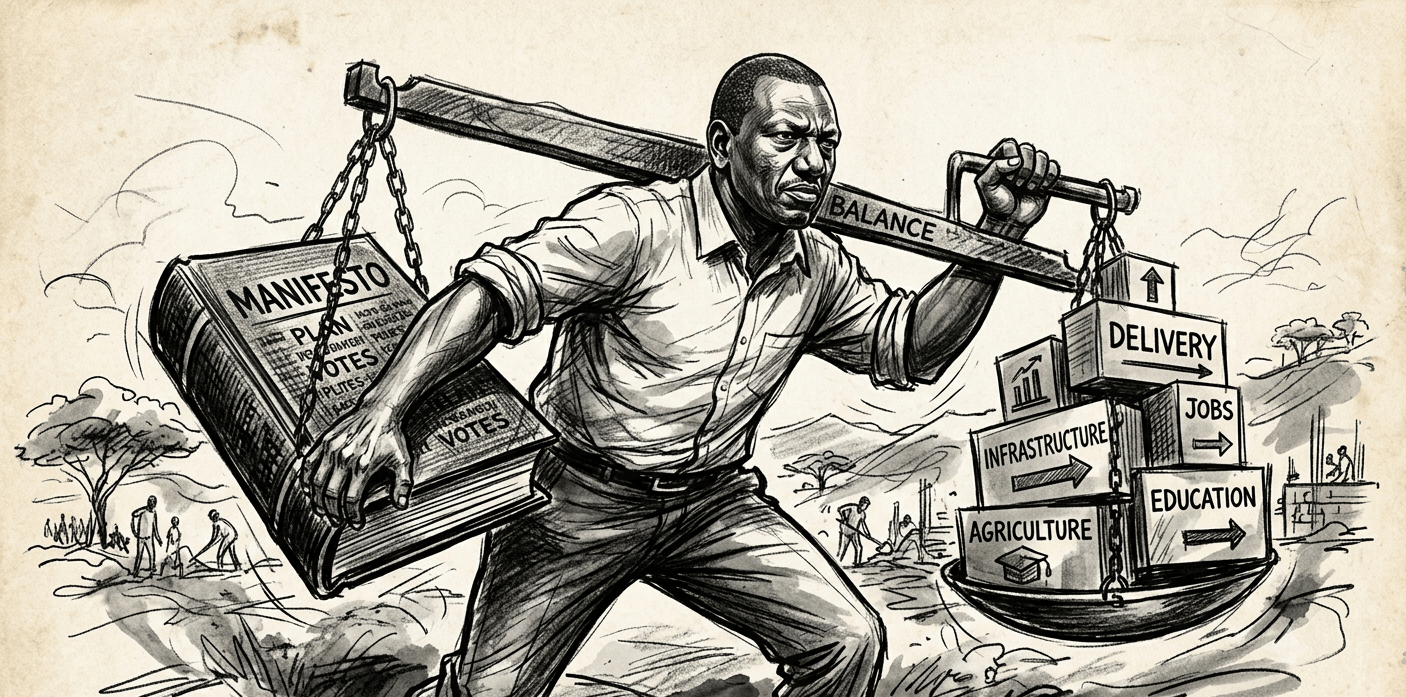
It is a gamble on the “delivery election,” an assumption that voters will prioritise visible progress over the persistent anxieties of the cost- of-living crisis. It is a confident posture, but whether it is an accurate one depends entirely on which scorecard you use.
The challenge for any incumbent is that governing and campaigning are evaluated differently. Opposition leaders campaign on hope. Governments campaign on evidence. And evidence is rarely unanimous.
When Kenya Kwanza unveiled The Plan in 2022, it presented perhaps the country’s most detailed election manifesto in decades. The document rested on one overarching philosophy: Bottom-Up Economic Transformation.
Unlike previous campaigns built around mega- projects or constitutional reform, Ruto’s campaign argued that Kenya’s economic problem lay not at the top of the economy but at its base.
The administration pledged to create jobs by supporting manufacturing and agriculture, lower the cost of living, expand affordable housing, reform healthcare, digitise government services, modernise education, improve infrastructure, increase electricity access and restore confidence in public institutions.
Not every promise was accompanied by precise timelines, but together they formed a governing agenda against which the administration can now reasonably be measured. Nearly four years later, the picture that emerges is neither one of sweeping success nor outright failure. It is considerably more complicated.
Strongest Case
The administration’s strongest case lies in sectors where the government has direct control over implementation. Affordable housing has become the flagship programme of the Kenya Kwanza administration.
Across multiple counties, thousands of housing units are either completed or under construction, supported by the Affordable Housing Levy that survived an extended legal battle before being entrenched in law. Whatever one’s view of the levy itself, the programme has moved beyond political rhetoric into visible physical infrastructure.
Similarly, the government has accelerated market construction, road rehabilitation, electricity connections and public infrastructure projects across the country. The administration has also invested heavily in digitising public services.
Passport processing times have reduced significantly compared with the early years of the administration. Government services continue to migrate onto eCitizen. Digital identity systems have expanded, while artificial intelligence and digital employment have become recurring themes in government policy.
Agriculture has also seen sustained intervention. Subsidised fertiliser programmes have continued, coffee sector reforms have been implemented through new legislation, direct payment systems are reshaping how farmers receive earnings, and sugar sector restructuring has re-entered the policy agenda after years of stagnation.
These are tangible interventions. Unlike campaign promises, they can be photographed, measured and visited. That matters politically.
The Contested
Other manifesto commitments are harder to evaluate because they depend not only on government action but on economic outcomes that voters experience in their daily lives.
The cost of living remains perhaps the Ruto administration’s greatest political vulnerability. Inflation has moderated compared with the post- pandemic highs experienced in 2022 and 2023, while fuel prices have become more stable than many analysts predicted. Yet many households continue to report that everyday life remains expensive.
Food prices, school expenses, rent and taxation continue to dominate public conversation. Economic statistics and household experience do not always move together. The government may point to macroeconomic stability, but voters often answer with supermarket receipts.
Youth employment presents a similar challenge. The administration frequently highlights digital jobs, overseas labour programmes and investments in manufacturing. Critics counter that formal employment growth has not matched expectations, while many graduates continue struggling to find stable work.
Healthcare reforms illustrate another mixed picture. The transition from NHIF to the Social Health Authority represents one of the most ambitious institutional reforms undertaken during the administration. Millions have registered under the new system. Yet implementation challenges, delayed reimbursements, confusion among patients and complaints from healthcare providers have prevented the reforms from achieving universal public confidence.
Whether voters judge it as courageous reform or administrative disruption may depend less on policy design than on their own experience at hospital reception desks.
The Independent Count
There have been various reports seeking to audit the delivery of the Kenya Kwanza manifesto, and all have had varying verdicts. It reflects a fundamental disagreement about what counts as delivery: promises initiated versus promises fulfilled, projects under construction versus projects completed, targets announced versus targets met.
The housing programme illustrates the distinction cleanly. The 2022 manifesto promised 250,000 new affordable units every year. In four years, that would amount to one million homes. The 2025 State of the Nation Address claimed 230,000 affordable homes delivered — the “most extensive housing rollout in our history.”
Even accepting that figure, it represents roughly one year’s worth of the original annual target, spread across nearly four. The Kenya Kwanza manifesto also promised to grow the number of mortgages from 30,000 to 1,000,000 by enabling low-cost mortgages of Sh10,000 and below. No public data suggests the mortgage market has moved anywhere near that figure.
On digital infrastructure, the government committed to constructing 100,000 kilometres of fibre optic networks. It has completed 4,690 kilometres. It promised 25,000 public WiFi spots; it has established 1,563. The trajectory is positive. The scale is not.
Measurable Change
The record is not uniformly thin, as some Kenya Kwanza promises have translated into measurable structural change. The fertiliser subsidy, whatever its imperfect implementation, reached farmers who had never previously benefited from government input support.
SHA, despite serious teething problems with hospital onboarding and claims backlogs, has brought millions into a formal healthcare financing system for the first time.
The Hustler Fund, with 21.87 million individuals enrolled and Sh54.9 billion disbursed since launch, represents a genuinely unprecedented expansion of digital credit access at the base of the pyramid, though the same government has acknowledged a 21 per cent non-performing loan ratio, suggesting the programme has served some borrowers into debt rather than out of it.
The road network is more contested. Ruto promised to deliver 1,000 kilometres of new roads, but his administration has suffered from budgetary constraints, leading contractors to abandon work. What the government has substituted, an ambitious pipeline of highway dualling projects announced in successive State of the Nation addresses, is a vision of a future road network rather than evidence of a current one.
But none of the government’s delivery metrics addresses the question that most ordinary Kenyans are actually asking: has their life become materially better since September 2022?
Inflation surged to 6.7 per cent in May 2026, the highest level since January 2024, driven by a government-authorised fuel price increase of up to 24 per cent following disruptions tied to the Middle East conflict.
Food prices rose 9.4 per cent year-on-year. Transport costs climbed 16.5 per cent. Private sector surveys showed Kenya’s business activity contracting for the second consecutive month, while economists warned that household incomes have largely remained stagnant despite steadily rising living costs.
Kenya’s poverty rate remains at 39.8 per cent, youth unemployment stands at roughly 30 per cent, and the fiscal deficit is forecast to widen to 6.1 per cent of GDP in 2026, well above the government’s own 4.0 per cent medium-term target.
This is the central tension in the delivery election argument. The government can point to the cranes in Kibera, the SHA registration queues, and the fertiliser bags arriving in the highlands.
What it cannot easily account for is the fuel queue, the school fees that went up, and the loan repayment that came due. Infrastructure is visible. The cost of living is felt.
The Re-election Arithmetic
Political science has long recognised that governments are judged less by the total number of projects completed than by whether citizens believe their own lives have improved.
Kibaki won in 2007, albeit controversially, not by campaigning on roads but by riding a wave of genuine economic optimism, GDP growth above six per cent, a booming middle class, and a sense that the future was arriving. Uhuru won in 2017 on an incumbency advantage and a split opposition, not on a widely acclaimed delivery record.
Ruto’s approach reflects what observers describe as ground-up coalition building: rather than relying solely on elite political alliances, he is targeting voters directly through projects. It is a rational strategy, particularly in regions such as Nyanza and Western, where previous administrations left deficits.
Whether it is sufficient depends on whether the voter experiencing a 16.5 per cent rise in transport costs weighs that against the construction site two kilometres away. The delivery election is a gamble. It assumes that Kenyans will judge the government primarily on what has been built rather than what has been lost.
The opposition argues that many of these projects either began under previous administrations or remain incomplete. Government responds that continuity is itself governance and that completion matters more than groundbreaking ceremonies.
Both claims contain elements of truth, as infrastructure rarely belongs exclusively to one administration. Most major projects span multiple governments, and the political reward, however, usually accrues to whoever delivers the finished product.
The government will argue that it inherited a difficult economy, stabilised public finances, expanded infrastructure and implemented long-overdue reforms. Its opponents will argue that taxation increased, living costs remained high, healthcare reforms struggled, and Kenyans have yet to feel the promised economic transformation.
Manifestos are written with certainty, but their implementation unfolds through compromise, economic shocks, court decisions, budget constraints and political realities.
The real question is not whether President William Ruto has implemented his manifesto in full. He has not. Nor is it whether Kenya has seen meaningful progress in several sectors. It has.
The question voters will answer in 2027 is simpler, more personal and ultimately more consequential.
Has the Kenya Kwanza government delivered enough to deserve another five years? That, more than any campaign slogan or political rally, is likely to determine the next presidency.