




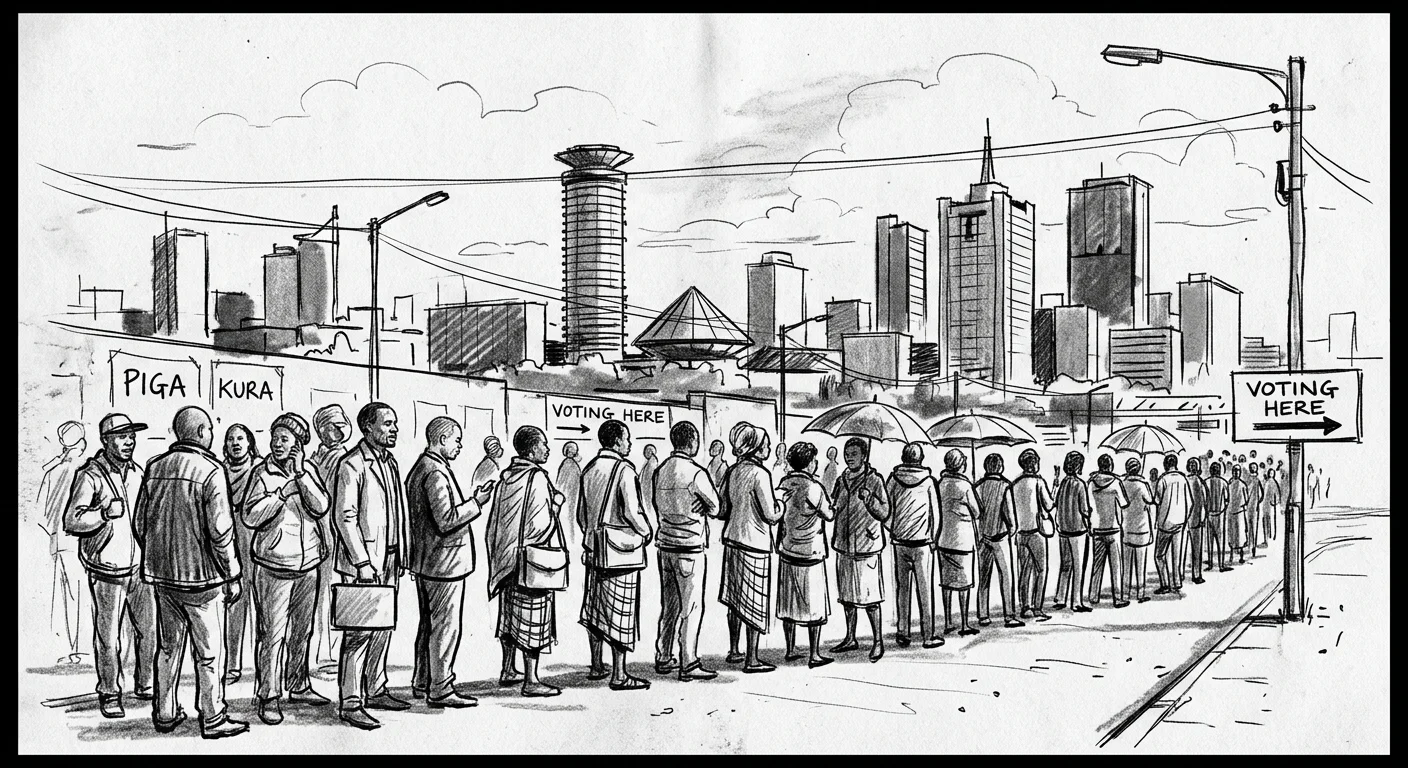
In the days around the Lamu groundbreaking, a court was asked what residents are owed for the land, a High Court judge certified as urgent a petition about what the state is committing to the refinery, a legislator gave the president 14 days to publish the agreement, and the national infrastructure fund’s boss said its first move was to buy government bonds.
None of this proves the project is wrong, but it shows how little the public can check, especially when Kenya’s ambition is not in doubt. The country is building a coastal refinery, a new financing model for roads and ports, and a digital government.
What is in doubt is whether the people asked to pay for it believe the systems delivering it.
This week, The Chronicle Weekly follows the trust chain and asks at each link what happens when confidence breaks. Our answer is that distrust is not only a mood. It is a cost.
How Government Lost Trust
Start with the numbers, because they complicate the usual story. Afrobarometer surveys show trust in the president at 72 per cent in 2014, 62 per cent in 2016, 66 per cent in 2019, 52 per cent in late 2021, and 45 per cent in April–May 2024.
Of the 27-point fall, 20 points came before William Ruto took office, when he was Uhuru Kenyatta’s deputy, and seven came in between late 2021 and April–May 2024, a period that straddles the handover.
Trust in the ruling party followed a similar pattern: 61 per cent in 2014, 32 per cent in 2021, and 38 per cent for the United Democratic Alliance in 2024, now below the 43 per cent for opposition parties.
The latest survey’s fieldwork ended before the June 2024 protests, so it does not capture what followed.
Both administrations lost trust through the same three doors: how power was won and counted, how money was borrowed and spent, and how the state answered those who objected.
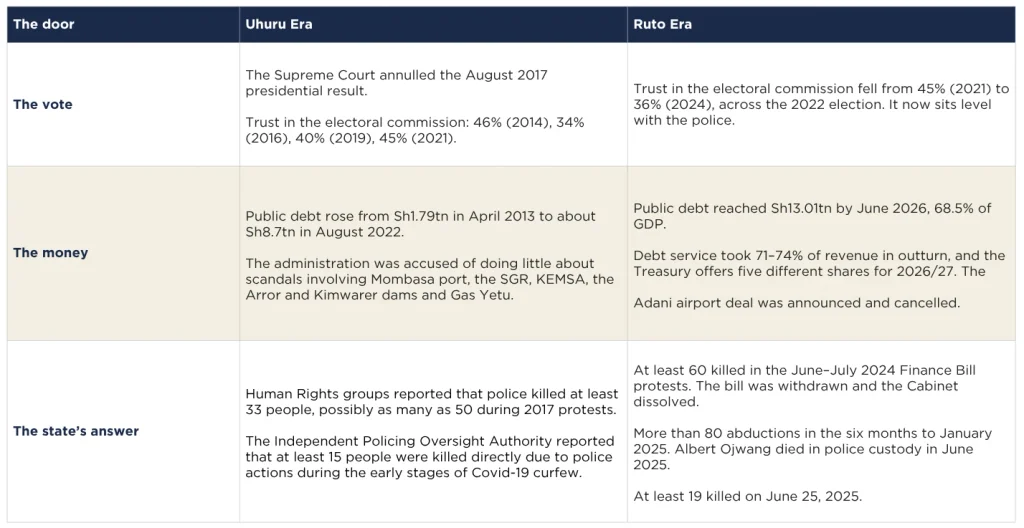
Two cautions. The table records what the sources show, not a verdict on motive, and its rows aren’t symmetrical because the evidence isn’t. And the Afrobarometer series ends in 2024.
Edelman’s 2025 barometer found that 38% of Kenyans trust the government to do what is right, down four points from the year before, which points in the same direction on a different instrument.
Where The Chain Breaks
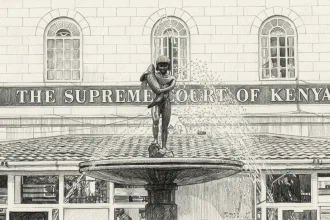
Institutions are where the numbers vary most. Trust in the courts peaked at 57 per cent in 2019, which Afrobarometer says may owe something to the Supreme Court’s annulment of the 2017 result: a court that checked the executive earned trust. It stood at 50 per cent in 2024.
The judiciary reported clearing 104 per cent of the cases it received in 2024/25, yet only 47 per cent of Kenyans think they could afford to bring a case, and 3 per cent would go to a formal court first
The information is more complicated than our premise assumed.
The Reuters Institute’s 2026 survey of connected Kenyans, as reported, found trust in news at 68 per cent, among the highest in its sample, and 62 per cent using WhatsApp for news weekly, up from 46 per cent a year earlier.
Edelman’s 2025 survey found 56 per cent of Kenyans finding it harder to tell credible journalism from misinformation. People trust the outlets they use and doubt the system around them.
Money is where the chain is least clear. For 2026/27, official or reported answers on how much revenue goes to debt run from 40 per cent to 91 per cent. The outturn has been 71–74 per cent.
A government that asks citizens to believe in a new financing model cannot offer five numbers for the old one.
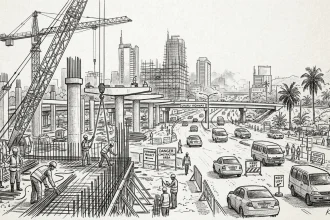
Projects are where the cost shows. Each way Kenya has paid for a flagship since 2013 moved the risk without removing it.
The SGR left taxpayers with the loan. The Expressway left its operator with a loss and the state with an additional bill. Public pressure collapsed the Adani deal.
The infrastructure fund is the fourth model. Its first move was to buy government bonds, and its first major interest is Lamu, where the Treasury says Kenya has been allocated 10 per cent and no agreement has been published
At Lamu, the disputes began before the first shovel: land, compensation, disclosure and participation.
Citizens have built their own systems.
Daily mobile money use reached 52.6 per cent of adults in 2024, up from 23.6 per cent in 2021, while 3 per cent would go to a formal court first with a legal problem, and Edelman found 66 per cent hesitant to trust people unlike themselves
Those systems work for people with a phone, an ID and a network. They leave out the 9.9 per cent of adults who remain financially excluded.
What Cuts The Other Way
This isn’t an anti-government issue, and some of what we found weakens our case. The courts are clearing more than they receive. The SGR was delivered at its headline cost.
Trust in the ruling party recovered between 2021 and 2024, and only 43 per cent trust opposition parties, so distrust of the government has found no home elsewhere.
The opposition has yet to name a candidate or, as far as we could find, publish a joint platform.
We have applied one standard to government, opposition, courts, media and citizens: can the public check what it is being asked to believe?
The cost takes three forms. The first is time. Lamu is already in court over land and disclosure, and the Adani deal took 15 months from announced cancellation to formal termination.
The second is protection. A tenfold multiplier on public seed capital needs private investors to accept the terms, and investors price risk; the refinery’s owner has said it will need government protection from cheaper imports.
The third is exclusion: workarounds that serve the connected and leave out the rest. What happens to a country when ambition grows faster than confidence in the institutions expected to deliver it?
It pays: in delay, in terms it cannot see, and in systems that work for those who can reach them. Kenya does not have to choose between ambition and trust. It has to stop asking for the first while spending the second.