




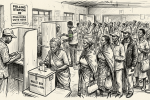


Kenya’s ‘Gen Z’ movement has emerged as a powerful force, reshaping the country’s political landscape through leaderless, digitally driven protests that began with opposition to the Finance Bill 2024.
From Nairobi to Mombasa, young Kenyans have taken to the streets and social media platforms, demanding accountability, transparency, and an end to systemic issues like corruption, unemployment, and police brutality.
A generation that was once dismissed as apathetic, distracted by social media, or too young to care has risen with a force that stunned the nation.
As the movement gains momentum, analysts and observers argue that its energy must now be channelled into structured political participation, specifically, organising for the 2027 elections and safeguarding the integrity of the vote.
Why Getting Organised Matters
The Gen Z movement’s strength lies in its decentralised, youth-led nature, fueled by digital platforms like X and TikTok.
However, this lack of formal structure, while effective for mobilising protests, limits its ability to influence policy or hold leaders accountable beyond street demonstrations.
But protests, no matter how massive, have limits. Governments can wait them out, make token concessions, or even crush them with brute force. History has shown us that without a clear path to political power, movements fade.
The energy of the Arab Spring dissolved into disillusionment. Occupy Wall Street never translated into policy. Even in Kenya, past uprisings, like the 2017 resistance, failed to produce lasting change because the anger was never channelled into electoral strength.
Posts on social media reflect a growing sentiment among Kenyans that Gen Z must organise politically to secure representation in parliament.
Without candidates or a unified platform, the movement risks remaining a pressure group rather than a transformative political force.
The ‘Gen Z’ movement could draw lessons from previous elections where frontrunners organised themselves to ‘protect the vote’. Many in the older generations know that it is not the voting that counts, but the vote that is counted that carries the day.
In 2022, the so called ‘hustler nation’ that backed President William Ruto put this into practice, especially with the fear that then President Uhuru Kenyatta’s operatives could use the state machinery to ‘engineer’ the vote in favour of Raila Odinga.
The parallel UDA tally system was a result of this organisation of the ‘hustler nation’ to be at each of the 43,000 polling stations to ‘guard the vote.’
Additionally, Kenyan elections are often stolen not just at the ballot box, but in the shadows, through voter suppression, manipulated tallies, and outright fraud.
The ‘Gen Z’ movement, with its tech-savvy and social networks, is uniquely positioned to fight back. Mass voter registration, citizen monitoring at polling stations, and real-time crowdsourced results could make rigging far harder.
Opportunity for ‘Gen Z’ movement
The 2027 general elections present a critical opportunity. Kenya’s youth, comprising over 75 per cent of the population under 35, hold significant voting power.
Yet, many young Kenyans are not active voters, either by choice or due to systemic disenfranchisement. The movement’s ability to mobilise millions online, evidenced by the viral #RejectFinanceBill2024 campaign, demonstrates its potential to drive voter registration and turnout.
By fielding candidates who reflect their values, the ‘Gen Z’ movement can challenge the entrenched political class, which has been criticised for co-opting opposition leaders like Raila Odinga to maintain power.
Political organisation would allow the movement to translate its demands for economic democracy, job creation, and accountability into actionable policies through elected representatives.
Kenya’s electoral history is marred by allegations of fraud, vote rigging, and post-election violence, notably in 1992, 1997, and 2007. These issues have eroded public trust in electoral institutions, with young Kenyans being particularly sceptical of the process.
For the ‘Gen Z’ movement players to ensure their votes translate into meaningful outcomes, they must prioritise mechanisms to safeguard electoral integrity.
The movement’s tech-savvy nature positions it uniquely to address this challenge. Grassroots innovations leveraging AI and open-source tools are already being developed to enhance electoral transparency.
For instance, civic technology initiatives are creating accessible databases to track public officials’ performance and financial disclosures, which could extend to monitoring election processes. These tools can help verify results, detect irregularities, and ensure accountability at polling stations.
On social media, users have proposed crowd-sourcing funds to place the movement’s representatives at every polling station and establish independent vote-counting centres for presidential elections.
Such initiatives could counter systemic issues like delayed results or manipulation by the Independent Electoral and Boundaries Commission (IEBC), which has faced criticism in past elections.
By training youth as party agents and leveraging technology to monitor vote counting, the ‘Gen Z’ movement can build a robust system to protect their democratic voice.
But Not Without Challenges
Organising for elections is not without obstacles. The movement’s decentralised structure, while a strength in protests, could hinder consensus-building around candidates or a unified agenda.
Deep mistrust of political processes, fueled by years of corruption and unfulfilled promises, may discourage some youth from engaging in electoral politics.
Additionally, the government’s response to protests, marked by police brutality, abductions, and media crackdowns, raises concerns about the safety of activists transitioning into political roles.
Moreover, the risk of co-optation looms large. Ruto has a history of neutralising opposition through strategic alliances, as seen with Raila Odinga.
The ‘Gen Z’ movement must remain vigilant to avoid being absorbed into the existing political system without securing structural reforms.
To succeed, the ‘Gen Z’ movement should focus on three key strategies. First, it must launch a nationwide voter registration campaign, using digital platforms to reach the 17 million-plus youth demographic.
Second, it should identify and support candidates who align with its values, ensuring representation that prioritises economic justice and accountability.
Third, it must invest in civic technology to monitor elections, from voter registration to result tabulation, in order to prevent fraud and restore trust in the process.
The movement’s invocation of historical struggles, such as the Mau Mau and Saba Saba protests, underscores its understanding of Kenya’s fight for democracy.
By organising for 2027 and protecting the vote, the ‘Gen Z’ can build on this legacy, turning their rage and resistance into a revolution at the ballot box.
The time to act is now, before the momentum fades and the old guard regains control.