



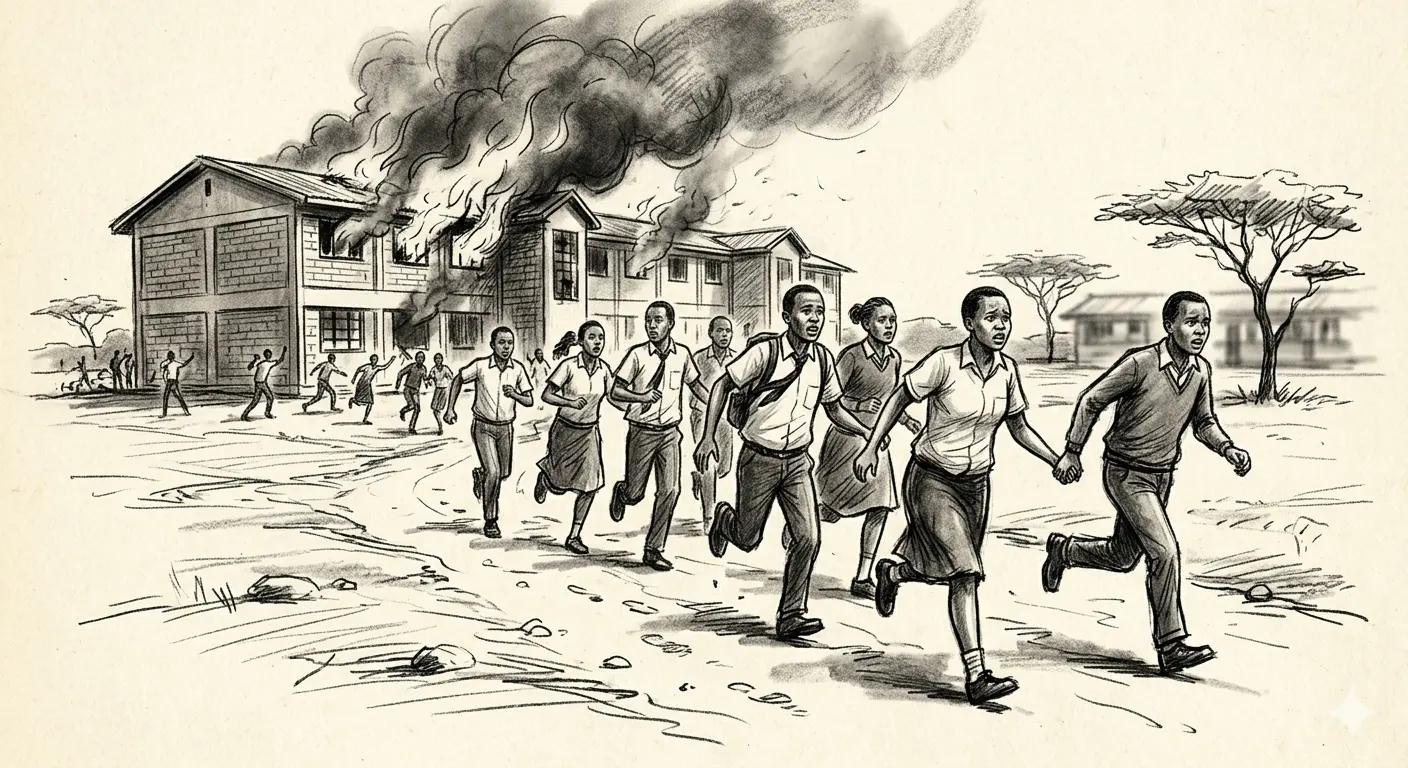
In the early hours of 28 May 2026, a fire tore through the Meline Waithera Dormitory at Utumishi Girls Senior Secondary School in Gilgil, Nakuru County. Sixteen students were killed, and 79 others were injured. Of those hospitalised, 71 were later discharged. Seven remained admitted.
Within 48 hours, eight students had been arrested as persons of interest, and the Directorate of Criminal Investigations had launched a full homicide inquiry, with CCTV footage reportedly placing five students inside the dormitory minutes before the fire broke out.
The Education Cabinet Secretary dissolved the school’s Board of Management, citing failure to comply with the School Safety Manual and Basic Education Regulations, specifically overcrowding in the dormitory and a locked exit door that worsened the evacuation.
It also emerged that two teachers had been informed of planned unrest by Form Three students more than a week before the fire, but took no preventive action.
The nation mourned. Officials visited. Investigations were launched. We have been here before.
A Timeline Written in Ash
The confirmed death toll from these headline incidents alone exceeds 200. It does not include the scores of smaller fires at Isiolo Girls, Njia High School in Meru, Bukhalarire Secondary in Busia, Kakamega High School, BuruBuru Girls, and dozens of others, almost all forgotten in national conversations within weeks.
Empirical records document at least 750 arson attempts in boarding secondary schools from 2008 through the 2010s alone.
Over the years, the government has constituted several commissions, committees and task forces to investigate school fires and recommend safety improvements
The Kirima Commission of 1994, the Wangai Task Force of 2001, and the Koech Committee of 2008 each produced recommendations, and each was largely shelved.
After Endarasha in 2024, President Ruto directed the Education and Interior ministries to ensure compliance with boarding school regulations and ordered a nationwide safety audit involving the Ministry of Health, the Department of Public Works, county governments, and the Red Cross.
The government promised to prosecute violators. Less than two years later, Utumishi burned. The pattern is not incidental. It is institutional. Kenya does not lack policies on school safety. It lacks the will, the resources, and the accountability mechanisms to enforce them.
What Is Actually Broken
Three distinct but interconnected failures explain the persistence of this crisis.
A 2024 report by the Usawa Agenda found that most boarding schools are unsafe for children, with spacing between student beds below the required guidelines. Less than half of the surveyed schools adhered to safety guidelines, with issues ranging from faulty structures to missing fire extinguishers.
Data from the Kenya Fire Protection Association indicates that over 60 per cent of school fires are attributable to electrical faults, meaning that even fires not caused by deliberate arson are products of neglected infrastructure.
Kenya’s public boarding schools are chronically stretched beyond capacity. When dormitories are packed beyond design limits, safety margins collapse, and so do evacuation prospects when fire starts at 1am.
Boarding schools have taken on an almost militarised approach; strict regimes, draconian rules, manual labour, restricted communication with the outside world, and limited student voice in decisions that govern them.
Research by Prof. Teresa Wasonga of Northern Illinois University found that student violence was a response to a devaluing and oppressive environment.
There is a strong case for school administrators providing formal means of representation and democratic decision-making to mitigate conditions that lead to strife.
A 2023 report by the Kenya Institute of Curriculum Development warned that students in boarding schools often feel isolated, overwhelmed, and unheard.
At Kaplong Girls in Bomet, complaints of sexual harassment went unaddressed for weeks until unrest broke out. At Ngara Girls in Nairobi, allegations ranging from sexual abuse to emotional abuse and tribal profiling had been raised but not resolved.
Fire, in too many of these cases, is not the cause; it is the endpoint of a chain of ignored signals.
Beyond the Blame Game
The charging of students, the dissolution of a board, and the suspension of teachers are appropriate immediate responses.
They are not solutions. They address the act without addressing the conditions that produced it. What does a genuine solution look like?
It begins with mandatory, independently verified safety audits of every boarding school in Kenya, not announced inspections that allow institutions to prepare, but surprise assessments with legally binding compliance timelines and real consequences for principals and county education officials who sign off on unsafe facilities.
It requires a national programme to reduce boarding school overcrowding, which means expanding day school options, investing in transport infrastructure, and resisting the political pressure to admit beyond capacity in the name of access statistics.
It demands the depoliticisation of school governance. Too many Board of Management appointments are patronage exercises. Too many principals report upward to officials who have an interest in quiet schools rather than safe ones
An independent school inspectorate, with ring- fenced funding and reporting directly to Parliament, would change those incentives.
Most fundamentally, it requires a rethinking of what boarding school is for. The model Kenya inherited, total separation from family, quasi- military discipline, and examination above all else, was designed for a different era.
These draconian rules are not relevant to today’s crop of students, who arrive with different expectations of dignity, communication, and participation.
The children in dormitories across Kenya tonight are not problems to be managed. They are citizens in formation, entitled to safety, voice, and care.
Twenty-five years after Kyanguli, the questions are the same. The task forces are the same. The presidential statements are the same. The only thing that keeps changing is the names of the schools and the numbers of the dead.
The next fire is not inevitable. It is predictable, which means it is preventable. Kenya has had every report it needs. What it has never had is a government that treated implementation as seriously as it treats mourning.