


On June 25, 2026, the second anniversary of the day protesters stormed Parliament, families of the dead attempted to lay wreaths at the building’s gates. They were met with barbed wire.
The wreath-laying happened anyway, against the wire, in the gap between what the country’s constitution promises and what its security forces permit. It was, in its quiet way, the perfect image for what accountability in Kenya looks like two years on from the most significant episode of state violence against civilians in a generation.
The facts of what happened in the weeks around June 25, 2024, are not seriously in dispute. The Kenya National Commission on Human Rights documented at least 63 deaths, 610 injuries, and 74 enforced disappearances. Amnesty International reported at least 60 killings.
The Missing Voices Coalition recorded 104 police killings in 2024 and 125 in 2025. According to the Human Rights Watch World Report 2026, 26 people linked to the 2024 protests and 15 linked to the 2025 demonstrations remain missing.
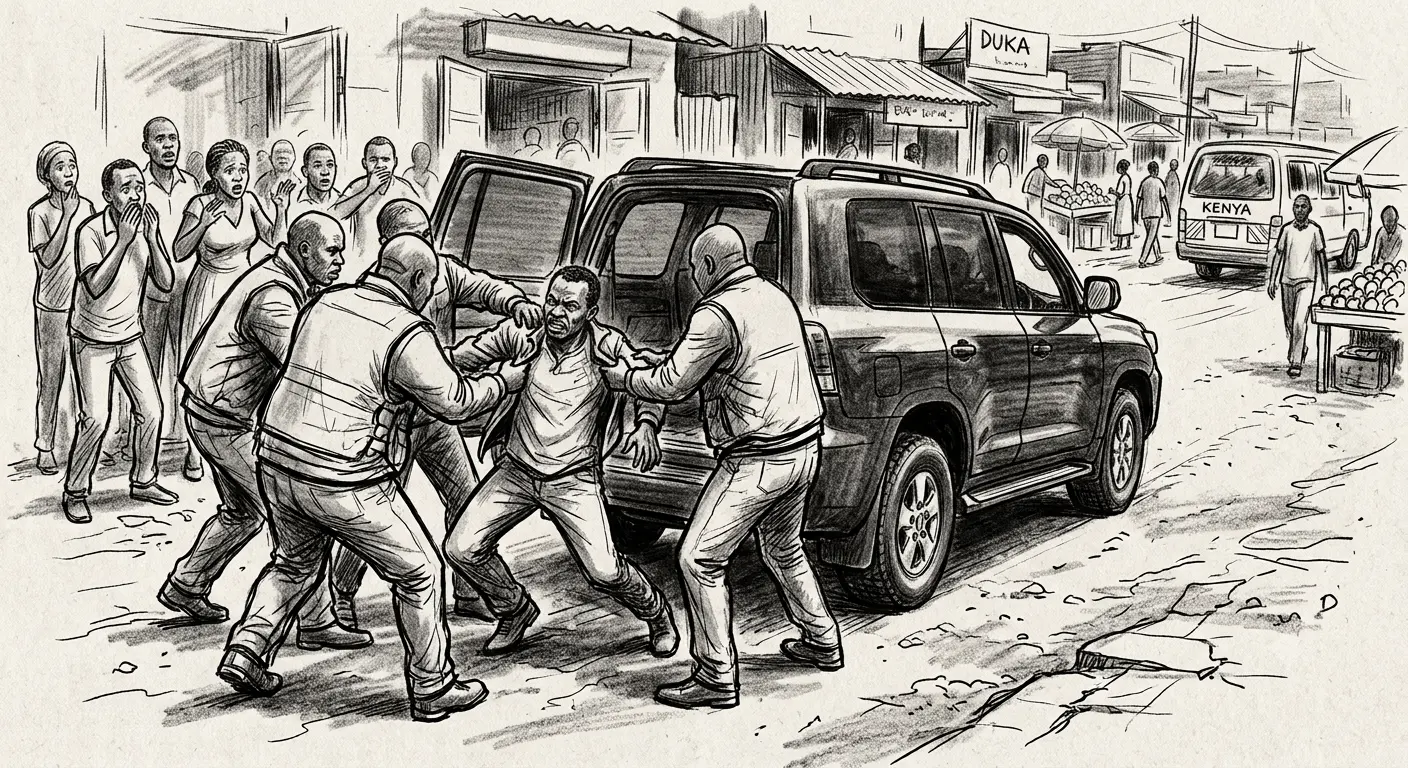
The KNCHR has separately documented more than 83 cases of abductions and enforced disappearances since June 2024. Survivor testimonies describe the same operational pattern: plain-clothes officers, Subaru vehicles, movement through multiple police stations, incommunicado detention.
The violence did not end in 2024. It continued. When protesters gathered in June and July 2025 to commemorate the killings, police again opened fire.
41 people died during the Saba Saba protests alone, including 12-year-old Bridgit Njoki, shot in the head by a bullet that pierced the roof of her home while she watched television.
Then, on the second anniversary, just four days before this issue went to press, five activists who had been arrested at Parliament Road resurfaced at Nairobi Women’s Hospital with injuries, alleging they had been abducted, beaten, and asked whether they had funded the protests, before being dumped in different parts of the city. A sixth activist, Davis Lichuma, remained missing.
“We were beaten so badly. I cannot even walk,” one of the five told journalists. “Why not take us to court if they thought we had committed an offence?” It is a fair question. It has not received a fair answer.
What the Government Has Offered
President Ruto’s response to the accountability crisis has taken two forms. The first is rhetorical: in May 2025, he said there was “an accountability mechanism” to bring those responsible to justice.
The second is financial: the government has allocated Sh2 billion for compensation of victims of human rights violations committed during protests between 2017 and 2025, with the KNCHR’s Panel of Experts establishing a voluntary programme covering 348 verified victims.
“A nation does not heal by choosing whose pain matters,” Ruto said when receiving the KNCHR report. “It heals by acknowledging all suffering, pursuing justice for all.”
The families of the missing have responded to that framing with a consistent, specific objection: compensation is not accountability. They say that the money will not be enough as long as those responsible are not held to account.
The Independent Policing Oversight Authority has published updates tracking three waves of protest deaths: 2024, the June 2025 commemorations, and the Saba Saba July 2025 protests, totalling 127 reported deaths under active investigation.
One case has reached court: the inquest into the killing of Rex Masai, with a plain-clothes police officer placed at the centre of the case. A second prosecution involves Constable Klinzy Baraza Masinde, charged with shooting mask vendor Boniface Kariuki during the 2025 demonstrations.
Two cases, against 127 documented deaths. The gap is not a function of the law’s inadequacy; Kenya’s constitution, the IPOA Act, and the penal code all contain provisions capable of sustaining prosecution of security officials for unlawful killing.
The gap is a function of what Kalonzo Musyoka described the day before the second anniversary as “investigative failures”; the evidence required to secure justice, he argued, was never gathered.
Even where prosecution proceeds, an officer may walk free not because innocence was established, but because the case was never built to the standard required to secure a conviction.
The Constitutional Question
Kenya’s constitution does not merely prohibit arbitrary arrest, torture, and extrajudicial killing. It requires the state to investigate and prosecute violations of those rights.
Article 49 guarantees the right of every arrested person to be informed of the reason for their arrest and to be brought before a court within 24 hours. Article 25 lists the rights that cannot be limited under any circumstances, including freedom from torture and the right to a fair trial.
The pattern documented across 2024, 2025, and now the June 2026 anniversary protests is not consistent with the legal framework Kenya gave itself in 2010. That is not an opposition talking point. It is an observable fact documented by the government’s own human rights commission.
What distinguishes Kenya’s current accountability moment from its post-2007 equivalent is that in 2008, there was at least a formal architecture of international and domestic accountability: the KNDR, the ICC referral, and a Truth, Justice and Reconciliation Commission.
In 2026, the architecture is thinner: an IPOA with 127 deaths on its docket, a voluntary compensation programme, and two active prosecutions.
The families laying wreaths against barbed wire are not asking for symbolic gestures. They are asking a question the government has not yet answered: who gave the orders?
Until that question is answered, Kenya’s 2010 constitutional commitment to the right to life and to accountability for its violation remains, in this specific and documented domain, a promise the state is actively breaking.