




The Ol Kalou by-election was widely framed as a political showdown between President William Ruto and former Deputy President Rigathi Gachagua. It was certainly that.
However, it also revealed something less obvious: that elections have become major economic events, sustaining businesses, creating temporary jobs, and generating commercial activity that stretches far beyond politics itself.
When campaign caravans rolled into Ol Kalou, they brought far more than politicians seeking votes. They arrived with fleets of four-wheel drives, fuel tankers, public address systems, photographers, videographers, livestream crews, event organisers, caterers, security personnel and hundreds of young people hired to mobilise crowds, erect stages and coordinate logistics.
Hotels filled with campaign teams, restaurants stayed open longer to serve the influx of visitors, printers worked overtime producing campaign posters and branded merchandise, while boda boda riders and taxi operators found themselves ferrying politicians, journalists and supporters across the constituency.
For several weeks, politics became the local economy.
When the votes were counted and the campaign ended, much of that activity disappeared almost as quickly as it had emerged. The temporary jobs dried up, the campaign convoys moved on and the businesses that had enjoyed a sudden surge in demand returned to normal.
Yet the by-election offered an important reminder that Kenya’s elections are no longer simply democratic exercises. They have become significant economic events that support a vast network of businesses and workers long before a single ballot is cast.
The financial cost of elections is usually discussed in terms of what political parties spend or what the Independent Electoral and Boundaries Commission budgets for polling day.
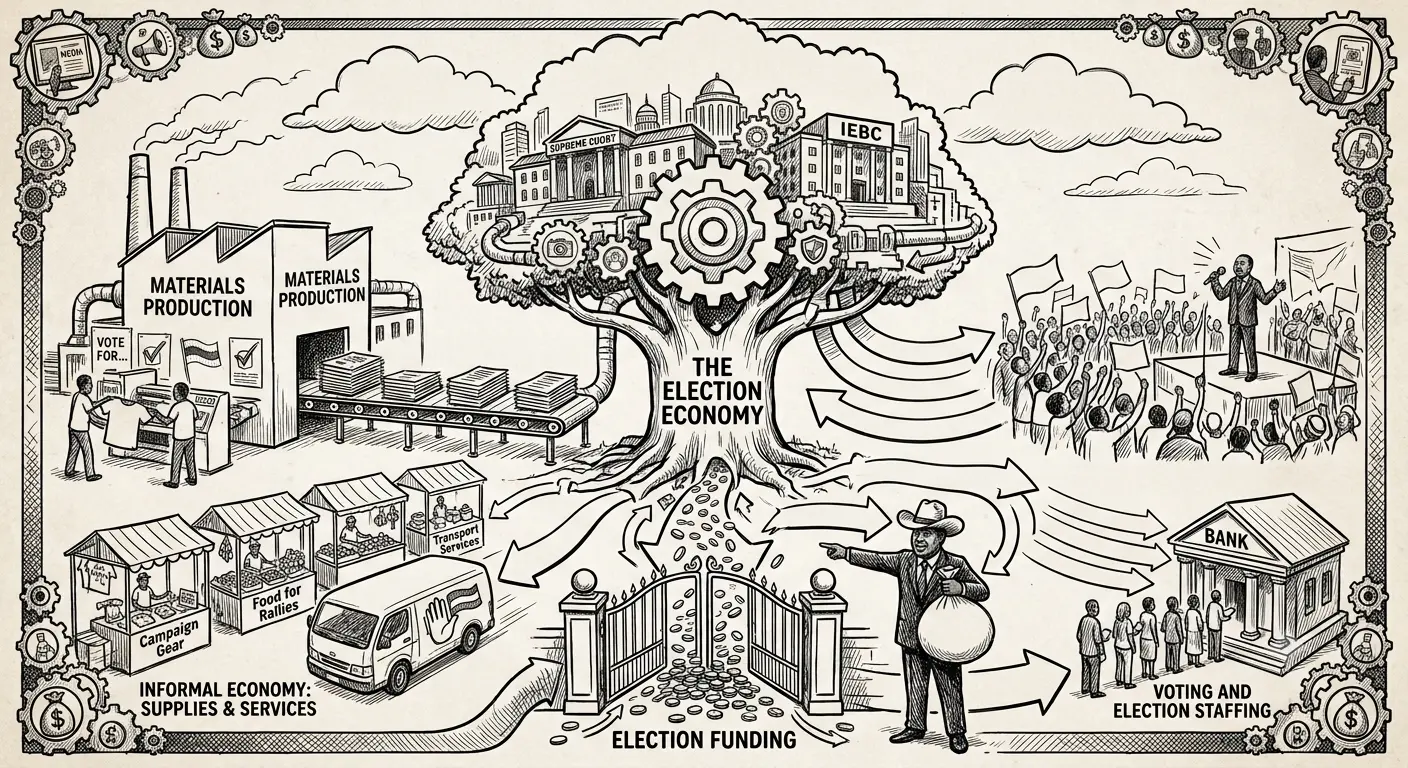
Less attention is paid to the broader economic ecosystem that campaigns create. Modern elections resemble temporary industries, generating demand across sectors that have little to do with politics on the surface but depend heavily on campaign activity whenever the country heads to the polls.
Today’s campaigns are sophisticated operations that function much like medium-sized companies. They employ logistics managers, communications consultants, pollsters, photographers, videographers, graphic designers, social media specialists, event planners and security coordinators.
Every rally requires transport, fuel, tents, sound equipment, catering, accommodation and publicity. Increasingly, campaigns also spend heavily on digital advertising, influencer marketing, data analytics and livestream production as political communication shifts online.
Politics has, in effect, become one of Kenya’s fastest-growing service industries.
Unlike conventional industries, however, its activity comes in intense bursts around elections and by-elections. The Ol Kalou contest demonstrated just how concentrated that economic activity can become.
Although it involved fewer than 100,000 voters, the campaign attracted national political leaders, media houses and campaign teams from across the country, injecting money into the local economy for weeks. Every convoy stopping at a shopping centre meant increased business for food vendors and fuel stations. Every political rally created opportunities for local traders, transport providers and casual labourers.
The Business of Mobilisation
The structure of campaigning has also changed significantly over the past decade. Political parties no longer rely exclusively on their traditional grassroots networks. Instead, they increasingly outsource mobilisation to specialised groups and individuals.
Youth organisations organise crowds, boda boda riders escort political convoys, photographers provide instant social media content, and digital creators produce campaign videos within minutes of rallies ending.
Professional livestream teams ensure campaign messages reach audiences far beyond the constituency, while influencers amplify political messaging across multiple online platforms.
This has created entirely new economic opportunities. Political communication has become a market in its own right, providing income for thousands of young Kenyans with skills in photography, graphic design, video editing and digital marketing.
The distinction between volunteers, supporters and temporary workers has become increasingly blurred. While some attend campaign events out of genuine political conviction, others do so because elections have become a reliable source of seasonal employment.
The economic ripple effects extend much further than campaign headquarters. Every poster begins with paper suppliers and printing companies. Every branded T-shirt or cap supports textile businesses and merchandise producers. Caterers, electricians, sound technicians, transport companies and local food vendors all become part of the political supply chain.
Even small businesses benefit from the temporary influx of campaign workers and journalists who require accommodation, meals and transport throughout the campaign period.
Unlike investment in manufacturing or infrastructure, however, campaign spending rarely creates lasting productive assets. It stimulates economic activity but leaves little behind once the election ends. The jobs are temporary, the contracts expire, and the money moves on to the next political contest.
The intensity of spending witnessed in Ol Kalou also reflects the strategic importance of the Mt Kenya region. It is not simply one of Kenya’s largest voting blocs but also among its most economically significant regions, contributing substantially to agriculture, manufacturing, trade and entrepreneurship.
Political dominance in Mt Kenya, therefore, carries implications far beyond parliamentary representation. It shapes investor confidence, influences business perceptions and affects the calculations of political financiers preparing for future elections.
This helps explain why parties commit enormous resources even to local contests. Winning a by-election in Mt Kenya is not only about securing an additional parliamentary seat. It is about demonstrating organisational strength, signalling regional influence and convincing supporters and financiers that a political movement retains momentum heading towards the next general election.
Campaign expenditure should therefore be understood as an investment rather than simply a cost. Candidates invest in visibility, parties invest in organisational networks, and political financiers invest in relationships that may deliver influence, appointments or commercial opportunities long after the election is over.
In many cases, the campaign itself is merely the beginning of a much longer political and economic relationship.
The Permanent Campaign Economy
The rapid growth of digital communication has made campaigns even more resource-intensive. Where political spending once focused largely on rallies and printed posters, today’s campaigns require professional video production, drone footage, social media advertising, rapid-response communications teams and increasingly sophisticated data analysis.
Political parties now operate much like media organisations, publishing content continuously, monitoring engagement metrics and refining their messaging in real time. Winning public attention has become almost as important as winning votes.
Yet this raises broader questions about Kenya’s political economy. How much entrepreneurial energy is channelled into elections instead of productive industries?
How many talented communications professionals spend years moving from one political campaign to another because politics offers more reliable income than journalism, marketing or entrepreneurship?
How much capital circulates within politics because electoral competition promises quicker returns than investment in manufacturing or innovation?
These are uncomfortable questions because they suggest that elections have become more than democratic exercises. They have become economic ecosystems that sustain businesses, create jobs and distribute money across entire sectors of the economy.
The temptation will be to remember the Ol Kalou by-election solely in terms of who won and who lost. That is the immediate political story. The more enduring story, however, is that Kenya has developed what amounts to a permanent campaign economy.
Political activity no longer begins a few months before a general election. It continues almost without interruption through by-elections, coalition negotiations, party launches, political tours and digital mobilisation.
For many businesses, politics is no longer an occasional disruption to economic life. It has become an integral part of it.
As the country edges closer to the 2027 General Election, more constituencies will experience what Ol Kalou has just witnessed: campaign convoys, temporary jobs, booming local businesses and millions of shillings changing hands.
The public debate will focus on who wins the vote. The more revealing question may be who profits from the campaign long before voters ever reach the ballot box.