





Kenya’s prison system has become an unlikely global reference point. When the United Nations Office on Drugs and Crime went looking for a country to prove that prisons and communities can work together, it picked Kenya.
Prison Matters 2026, UNODC’s annual global survey, devotes its entire case-study section to the Kenya Prisons Service (KPS), praising a system that, on paper, has spent two decades quietly dismantling the walls between cells and civil society.
Read past the praise, though, and the report’s own evidence tells a less comfortable story: a state that has learned to let others do its job, without ever building a way to take that job back.
The report singles out Kenya as an example of how prisons can work with communities, churches, universities and former inmates to rehabilitate offenders. Yet the same report paints a stark picture of a system buckling under overcrowding, lengthy pre-trial detention and chronic resource shortages.
The contradiction reveals the limits of reform when the criminal justice system continues sending more people to prison than the system was designed to hold.
For decades, Kenya’s prisons have largely featured in public debate as places of punishment, crowded, underfunded institutions that only attract attention after jailbreaks or allegations of abuse, and the report suggests the picture is more complicated.
Rather than profiling countries with the world’s largest prison populations or the harshest conditions, UNODC selected Kenya as its principal field study for this year’s global report on prison-community engagement.
Researchers spent April and May this year interviewing prisoners, prison officers, former inmates and civil society organisations working inside correctional facilities around Nairobi to understand how rehabilitation actually happens.
That decision places Kenya in an unusual position. It is simultaneously presented as a country with innovative prison reforms and as one still struggling with some of the oldest problems facing correctional systems across Africa.
A System Under Pressure
The numbers illustrate the scale of the challenge. According to the report, Kenya held 59,013 prisoners in 2024. Of these, 22,438 (about 38 per cent) were people who had not yet been convicted but were awaiting the conclusion of their cases.
The prison population exceeded official capacity by 73 per cent, making overcrowding one of the defining features of the system. Women accounted for less than eight per cent of inmates.
These figures broadly mirror wider African trends. Across the continent, around 34 per cent of prisoners remain in pre-trial detention, while nearly nine in every ten African countries operate prisons beyond their intended capacity.
UNODC identifies overcrowding as one of the greatest barriers to rehabilitation because it strains staff, reduces access to education and counselling, and undermines basic living conditions.
The report also notes that Africa records some of the highest levels of prison overcrowding globally, alongside the Americas, with nearly two-thirds of countries worldwide now operating prisons above their intended capacity.
For Kenya, this means that even well-designed rehabilitation programmes are competing against the daily realities of congestion. Yet the report’s most significant finding is not about overcrowding.
Instead, UNODC argues that Kenya has quietly developed one of the continent’s most mature models of community engagement inside prisons.
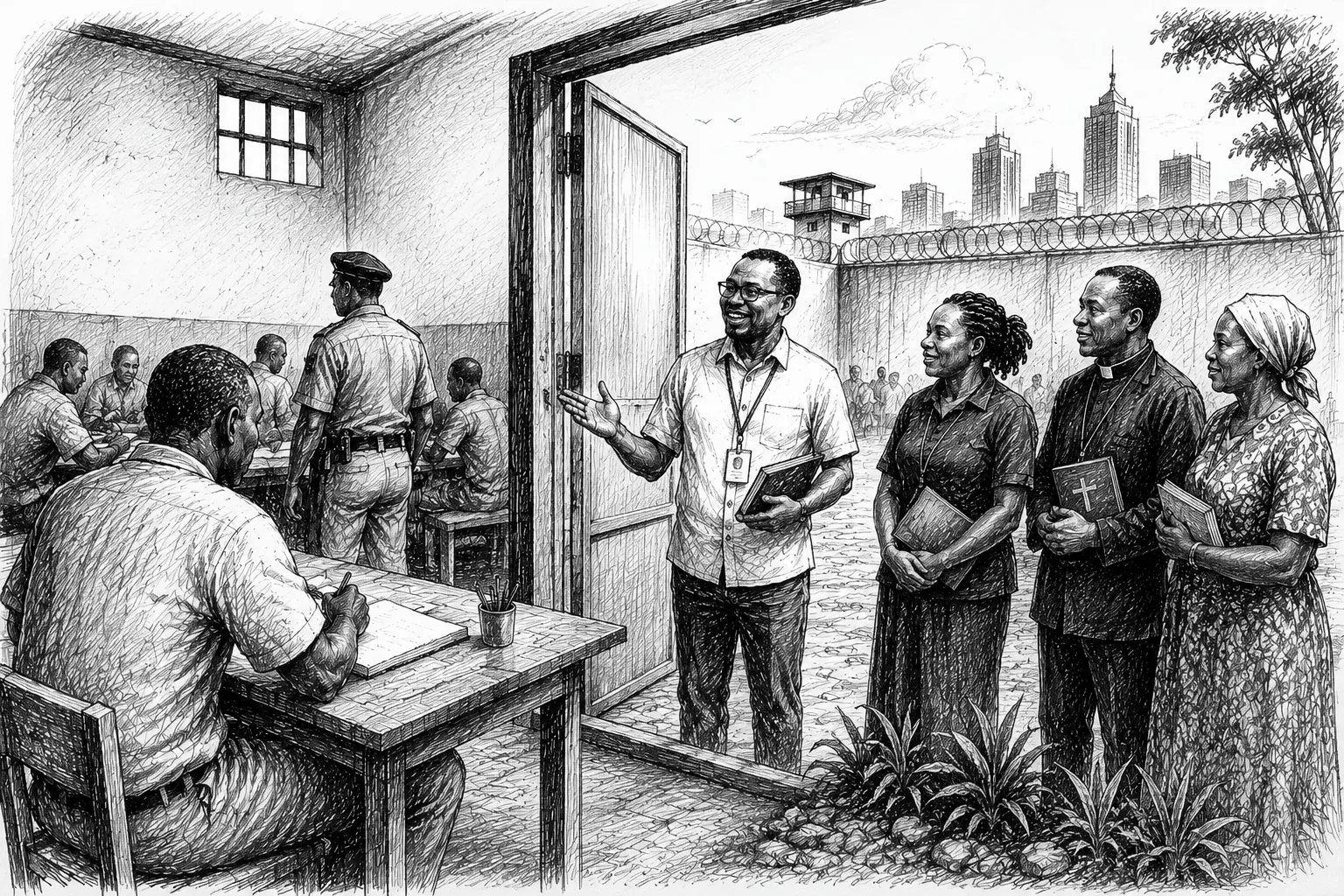
Researchers trace this transformation to the “Open Door Policy” introduced in 2001 following prison reform efforts that sought to dismantle the isolation inherited from the colonial prison system.
Rather than keeping prisons closed institutions, the policy encouraged churches, civil society organisations, educators, legal aid groups, psychologists, employers and volunteers to become active participants in prison life.
One community organisation interviewed by UNODC described the policy’s effect in simple terms: it “opened the walls of prisons, and people walked into prisons and started seeing prisoners as human beings.”
Today, according to the report, volunteers ranging from faith-based organisations to vocational trainers, legal aid providers and psychosocial counsellors are embedded across many of Kenya’s 134 prisons, although access remains uneven, with larger urban prisons receiving considerably more support than smaller facilities.
Beyond Punishment
UNODC argues that these partnerships do more than provide services, and community involvement changes prison culture itself.
Its global survey found that jurisdictions with strong community participation reported improvements in prisoner well-being, education, preparation for release and eventual reintegration into society.
Community actors also helped reduce stigma by maintaining links between prisoners and the outside world before release.
This matters because international evidence increasingly suggests that rehabilitation begins long before prisoners leave custody.
Employment training, family support, education, counselling and faith-based programmes all improve the chances that former prisoners successfully reintegrate instead of returning to crime.
UNODC therefore argues that prisons should not operate as isolated institutions but as part of broader community networks.
The report is careful, however, not to romanticise Kenya’s experience with repeated emphasis that community organisations cannot substitute for government responsibility.
Volunteers may provide counselling, vocational skills or legal advice, but they cannot solve overcrowding, staff shortages or infrastructure deficits. Those remain state obligations.
The report’s broader global conclusion is telling: community actors can innovate, but only governments can deliver reform at scale.
That conclusion resonates strongly in Kenya. The country’s prison reforms have attracted international recognition because they demonstrate what is possible even under difficult circumstances. But they also expose the limits of incremental change.
As long as courts continue remanding thousands of people awaiting trial, prisons will remain overcrowded regardless of how many rehabilitation programmes exist inside them.
The report therefore, suggests that meaningful prison reform cannot be separated from wider criminal justice reform.
Reducing case backlogs, expanding alternatives to imprisonment, improving bail systems and accelerating trials may ultimately have a greater impact on prison conditions than any single rehabilitation programme.
A Mirror for the Justice System
Perhaps the most important message of Prison Matters 2026 is that prisons reveal the strengths and weaknesses of the entire justice system.
Kenya has earned international recognition for opening prison gates to communities rather than closing them off. That achievement is significant and worth celebrating.
But the same report reminds policymakers that no amount of community goodwill can compensate for overcrowded cells, prolonged pre-trial detention and limited state resources.
UNODC’s conclusions insist that community engagement “should never be misunderstood as replacing… the duty of care” a government assumes the moment it deprives someone of liberty.
Kenya’s own coordination gaps bear that out: prisoners transferred between facilities are, per the report, routinely relied upon to tell new officers what programmes they’ve already received, because no central case-management system tracks it. One CSO leader called it “coordinating an uncoordinated system.”
The picture UNODC paints, intentionally or not, is of a state that opened its doors before it built the infrastructure behind them, and has spent twenty-five years mistaking the first for the second.
What Kenya has proven is that civil society can do remarkable things inside a resource-starved prison system. What it hasn’t proven, because the state hasn’t built it, is that any of it survives an organisation walking away.
In that sense, Kenya’s prisons are no longer simply a corrections story. They have become a measure of whether the broader justice system can balance punishment with rehabilitation, and whether reform can move beyond the prison walls into the courts, policing and sentencing policies that determine who enters those gates in the first place.