





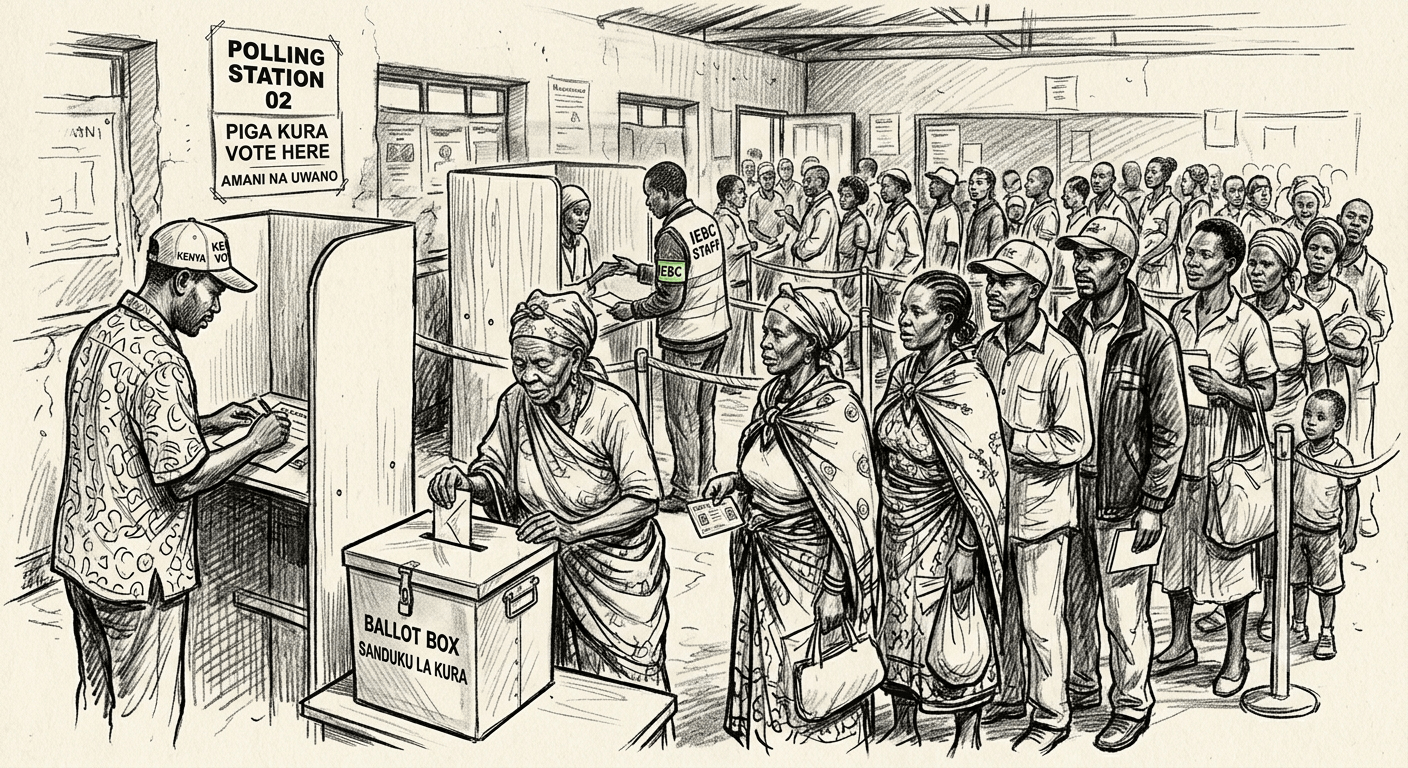
There was a time when by-elections were little more than administrative exercises to replace deceased or resigned legislators. Today, they have become something entirely different.
By-elections are no longer local contests fought over local issues. They have evolved into proxy wars through which political parties measure strength, reassure supporters, attract financiers and test strategies for the next general election.
They are national political laboratories where alliances are tested, narratives are shaped, and the road to the next general election begins years before polling day.
This transformation reflects a broader shift in Kenya’s political culture. There was a time when by-elections revolved around constituency concerns.
The just-concluded Ol Kalou by-election was never just about choosing a new Member of Parliament. When voters in Ol Kalou cast their ballots, they were electing a Member of Parliament.
Download Your Copy: The Chronicle Weekly July 20, 2026
Yet anyone observing the campaign could easily have mistaken it for a presidential election. Candidates campaigned on roads, schools, markets and healthcare, while national party leaders made only occasional appearances to support their preferred candidates.
Cabinet Secretaries descended on the constituency, senior politicians pitched camp for days, and both government and opposition figures treated the contest as though the future of the country depended on its outcome. Today, those local issues are often overshadowed by national political rivalries.
Every by-election is framed as a referendum on the popularity of the government or the strength of the opposition, regardless of the vacancy that triggered the contest.
National media carried campaign rallies live, while social media amplified every speech, confrontation and endorsement in real time.
For a constituency with fewer than 100,000 registered voters, the level of political attention was extraordinary. But it was also revealing.
The contest quickly became less about who would represent the constituency in Parliament and more about the battle for political dominance in the Mt Kenya region. The Ol Kalou by-election demonstrated how profoundly Kenyan politics has changed.
President William Ruto’s allies portrayed victory as evidence that the Kenya Kwanza administration retained its support in one of the country’s most important voting blocs.
Former Deputy President Rigathi Gachagua treated the campaign as an opportunity to demonstrate that he remained the region’s most influential political figure despite his fallout with the President. This explains why campaign budgets for by- elections often seem excessive.
The investment is not measured against the value of one parliamentary seat but against the value of the national narrative. Political parties are buying more than votes; they are buying momentum.
Neither side was simply chasing a parliamentary seat; they were all competing for the political story that would emerge after the votes were counted.
Politics as Perception
The media has amplified this transformation. Whereas local elections once attracted modest coverage, today’s by-elections unfold before a national audience. That story matters because modern politics increasingly operates through perception as much as reality.
Television stations broadcast campaign rallies live, while digital platforms ensure that every speech, handshake and slogan reaches millions of people within minutes.
A by-election victory does not alter the balance of power in Parliament in any significant way, but it can dramatically influence public opinion. Winning creates momentum. It energises supporters, reassures political financiers and strengthens a leader’s claim to be on the rise. Political influencers dissect each development online, turning even routine campaign events into national talking points.
Losing has the opposite effect, fuelling narratives of decline and raising questions about organisational strength. The result is that by-elections no longer remain local stories. They become media events whose significance is often determined as much by online conversation as by the final tally of votes.
In that sense, by-elections have become psychological contests as much as electoral ones.
Political parties invest disproportionate resources because they understand that the outcome will be interpreted far beyond the constituency itself.
A Rehearsal for 2027
A single victory can dominate headlines for days, influence coalition negotiations and shape conversations about who appears strongest heading towards the next election.
By-elections have also become testing grounds for coalition politics. Kenya’s political landscape is increasingly defined by shifting alliances rather than stable party loyalties, and these contests provide opportunities to assess which partnerships work, which messages resonate and which leaders retain influence.
Every campaign serves as a rehearsal for the next general election, allowing parties to refine their strategies years before Kenyans return to the polls.
Ol Kalou illustrated this dynamic perfectly. This is perhaps the defining feature of Kenya’s emerging political culture: the country is in a state of almost permanent campaigning.
The constituency became a political laboratory where leaders measured not only voting intentions but organisational discipline, fundraising capacity, crowd mobilisation and message effectiveness.
The distinction between governing and campaigning has become increasingly blurred as political leaders spend much of their time positioning themselves for the next electoral contest rather than focusing exclusively on the responsibilities of office.
Every rally doubled as a strategy meeting, while every endorsement offered clues about future alliances. Political actors were not simply contesting; they were gathering intelligence for 2027.
Coalition negotiations continue throughout the electoral cycle, political tours never really stop, and every by-election feeds into the larger
contest for State House.
For residents, however, this transformation presents a paradox. National attention can bring roads, promises of development and unprecedented visibility to a constituency that might otherwise be overlooked.
History is unlikely to remember the names of most by-election winners. What is more likely to be remembered is what those contests revealed about the state of Kenyan politics.
Yet it also risks drowning out the very local issues that prompted the by-election. Conversations about agricultural prices, access to healthcare, water shortages or youth unemployment are displaced by debates over presidential succession and coalition arithmetic.
Ol Kalou will be remembered not simply because it elected a new Member of Parliament, but because it confirmed that by-elections have evolved into proxy wars where parties test their machinery, leaders measure their influence and competing coalitions seek to shape the political narrative long before the country votes in a general election.
In effect, local voters become participants in a much larger political drama. The constituency serves as a stage upon which national leaders perform, while the immediate concerns of residents often receive only passing attention.
In today’s Kenya, there are no longer off-year elections, but rehearsals for the next battle.