


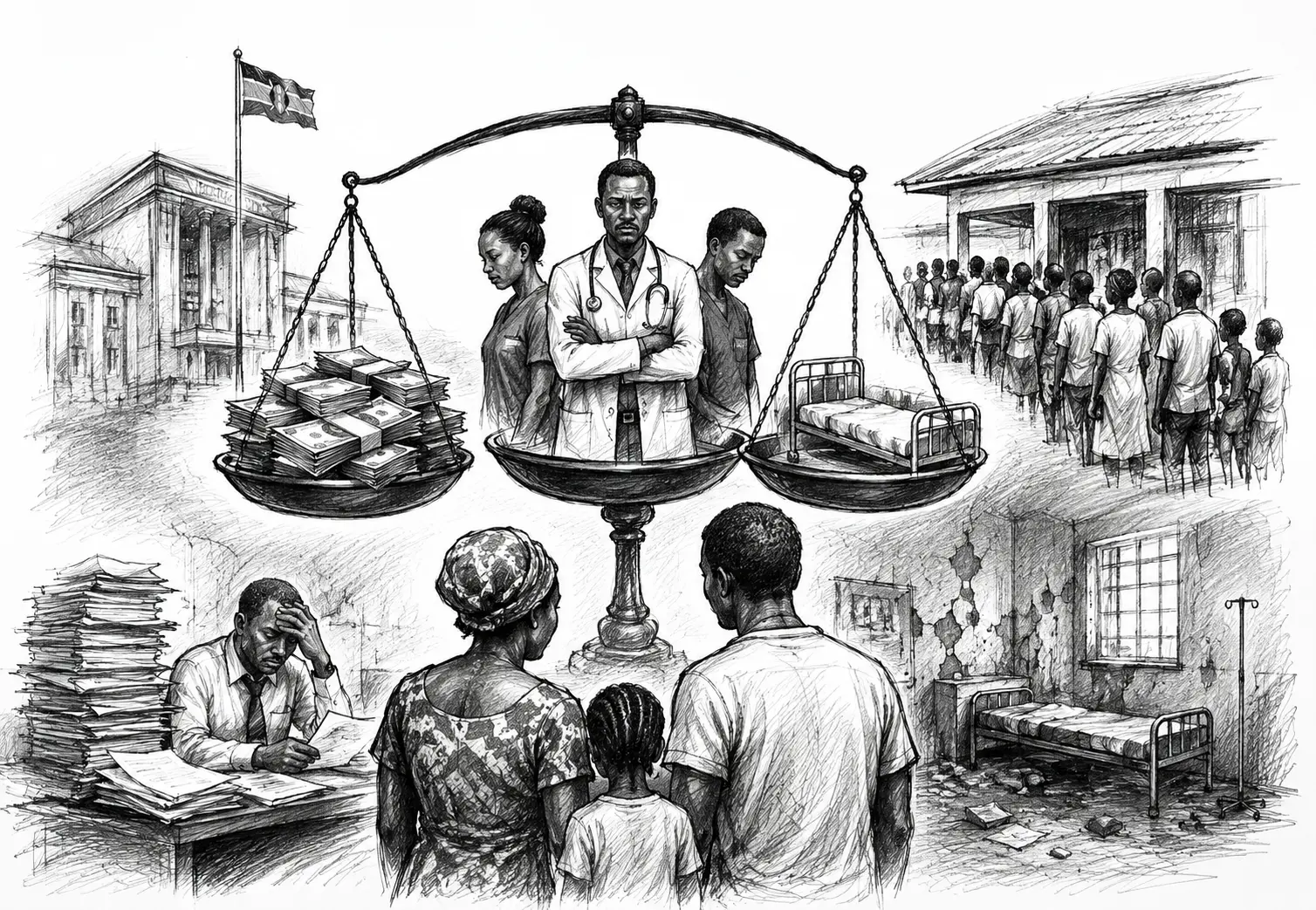
For much of the past two years, Kenya’s healthcare debate has been reduced to three letters: SHA.
The Social Health Authority has become the political shorthand for almost everything wrong with the system, the government’s most visible reform and, depending on who is speaking, either the foundation of universal health coverage or a bureaucratic experiment that has made an already difficult system harder to navigate.
However, the intensity of the argument around SHA risks obscuring a more uncomfortable truth: Kenya’s healthcare problem did not begin with the new insurance system, and it will not end with it.
Kenya is attempting to build universal healthcare atop a system that has spent years struggling with inadequate financing, uneven distribution of health workers, unreliable supplies and a dependence on households paying directly for treatment.
SHA may change how money moves through the system, but it cannot create doctors or guarantee that a patient finds the prescribed medication.
Debt at the Centre of the Debate
The clearest evidence that SHA has become a financing crisis as much as an insurance reform sits in the numbers hospitals are owed.
The Controller of Budget’s reporting shows county health facilities were owed roughly Sh27 billion by SHA as of mid-2026. The consequence has been visible enough to make national news.
In November, more than 100 women were held at Mama Lucy Kibaki Hospital in Nairobi over unpaid medical bills.
The hospital’s chief executive, Frederick Obwanda, attributed the episode to low uptake of the new insurance scheme, saying hospitals were being forced to demand cash payments for sustainability.
RUPHA has been blunter still, describing the authority in one directive to its 700-plus member facilities as “a bad borrower and a bad debtor”.
Homa Bay Governor Gladys Wanga told the Senate’s County Public Accounts Committee in June that SHA owed her administration some Sh350 million.
The pattern is instructive: this is not simply a Nairobi story or a private-hospital story. It runs through counties of every fiscal capacity.
The government’s response has been incremental, with Health Cabinet Secretary Aden Duale overseeing a phased release of funds.
Sh4 billion was released in June, for facilities owed Sh10 million or less, with the larger Sh33 billion owed to bigger providers deferred to the 2026/27 budget cycle pending “forensic verification”.
SHA has since reopened a review window, giving facilities until July 31 to contest the amounts communicated for claims inherited from the defunct NHIF.
Registration ≠ Coverage
The government points, reasonably, to scale: roughly 15 million people had enrolled under SHA against a population of over 57 million, according to the 2025 Budget Policy Statement, and separate figures cited in 2026 put registered numbers above 30 million.
However, registration is not coverage, and coverage is not access.
Kenya’s out-of-pocket health spending, the money households pay directly, uninsured, at the point of care, has stood at roughly a quarter of total health expenditure for over a decade, well above the 15–20 per cent ceiling the World Health Organisation treats as the threshold for adequate financial protection.
Multiple studies estimate that a meaningful share of Kenyan households still face what economists call catastrophic health expenditure: out-of-pocket costs large enough to threaten their basic consumption.
The danger, as this magazine has argued before in different contexts, is a system with universal registration but not universal access, one in which more people hold a card without the underlying service ever reaching them.
Workforce Kenya Cannot Keep
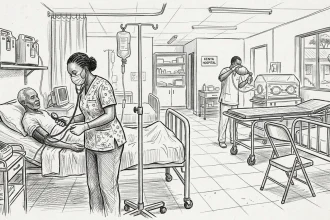
If the claims-payment crisis is SHA’s most visible failure, the workforce shortage is the deeper structural one, and it long predates the current reform.
Government data cited in 2026 shows the country needs 311,060 healthcare workers nationally, but can only supply 234,140, a shortfall of 76,920 positions.
The Ministry’s own modelling has projected this to grow to 114,352 by 2031 as demand for health workers rises faster than the country trains and retains them.
KMPDU secretary-general Davji Atellah has linked the shortage directly to how counties hire under devolution, noting that some counties recruit only a handful of doctors a year, even as graduates go unemployed, a mismatch he says is why many hospitals cannot deliver quality care.
The irony is sharp: Kenya trains health professionals to a standard recognised well beyond its borders, then struggles to employ the ones who stay. A pharmaceutical technologist shortage of a different kind is emerging, too.
Government data shows pharmaceutical technologists have the highest stated willingness to migrate of any cadre, at around 79 per cent, though nurses and medical officers remain somewhat more likely to stay.
Problem Devolution Didn’t Solve
Devolution was supposed to bring healthcare closer to citizens, and in places it has. Counties have built facilities and hired staff in ways that would have been difficult under a fully centralised system.
But devolution also means Kenya does not have 47 versions of the same health system; it has 47 counties with radically different fiscal capacities and administrative competence.
A doctor cannot serve a patient in a facility with no equipment, no support staff and no referral infrastructure, and a hiring decision made in a well-resourced county tells us little about what is possible in a poorer one.
The SHA debt crisis has landed on this uneven terrain unevenly: a governor in Homa Bay and a hospital administrator in Nairobi are living the same national policy in different fiscal realities.
None of this means reform was wrong to attempt. NHIF model was increasingly inadequate for a population living longer, with more chronic disease, in an economy where a large informal sector makes predictable contributions difficult to collect.
Duale’s acknowledgement that Kenya has lacked a comprehensive workforce policy “since independence”, the basis for a proposed Healthcare Professionals’ Policy in 2026, is a rare admission of a structural problem rather than a talking point. But an admission is not a result.
The government’s task is to show that SHA is changing not just how healthcare is financed, but whether it is delivered, whether claims are paid on time, whether facilities stop turning away patients or detaining them over bills, and whether the counties furthest from Nairobi’s fiscal advantages can hire and keep the staff that a national policy promises them.
Measure That Matters
For the ordinary citizen, none of this arithmetic matters as much as one plain question: when the doctor writes a prescription, can the patient get the medicine from a facility with the staff to treat them, without the household absorbing a debt it cannot repay?
Kenya’s healthcare crisis is bigger than SHA, and so is the fix.
Until claims are paid reliably, workforce policy stops being aspirational, and county capacity stops being an accident of geography, the argument over three letters will keep distracting from the larger question: whether Kenya is building a health system that works for the people it was designed to serve.