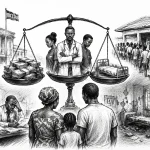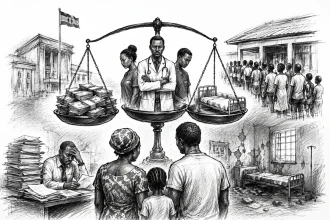



Kenya’s health debate has become consumed by the controversy surrounding the Social Health Authority, making it easy to lose sight of the larger reform project that President Ruto’s administration has been attempting since taking office.
SHA is important, perhaps even central, because the financing determines what kind of health system a country can sustain. Yet the government’s health agenda was never only about replacing NHIF.
It was about changing how Kenyans enter the health system, how they pay for care, how primary healthcare is organised, how medicines are procured, how medical equipment is deployed, how health information is managed and how much of the burden of illness is carried by households.
Measured against the 2022 manifesto, the Ruto administration has at least attempted to move on several of the problems it identified. The manifesto proposed a Universal Health Coverage system built around three pillars: publicly financed primary healthcare, a universal health insurance system and a national mechanism for covering chronic illnesses.
It also promised to strengthen community health, utilise technology to integrate health information, reform the NHIF, enhance the procurement of medical commodities, and find a solution to the tensions surrounding health workers and devolution.
That is a substantial agenda, and it would be intellectually dishonest to assess it only through the frustrations surrounding SHA. It would be equally dishonest, however, to assume that changing the architecture of healthcare automatically means that healthcare itself has improved.
The more useful question is neither whether the government has done nothing nor whether it has transformed the system. It is whether the reforms are beginning to produce the promised outcomes, and whether today’s changes are building a health system that will work better tomorrow.
Manifesto Got The Diagnosis Largely Right
The starting point matters because the manifesto was explicit about what it believed was wrong with Kenya’s healthcare system. It argued that the country was spending substantial sums on healthcare without always converting those resources into the outcomes Kenyans needed.
It identified the financial burden of illness as a major vulnerability, noting that households were still carrying a significant share of health expenditure, and illness could push families into poverty. It also recognised that Kenya’s insurance model was poorly suited to a labour market where the informal wage economy represented the majority of workers.
The underlying logic of the government’s reform agenda is therefore defensible: healthcare financing must become broader, primary care must become more important, and the system must do more to prevent people from reaching the point at which treatment becomes prohibitively expensive.
This is where the administration deserves credit. It did not simply preserve NHIF and attempt to make minor administrative adjustments around the edges. It chose to undertake a much more disruptive restructuring of health financing, while simultaneously trying to move the system towards primary healthcare and digital management.
That ambition should not be dismissed merely because implementation has been difficult. At the same time, the manifesto itself promised a specific UHC model that included publicly financed primary healthcare, a seamless insurance system and a national fund for chronic and catastrophic illnesses.
The government’s current model is therefore not a perfect replication of what was originally promised, and the shift from manifesto language to policy reality deserves scrutiny. The question is whether the new system ultimately delivers the same objective more effectively, rather than whether it reproduces the original institutional design.
SHA: A Necessary Reform
The replacement of NHIF with SHA is the most visible and controversial part of the health agenda, but it should be assessed on two separate questions: whether reform was necessary, and whether the reform being implemented is working.
On the first question, the case for change was strong as many agree that NHIF had serious structural weaknesses, particularly its reliance on formal employment contributions in an economy where most workers are in the informal wage system.
It also highlighted the uneven distribution of insurance coverage across the country and the issue of households joining or contributing because of the way the system was designed.
The argument for reform, therefore, predates the Ruto administration and is larger than politics, but the harder question is whether SHA is solving the problems that NHIF could not.
The transition has been complicated by disputes over registration, contributions, eligibility, claims processing, provider payments and the practical experience of patients navigating the new system.
The government can explain the architecture of SHA, but a patient does not experience architecture; they experience a hospital. If a patient cannot register easily, or a hospital cannot confirm coverage, the reform feels like a failure. If a provider is not paid and becomes reluctant to accept insured patients, the reform appears like a failure.
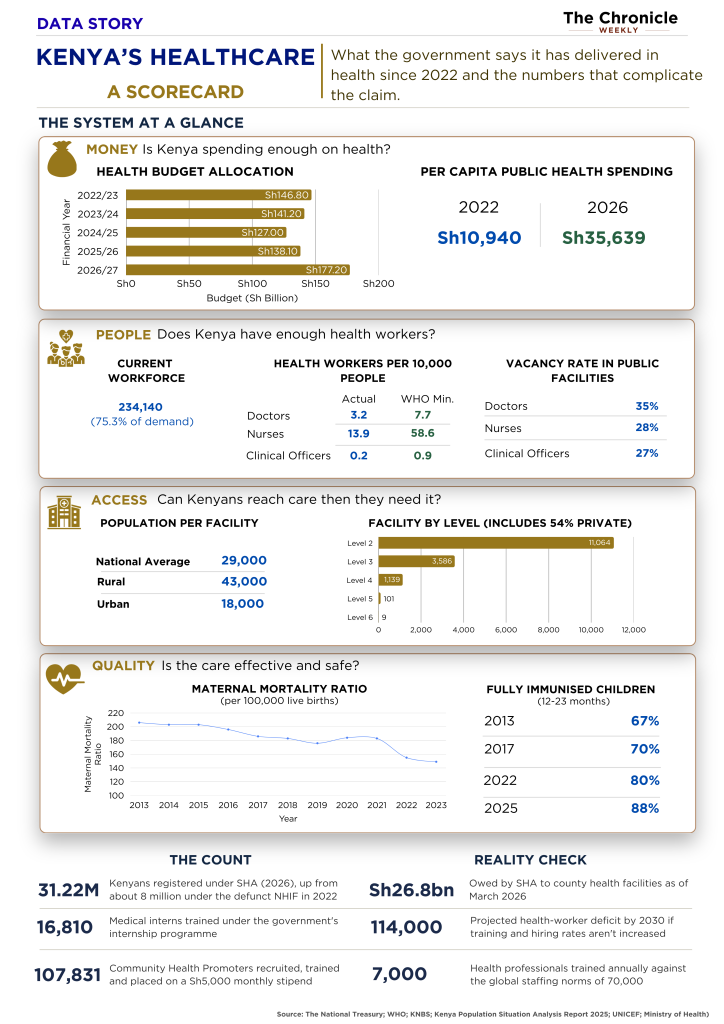
The Bigger Story: Primary Healthcare
If SHA has dominated the political conversation, the shift towards primary healthcare may ultimately prove to be the more consequential.
The Kenya Kwanza manifesto placed community health at the centre of its proposed UHC model, arguing that prevention was more efficient than waiting for people to become seriously ill before intervening.
The administration’s emphasis on community health promoters and primary healthcare is therefore one area where there is a clear line between manifesto promise and policy direction. A health system that waits until a patient requires expensive hospital treatment will always struggle with rising costs.
A health system that identifies hypertension earlier, supports maternal health closer to home, promotes immunisation, detects disease sooner and manages common conditions before they become emergencies has a better chance of improving both health outcomes and household finances.
Primary healthcare requires a functioning system behind the first point of contact. A community health promoter who identifies a patient with hypertension has achieved only half the objective if the patient cannot find the medicine required.
A health worker who identifies a high-risk pregnancy has not solved the problem if the nearest facility lacks the personnel and equipment needed when complications arise. This is why the government’s primary healthcare agenda deserves credit for identifying the right direction while still requiring scrutiny over execution.
The manifesto’s ambition was to make prevention the foundation of UHC. The administration’s challenge is to ensure that primary healthcare does not become another programme that exists separately from the hospitals, laboratories, pharmacies, referral networks and health workers required to make it work.
Medicines Are Where Reform Becomes Real
For most Kenyans, the health system is judged less by policy documents than by what happens after a doctor writes a prescription. If the medicine is available, the system appears to be functioning, but when the patient is told to buy it from a private pharmacy, the system feels broken.
The Kenya Kwanza manifesto promised a new approach to health commodity procurement to reform the supply chain. It also identified the expansion of domestic pharmaceutical manufacturing as part of the longer-term solution.
The administration has pointed to improvements in the performance of KEMSA and the availability of essential medicines, and these improvements should be acknowledged where evident.
However, the real test is whether a patient in a county hospital can consistently obtain medication, whether facilities receive supplies on time and whether health managers can plan their inventories rather than repeatedly dealing with shortages.
Kenya has spent years investing in infrastructure and equipment, but the country has often struggled with maintenance, staffing and utilisation.
The government’s equipment investments could become genuinely transformative if they reduce the need for patients to travel to Nairobi for services that can reasonably be provided closer to home.
Health Worker Problem Remains The Hardest
No health financing reform can compensate for a shortage of doctors, nurses, clinical officers, specialists and other professionals who deliver care.
The Kenya Kwanza manifesto recognised this and promised to mediate the long-running tension between health workers and county governments, acknowledging that both sides had legitimate concerns over professional development, accountability and the distribution of specialists.
Kenya’s health worker problem is not simply about numbers. It is about where they work, whether they have the equipment and medicines required to practice effectively, whether they are paid on time, whether they can advance professionally and whether the country can retain the skills it has invested in developing.
The recurring disputes between health workers and the government, therefore, reflect a deeper structural problem. The government cannot build a sustainable health system while treating the people who operate it as an afterthought.
At the same time, this is not a problem that any administration can solve overnight. The more reasonable standard is whether the government is moving towards a more sustainable workforce model and whether it’s creating conditions in which health workers can actually deliver better care.
Digital Health
Kenya’s digital health ambitions are perhaps the least visible of its major reforms, yet they could eventually have the greatest consequences. The manifesto promised an integrated health information system that would allow Kenyans to control access to their health records and obtain information about health services through their phones.
An integrated digital health system could reduce duplication, improve continuity of care and make it easier for doctors to understand a patient’s medical history. It could also improve claims management and give authorities better information about where resources are needed. But digital systems can easily create a new layer of bureaucracy.
If patients struggle to use them, if facilities lack reliable connectivity or if overstretched health workers are expected to become data-entry clerks, technology will merely digitise existing frustrations.
The Constitution placed substantial responsibility for healthcare delivery with counties, creating the possibility of more responsive local services but also producing significant variation in capacity.
Some counties have invested heavily in health infrastructure and personnel, while others have struggled with financing, management and staffing.
The result is a country in which the quality of healthcare can still depend heavily on where a person happens to live.
The national government then faces a delicate task of supporting a national standard of healthcare without undermining the constitutional role of counties, while county governments must accept that autonomy cannot become an excuse for weak accountability.
The Kenya Kwanza manifesto recognised this tension and promised to act as an honest mediator, but the underlying challenge remains unresolved. Patients, however, do not care which level of government is responsible when they cannot find a doctor, medicine or functioning equipment.
That is why the ultimate measure of health reform must be the experience of the citizen rather than the division of constitutional responsibilities.
Mixed Scorecard
The fairest assessment of the Ruto administration’s health record is neither triumph nor failure. When measured against the 2022 manifesto, the administration has acted on many of the areas it identified as requiring reform, even if the solutions adopted have not always followed the exact institutional model originally proposed.
But the government must also recognise that identifying the right problems is only the first half. The second half is making the solutions work.
This is why the administration’s health legacy remains unfinished; it has changed the machinery and must now demonstrate that it can change the experience.