



The most important economic question surrounding Kenya’s 2027 election may not be what the candidates promise during the campaign, but what the winner will discover after taking office.
Beneath the familiar arguments about coalitions, personalities, development records, and the cost of living lies a more consequential reality: the next government will inherit an economy that is growing at a reasonable pace, but a state whose ability to spend, borrow and respond to new demands is becoming increasingly constrained.
That distinction matters because election campaigns naturally turn the economy into a catalogue of possibilities. Candidates can promise more jobs, lower living costs, better healthcare, stronger education, new infrastructure and greater support for businesses and households.
However, the fiscal numbers suggest that whoever takes over State House in 2027 will begin with a much more difficult question: how much of the programme that won the election can the government actually afford to implement?
Warning Signs
This is particularly important because the government that takes office after the 2027 election will inherit a difficult fiscal environment.
In FY2025/26, total government revenue, including Appropriations-in-Aid, amounted to Sh3.199 trillion against a target of Sh3.259 trillion, while expenditure and net lending reached Sh4.484 trillion, leaving a deficit of Sh1.265 trillion, equivalent to 6.8 per cent of GDP.
The medium-term outlook remains constrained. For FY2027/28, the Treasury projects revenue of Sh3.943 trillion against expenditure and net lending of Sh5.323 trillion, leaving a projected deficit of Sh1.321 trillion. More than Sh1 trillion of that deficit is expected to be financed domestically.
There is also a substantial stock of existing obligations. National Government pending bills stood at Sh465.9 billion at the end of June 2026, including obligations to contractors and suppliers.
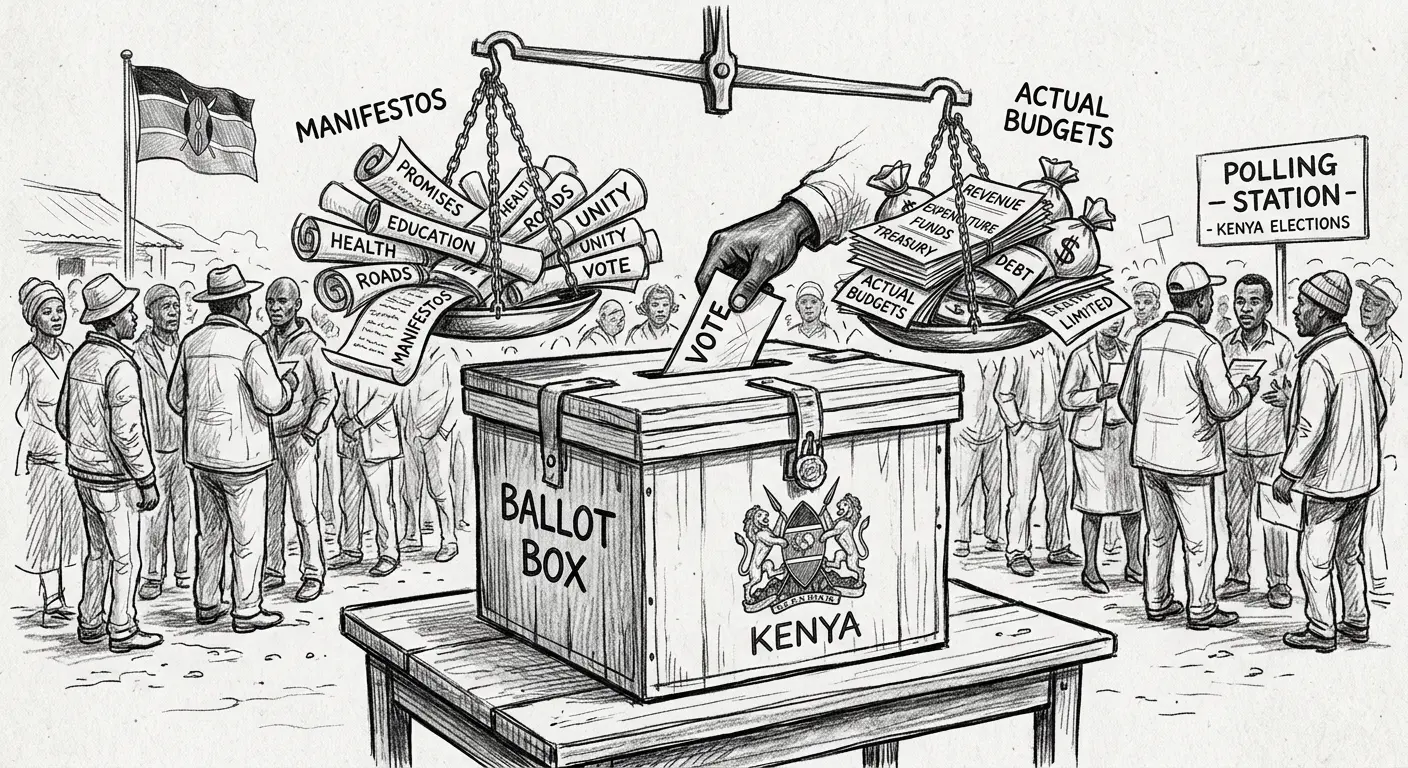
These numbers should not be used to suggest that Kenya cannot afford to undertake any new initiatives. They should instead encourage a more demanding kind of politics in which every major promise comes with an explanation of its cost and funding mechanism, and that gives voters a simple test to apply to every manifesto.
There will be promises of jobs, lower taxes, cheaper living costs, better healthcare, more affordable housing, improved education, higher agricultural incomes, more money for counties and new infrastructure. Some will be credible, some will be achievable with difficult choices, and others will sound attractive precisely because nobody will explain what they will cost.
However, this time, Kenyan voters have a useful way of separating the three. The question voters should ask of every presidential candidate is not simply whether a proposal is desirable; most of the things politicians promise are desirable.
The harder question is whether the government can afford to deliver them, where the money will come from, what existing spending will have to be reduced or abandoned, and whether the proposed intervention is likely to produce the economic results being claimed.
How much will it cost?
A manifesto that says it will create millions of jobs, build thousands of hospitals, subsidise households, reduce taxes and increase spending on education without putting a price on those commitments is not yet an economic programme.
It is an aspiration, and the cost matters because the government has a finite pool of resources. If one candidate proposes a major expansion of public healthcare, another promises universal agricultural subsidies, and a third wants to build an extensive new infrastructure programme, voters should be able to see what each proposal will cost annually and over the full term of government.
The absence of a price tag should be treated as a warning sign rather than a minor omission.
Where will the money come from may be the most important question of the election. There are only a handful of broad ways for government to finance new commitments: raise more revenue, borrow more, reduce existing expenditure, increase economic growth sufficiently to expand the tax base, or use some combination of these.
Each has consequences, and so if a candidate promises lower taxes and higher spending simultaneously, voters should ask how the resulting gap will be financed. If the answer is borrowing, the next question should be how much additional debt will be accumulated and what that will do to debt service.
If the candidate proposes new taxes, voters should ask who will pay them and whether the proposal is likely to generate the promised revenue without damaging investment, consumption or employment.
If the candidate promises to cut government waste, voters should ask for specifics: which programmes will be cut, which agencies will be merged, which subsidies will disappear and how much money will actually be saved. “Stop corruption” may be an important objective, but it is not a budget line.
What happens to the promises already on the books is the next most important question, as this is where manifestos can become misleading.
A new government does not begin with an empty budget; it inherits debt, salaries, contracts, pensions, county transfers, pending bills and ongoing projects.
The question for every candidate should therefore be what happens to existing commitments.
Will they continue the projects already under construction? Will they cancel them? Will they renegotiate contracts? How will they clear pending bills? What happens to programmes that the current administration has already committed to financing?
A candidate who promises a completely new development agenda without explaining what happens to the existing one is asking voters to imagine that the government starts afresh on inauguration day.
What will actually create jobs?
Jobs will probably be among the most heavily used words in the 2027 campaign, but voters should become much more demanding about what politicians mean by employment creation.
A serious manifesto should identify the sectors expected to create jobs, the investments required, the number and type of jobs anticipated and the mechanism through which government policy will produce them.
There is a significant difference between saying that a government will “create jobs” and explaining how better access to credit will allow MSMEs to expand, how agricultural value chains will generate additional employment, how manufacturing investment will be attracted, or how digital businesses will be supported to grow.
The first is a slogan, and the second is an economic proposition that can be tested.
The fifth question that voters must ask is whether the proposed policy will make Kenya more productive, as this is perhaps the most overlooked test.
The government can spend money without necessarily making the economy more productive. A road can be built in the wrong place, a factory can receive a subsidy without becoming competitive, a training programme can graduate thousands of people without creating employment, and a government agency can consume billions without improving the service it was established to provide.
The better question is, therefore, what an intervention will enable Kenyans to produce, earn or save.
The Treasury’s new medium-term budget approach is moving in precisely this direction, with a greater emphasis on measurable outcomes, programme performance, and value for money. Voters should demand the same standard from political candidates.
What will you stop doing?
This may be the question that most clearly separates a serious manifesto from an election wish list. Every candidate can identify something new that the government should do, but the more difficult exercise is identifying what the government should stop doing.
Kenya’s fiscal constraints mean that the next administration will have to make choices. If it wants to introduce a major new programme, voters should ask which existing programmes will be reduced or discontinued to finance it.
If the answer is “none”, then the candidate needs to explain whether the money will come from higher taxes, more borrowing or significantly faster economic growth. A government that promises everything is effectively promising nothing about its priorities.
The presidential campaign can create the illusion that every problem in Kenya is solved from State House.
Counties control and deliver many of the services that citizens encounter most directly, from healthcare and local roads to markets, water, waste management and local economic development.
Yet counties themselves face significant financial and administrative constraints. During the first nine months of FY2025/26, aggregate development expenditure absorption stood at only 30.8 per cent, while recurrent expenditure absorption was 65.1 per cent.
A presidential candidate promising substantially more money for counties should therefore be asked not only how much will be transferred, but how the additional resources will be used, what safeguards will accompany them and how county governments will be held accountable for results.
The voter should be interested in both sides of the equation: how much money goes in and what comes out.
Evidence
Every manifesto will contain numbers. Some will be impressive, others will be deliberately enormous, and the important thing is to ask where the numbers came from.
If a candidate promises a million jobs, what is the baseline? If they promise to reduce debt by half, what assumptions make that possible? If they promise to cut the cost of living, which prices are expected to fall and through what mechanism? If they promise dramatically higher revenues without raising taxes, what economic expansion or administrative reform will produce the additional money?
A good manifesto should allow its claims to be interrogated because, in the absence of evidence does not necessarily mean a proposal is wrong, but it should make voters much less willing to accept it at face value.
Voters must also ask the question politicians may not want to answer: What will we have to give up?
This is the ultimate fiscal test because governing is about choices, and resources are limited. If a candidate wants to spend more on healthcare, infrastructure, education, agriculture, social protection and security while simultaneously reducing taxes and public debt, something in the equation has to explain how all those objectives can coexist.
The answer cannot simply be that the economy will grow. Growth matters enormously, but it is not a magic source of unlimited money, particularly when the government begins with a large deficit, substantial debt obligations and billions of shillings in pending bills.
Kenya’s Treasury is already attempting to navigate this problem by concentrating scarce resources around priority areas, strengthening zero-based budgeting and demanding greater evidence of value for money. The 2027 candidates should be held to at least the same standard.
This does not mean voters should become economists before choosing their leaders. It means that the political conversation should mature beyond the question of who promises the most.
The better question is who has thought most seriously about what Kenya can afford, what it should prioritise and how public money can generate the greatest possible return.
The next government will inherit an economy with considerable potential, but it will also inherit debt, a persistent fiscal deficit, pending bills and a state that has less room for expensive mistakes than it once did.
That makes the 2027 manifesto more than a political document and should be a financial proposition presented to the Kenyan people.