



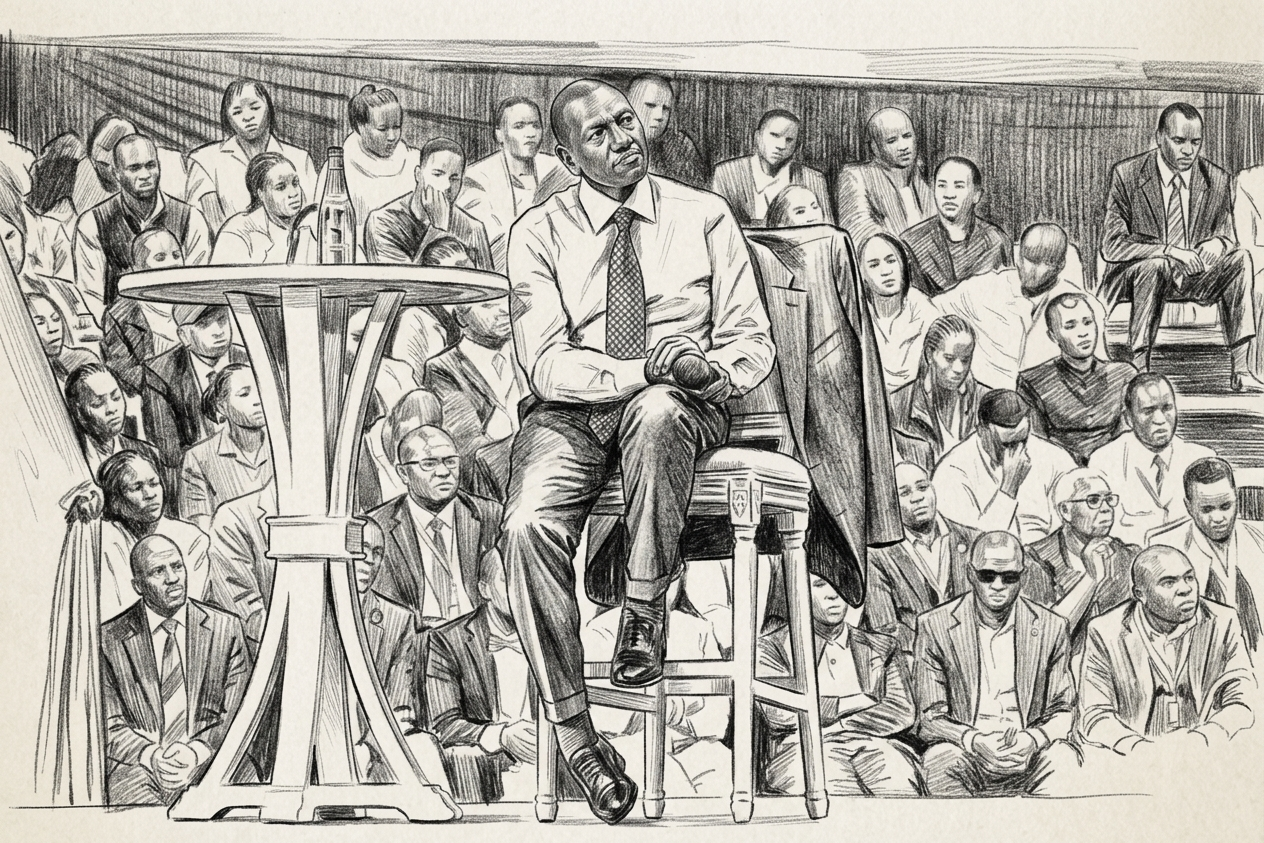
On Tuesday, President William Ruto took the stage at the KICC to moderate a town hall on Kenya’s health reforms; the closing act of day 1 of the National Health Summit held under the theme “Reform Delivered, Health as a Right.”
Kenyans in the room were invited to share their experiences with the Social Health Authority, primary healthcare access and health financing, and to raise their concerns directly with the President.
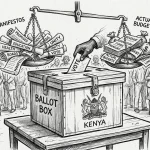
It was billed, accurately, as a platform for citizen voice, but whether it functioned as one is a separate question that matters more. Kenya has a stronger constitutional claim to the town hall than almost any government attempting the format today.
Article 10 names public participation a binding national value, not an optional courtesy, applying whenever state organs enact policy or interpret law. The County Governments Act goes further, listing town hall meetings by name as a required modality county governments must establish.
Few constitutions anywhere spell out the tool this explicitly, so the gap is not in the law but in what happens when the law meets a stage, a summit programme and a single moderator who is also the subject of the accountability exercise.
Kenyan civil society has already named that gap with ICJ Kenya arguing that Article 10 sets no precise threshold for what counts as sufficient engagement, leaving room for officials to hold token forums that do not genuinely represent public input.
The ICJ has specifically pointed to the NHIF-to-SHIF transition as a case where participation was more theoretical than practised.
That history should sharpen scrutiny of Tuesday’s session, not soften it: SHA is the direct successor to the reform ICJ Kenya flagged as a participation failure, and the town hall built to discuss it arrived only after the system was designed, legislated and rolled out to Kenyans.
Sequencing is the tell: the town hall did not open day one of the summit; it closed it, after the SHA chief executive, senators, MPs and Cabinet secretaries had already framed the reform’s achievements from the stage.
A citizen invited to speak into that structure is not shaping the policy; they are reacting to a finished narrative, on a schedule and platform the government controls end to end.
That is a legitimate governance function. It is closer to a report-back than to the deliberation Article 10 envisions, and Kenyan newsrooms should be precise about which one they are covering.
Lessons From Elsewhere
Set beside comparable formats elsewhere, the design choice becomes clearer.
South Africa’s Presidential Imbizo is the closest structural cousin; a platform explicitly built for face-to-face engagement between citizens and senior leaders, intended to hold the administration accountable on service delivery.
It draws the same criticism Kenya’s format invites: opposition parties have accused Ramaphosa of timing Imbizo tours to elections and using them as public-relations exercises rather than accountability ones. This critique applies easily to any head-of-state-moderated town hall regardless of country.
“Deliberative town halls,” developed by Ohio State University’s Institute for Democratic Engagement and now exported to Northern Ireland, Australia and the United Kingdom, use randomly sampled participant groups and professional, non-partisan moderation rather than the official being questioned.
Independent surveys have found that 95 per cent of participants rate the sessions valuable, and in at least one case a legislator changed a bill after hearing directly from constituents in that structure. The difference from Tuesday’s format is not turnout or enthusiasm but who sets the terms of conversation.
New England’s town meeting tradition draws the sharpest line of all. Unlike town halls held by state and politicians to answer questions, sessions that carry no decision-making power, a town meeting lets the participants legislate policy and budgets directly.
Kenya’s SHA town hall sits firmly in the listening category, not the deciding one, and that placement is not itself the problem. The problem is a listening exercise dressed, in coverage and framing, as if it were closer to a decision-making one.
The Council of Europe’s 2023 recommendation on deliberative democracy offers a checklist against which any of this could be scored: a clear legal framework, an unambiguous mandate for the exercise, fair representation of who gets to speak, and accountability for what happens to what is said.
Kenya’s SHA town hall passes the first test by a wide margin. It has not yet demonstrated it passes the fourth, as there is no visible mechanism turning Tuesday’s testimony into a document anyone can hold the government to next year.
Representation is the final test, and it is the one every version of this format struggles with, not just Kenya’s. Research on comparable local-government meetings elsewhere has found that the people who actually show up to speak skew markedly older and more male than the general voting population.
This is an elite-capture pattern that a curated, single-city, single-day summit at KICC does nothing to correct, and that rural or lower-income Kenyans without the means to travel to Nairobi are structurally excluded from by design, not accident.
None of this argues against the town hall as a tool; Kenya’s constitutional commitment to it is a genuine asset, and one most governments in the region cannot claim. It argues against mistaking the tool’s presence for its function.
The Public Participation Bill, passed by the National Assembly a week ago, will test whether Kenya legislated the design standards: independent moderation, published commitments, a feedback loop with teeth, that separate a deliberative process from a well-attended briefing.