



Picture two Kenyans on a Tuesday evening. One is scrolling Instagram in Kilimani, a television humming in the background, tuned to nothing in particular. The other is in a market town out west, radio dial fixed to the local vernacular station; the only screen in the house is off, because there isn’t one.
Both count as “media consumers” in the Communications Authority’s books. On the numbers, they might as well live in different countries.
That’s the story hiding inside the CA’s latest Audience Measurement and Industry Trends Report, covering Q4 of the 2025/26 financial year. The national totals look calm enough: radio at 75 per cent, TV at 74 per cent, internet at 57 per cent.
Split by income, the calm disappears. Among the poorest bracket (LSM 1 to 4), radio reaches 94 per cent of people. Television reaches 24 per cent and the Internet, 7 per cent. For Kenya, radio isn’t one option among several; it is the medium.
Flip to the top bracket, LSM 12+, and the picture inverts almost exactly: TV at 94 per cent, internet at 93 per cent, radio down to 68 per cent and still falling – from a high of 92 per cent among the poorest group down to fourth place among the richest.
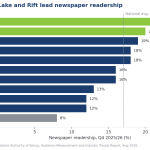
Newspapers tell the same story in miniature: 35 per cent of LSM 12+ read one last week, against roughly 1 per cent of LSM 1-4.
Nairobi Doesn’t Fit Model
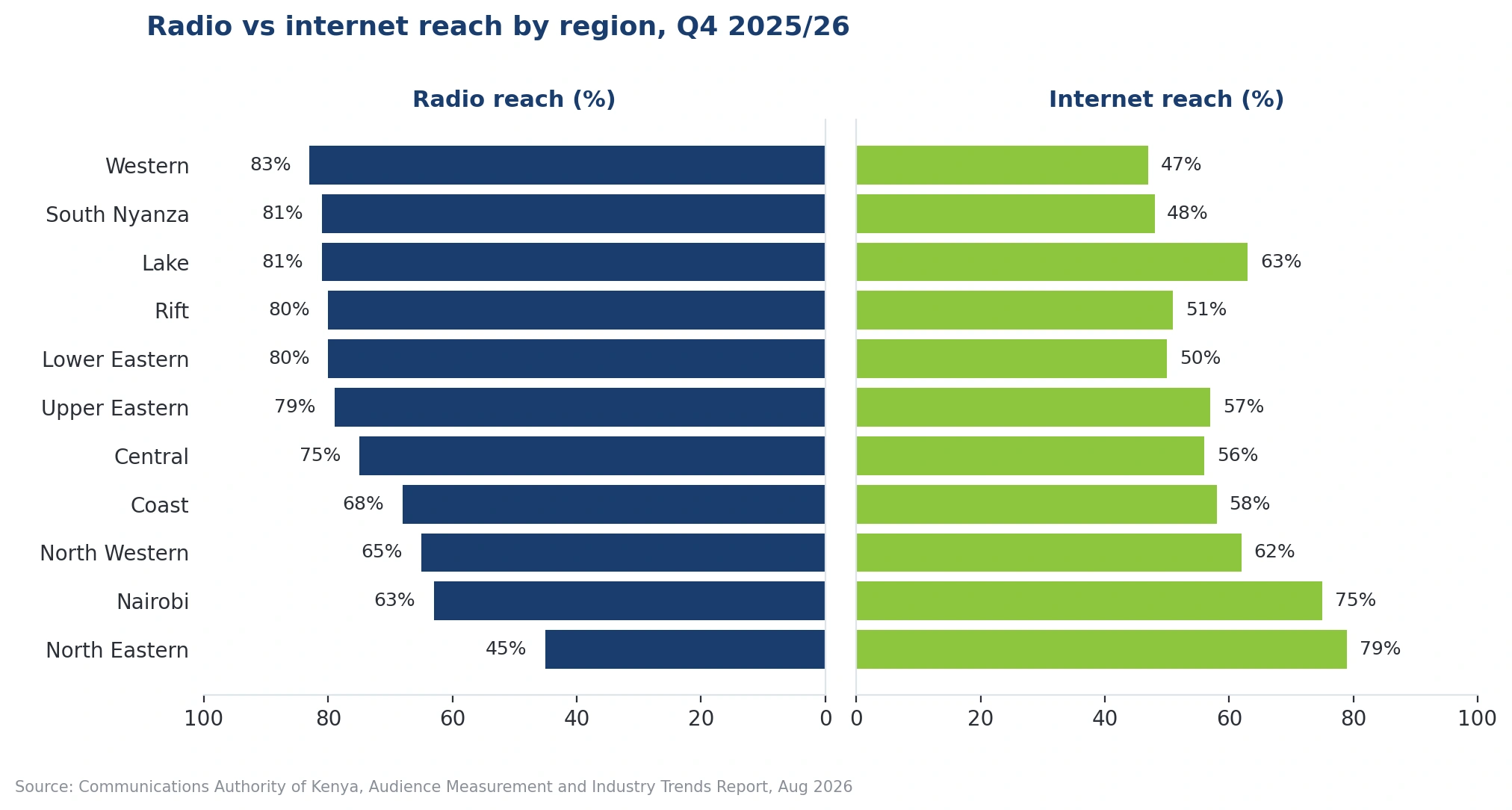
Nairobi posts the lowest radio listenership in Kenya (63 per cent in Q4), trailing Western and Rift at 83 per cent apiece, and Lake at 81 per cent. But Nairobi’s TV reach (84 per cent) and internet access (75 per cent) sit near the top nationally.
North Eastern is stranger still, with the lowest TV viewership in the country, at 58 per cent, yet leads on internet access, at 79 per cent, ahead of even Nairobi. A young, mobile-first population that never had legacy broadcast infrastructure to begin with, reaching straight for the phone instead. Digital-first, in other words, does not mean well served.
The split runs down to the language coming out of the speaker. Nationally, Swahili carries 61 per cent of radio listenership, vernacular 39 per cent, and English 11 per cent. But English listenership among LSM 12+ has been climbing all year, hitting 17 per cent in Q4, roughly double the mid-income rate, while vernacular stays the default for lower-LSM and rural Kenya.
In plain terms, a lower-income, rural Kenyan is reached almost exclusively through vernacular or Swahili radio.
Why It Matters
The CA’s own report calls this the industry’s defining tension: broadcasters must “serve different audiences across multiple platforms without weakening their core radio and television products,” even as unequal digital access keeps rural, lower-income Kenya “reliant on radio and television”.
For advertisers, the message is blunt. A Nairobi-weighted digital campaign will systematically miss rural, lower-income, non-Nairobi Kenya, where Swahili and vernacular radio remain the only thing that actually arrives.
For everyone else -media houses, regulators, anyone running a national message – the real question isn’t whether Kenya is “going digital.” It’s how long a country can run on two disconnected media publics before something built for one stops reaching the other at all.