
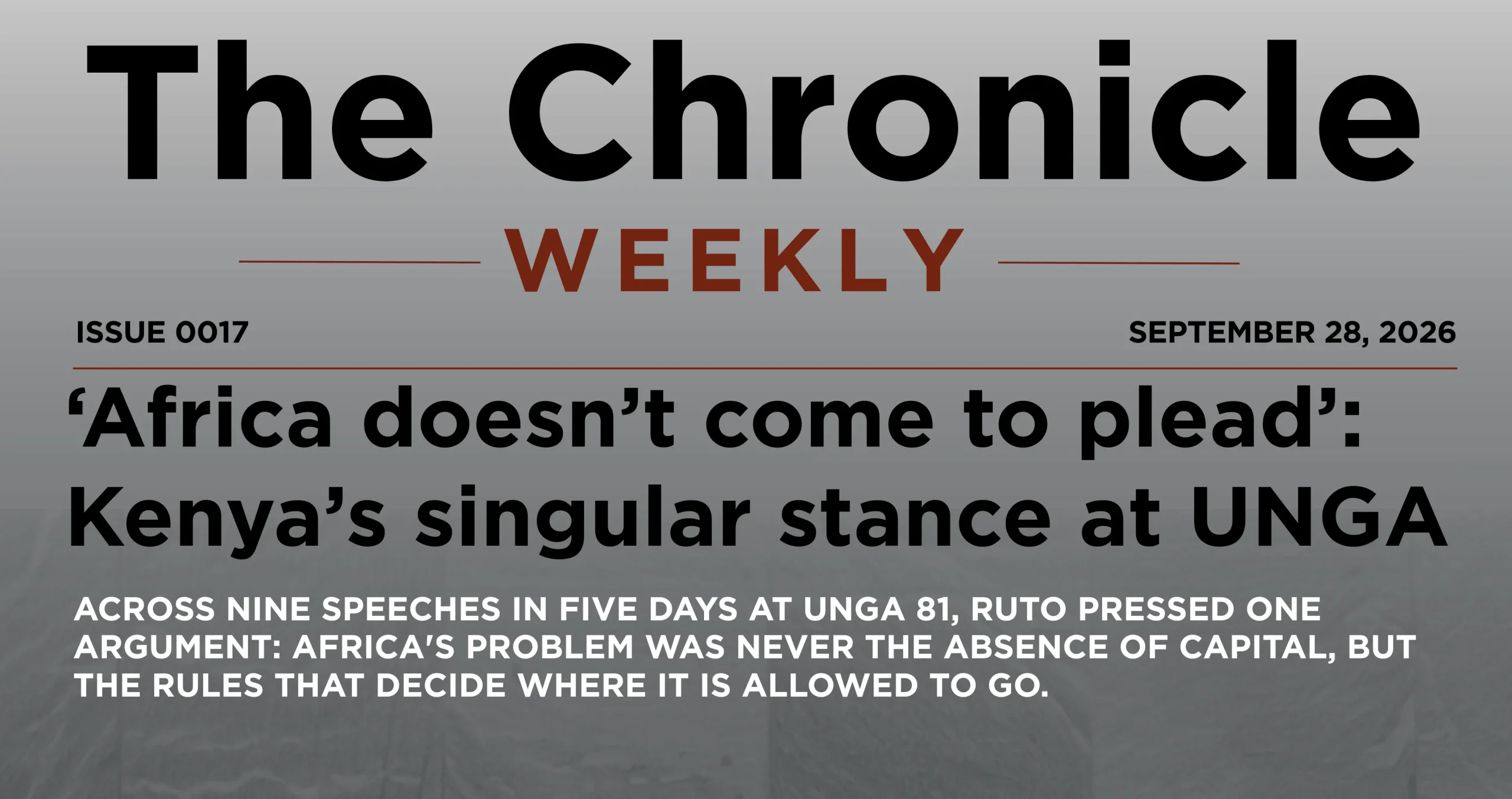
Download Your Copy: The Chronicle Weekly September 28, 2026
Every story in this issue of The Chronicle Weekly asks a version of the same question: is this delivery, or does it just look like delivery?
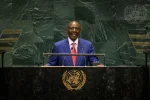
President Ruto spent five days at UNGA making one argument in nine settings — that Africa’s constraint was never capital but the rules governing where capital is allowed to go. It is a coherent, well-evidenced case. But Ruto did not only make it abroad. He made it at home too, using Kenya’s own pension funds, credit-rating actions and infrastructure pipeline as proof that the country was applying the argument to itself before asking anyone else to. That domestic half of the pitch is the one this newsroom can actually check, week by week, against what gets built.
Nairobi offers the clearest test case. Governor Sakaja’s Sh80 billion cooperation pact with the national government hands him more resources and, with them, less room to blame City Hall’s failures on somebody else. By 2027, the pact will have either produced visible roads, water and lighting, or it will have become the opposition’s best argument that Sakaja needed Nairobi’s problems solved for him. There is no middle outcome that helps him politically.
The milk shortage tells a smaller version of the same story. Two arms of one government — the Dairy Board and the Agriculture CS — describe the identical empty shelf in deliberately different language, one reassuring markets, the other conceding just enough to satisfy the Senate. The one intervention with a price tag attached, a Sh1.4 billion cooler programme, was procured before the drought that supposedly justifies it. Government’s own timeline for fixing this rests on rain, not policy.
Kithure Kindiki’s tour of Mt Kenya is an attempt to build something more durable than a rally — a network of elders, churches and local officials tied to the resources of the state. Kirigiti showed what that can produce; Embu, twelve days earlier, showed how fragile it still is when two men die at a UDA meeting the Deputy President attended.
Even basketball fits the pattern. Kenya now has a BAL franchise, a celebrity investor, an NBA-brokered arena deal and a stadium-upgrade budget — four real things that do not yet add up to an ecosystem, because nobody has said who builds the courts in between.
None of this is cynicism. It is the standard this newsroom applies to everyone equally: not what was announced, but what can be verified against it later. That standard is the thread running through Issue 0017.