




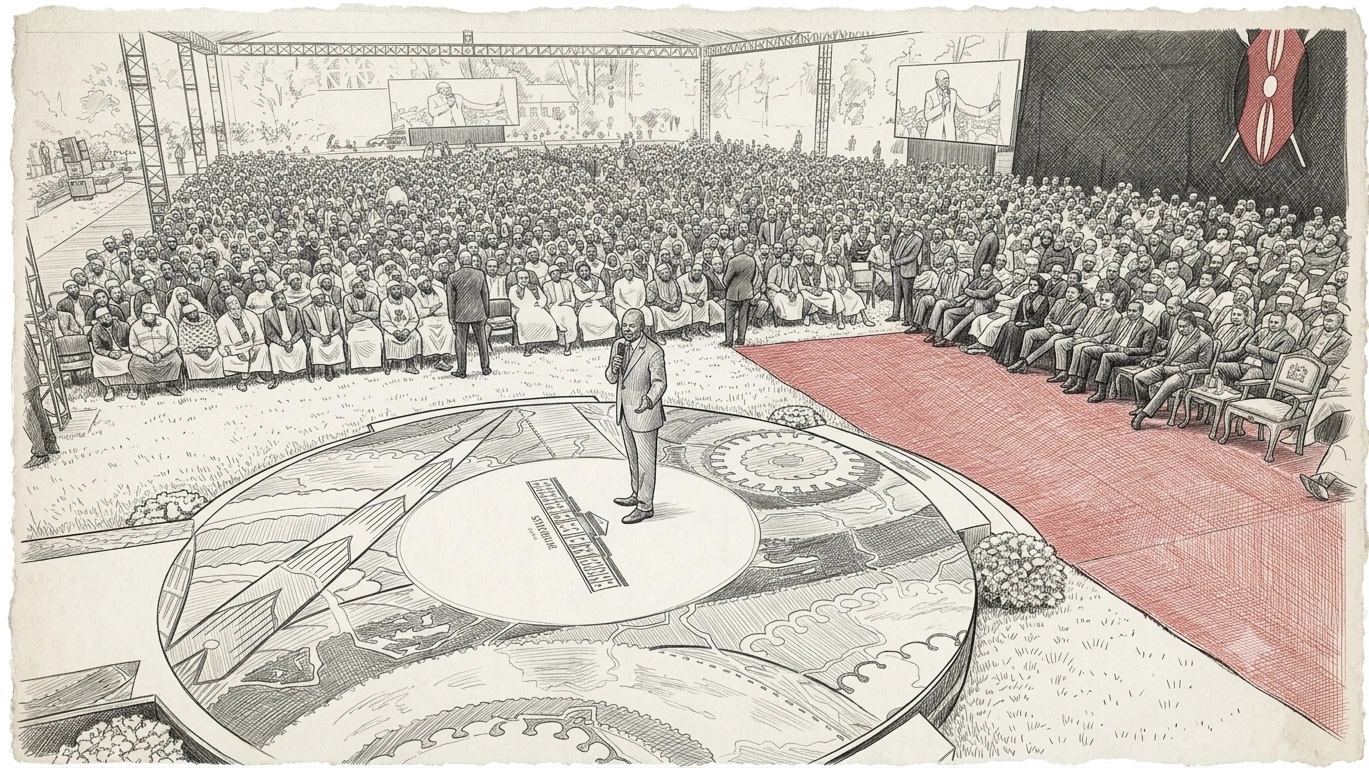
On Thursday, President William Ruto hosted thousands of private security guards at State House, where he said Kenya was implementing key reforms on the welfare, professionalism and recognition of private security officers, as indispensable partners in maintaining national security.
Two days earlier, he hosted more than 9,000 Muslim religious leaders. Here, he declared that his administration was correcting historical injustices through equitable development across our Republic.
“Historically underserved regions, including Northern Kenya and the Coast, are receiving unprecedented investment in infrastructure and economic opportunity as we ensure that no community is left behind,” Ruto said.
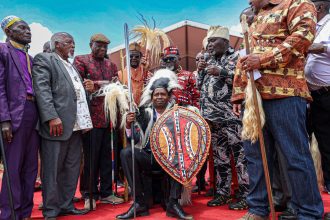
In the same week, he held a separate consultative forum with village elders from across the country, an event described by Interior PS Raymond Omollo as historic because it was the first time village elders had been collectively brought to State House.
The President announced Sh3,000 monthly stipends, SHA health cover and smartphones for more than 106,000 elders and their families, effectively embedding a new layer of actors into a structured state-supported programme.
Ruto used the occasion to announce a significant increase in Chief’s operational funding, raising quarterly allocations from Sh30,000 to Sh50,000 while doubling assistant chiefs’ support from Sh15,000 to Sh30,000.
A day earlier, he had hosted roughly 5,000 members of the Friends Church, also known as Quakers, at State House and presented a Sh50 million cheque for a peace centre. This adds a religious constituency to a growing list of organised groups being received at the seat of executive power.
None of these meetings, taken individually, can be reduced to campaigning, because presidents meet citizens, governments engage communities, and public officials routinely announce programmes that fall within their mandate.
However, politics is rarely located in isolated events and is instead revealed in patterns that accumulate over time and begin to suggest a method. And the pattern emerging around State House now looks strikingly familiar; it has a precedent.
The address has changed, the office has changed, and the resources available to the man at the centre have changed. However, Ruto appears to be returning to a political method that served him exceptionally well in the run-up to the 2022 election.
The Karen Precedent
Between 2020 and 2022, Ruto’s official residence in Karen, widely nicknamed the Hustler’s Mansion, functioned less as a conventional government residence and more as a political coordination hub where hundreds of delegations passed through in a steady rhythm that mirrored, and in many ways substituted for, traditional campaign infrastructure.
After Uhuru’s administration restricted political gatherings during the Covid-19 period, Ruto’s events increasingly concentrated in Karen, where he received regional power brokers, youth and women’s groups, religious leaders, professional associations, party operatives and ordinary supporters, all arriving not as isolated individuals but as organised delegations representing identifiable constituencies.
The significance of this format lay in what it enabled, because a rally demonstrates popularity in aggregate while a delegation demonstrates access to organised networks. In Kenyan politics, that distinction is decisive since networks, not crowds, ultimately determine electoral mobilisation.
The Karen meetings, therefore, became a form of political mapping in which grievances were recorded, alliances tested, regional balances assessed and local organisers identified, gradually producing a distributed structure that could later be activated during the formal campaign period.
The conversion of these interactions into political capital became visible in multiple ways, and many emerged from Karen publicly aligning themselves with the “hustler movement” and pledging support for Ruto’s presidential bid.
Later, at the same address, the country was introduced to the later Hustler Nation parliamentary strategy sessions that brought together more than 140 legislators to assess grassroots penetration ahead of the election.
Even as the political significance of these gatherings became increasingly apparent, allies defended them on procedural grounds arguing that the Deputy President was simply exercising his right to receive guests at his residence.
It is a defence that was technically accurate but politically incomplete because it treated form as substance while ignoring the organisational function the residence had come to serve.
The importance of Karen was never architectural; it was operational and functioned as a node through which political relationships were built, consolidated and converted into an electoral structure long before the formal campaign began.
Same Script, Now With A Treasury Line
What distinguishes the current moment is that Ruto no longer needs to simulate proximity to state power, as he now occupies it fully. This means that the same delegation-based strategy that once relied on access and hospitality can now be combined with policy authority, administrative direction, and direct fiscal allocation.
Where Karen offered political access, State House now offers institutional capacity, and that shift fundamentally alters the scale and implications of the same underlying method.
The chiefs and elders forums illustrate this most clearly, because beyond the announced increases in funding and stipends, the President directed the Ministry of Interior to prepare a Sessional Paper to formalise the reforms that would effectively tighten the institutional link between grassroots administration and the executive.
It was in this context that he told assembled elders, in reference to the new Sh3,000 stipend, that “we start from here, and when we cross the next election, we will push it even higher,” a statement that was met with chants of “Tutam”, which explicitly located a State benefit within a post-election trajectory.
In the Karen years, the key political resource was access; in the State House years, access is combined with authority and expenditure, creating a qualitatively different political environment, even when the format of engagement appears similar.
The irony of Ruto’s current position is that the same political instincts that required improvisation in 2021 are now being exercised from within the institutional core of the state, which means that a strategy once built on proximity to power is now being executed through power itself.
In 2021, he was a Deputy President increasingly estranged from the President, with visibility but limited control over state machinery, and therefore compelled to construct an independent political infrastructure that could operate alongside, and at times outside, formal government channels.
In 2026, he is the President, which means that the convening power of State House and the scale of the national budget are available within the same architecture that once had to be built externally.
This creates both advantage and constraint, because while it allows for a far more extensive form of engagement with communities, it also removes the ambiguity that once allowed him to position himself as an outsider challenging an establishment he was formally part of.
In 2022, he could ask voters to imagine what he might do with power; in 2027, voters will evaluate what he has already done with it, which means that every engagement now carries dual meaning, functioning simultaneously as governance and as political signalling.
The Dry Run Was Already Underway
The current pattern did not begin with chiefs or elders, because in September 2025, the President hosted approximately 10,000 teachers at a “Walimu na Rais” forum at State House, where participants who had queued from early morning received Sh10,000 transport reimbursements while broader commitments were made regarding sector reforms that later drew institutional scrutiny.
That event was not isolated, but part of a broader sequence of engagements involving boda boda riders, small business groups, religious leaders, professional associations and regional delegations, all of which followed a similar structure in which organised constituencies were received at State House and engaged through a combination of dialogue and material commitments.
The teachers’ union leaders publicly endorsed Ruto’s re-election bid and proposed institutionalising the forum, which illustrates how such engagements can evolve from one-off meetings into durable political relationships that extend beyond their immediate administrative purpose.
The import of this pattern lies not in any single event but in its accumulation, because one group can be dismissed, two can be coincidental, but a sustained sequence of demographically and regionally targeted delegations resembles a structured political play.
The visit by the Friends Church adds another layer of interpretation because the denomination has deep roots in Western Kenya, which forms a critical electoral bloc that both the government and opposition are actively attempting to influence.
This is the same region that has become central to emerging opposition calculations, including efforts to consolidate a coalition that would combine Western Kenya, Nairobi and Lower Eastern into a competitive electoral formation against Ruto.
In that context, the combination of a Sh50 million cheque and a Sh550 million hostel commitment delivered within a short period to a major religious institution in the region cannot be read as determinative of political alignment. However, it does reflect the broader reality that Western Kenya is already being treated as a decisive electoral theatre.
Every major political actor understands this and is investing in relationships there well before the formal campaign period begins, although only the incumbent can do so while simultaneously deploying state resources.
These outreach efforts are unfolding alongside visible internal coalition management, including the need to maintain cohesion within Kenya Kwanza at a time when succession politics and regional recalibrations are already generating tension.
In late July, Deputy President Kithure Kindiki released photographs of a private meeting with the President at State House without accompanying commentary. A deliberate act of visual cue intended to counter speculation about internal friction, and which underscored the sensitivity surrounding cohesion within the ruling coalition.
At the same time, the collapse of the Ruto-Gachagua alliance has reshaped Mt Kenya politics, creating a vacuum that both government and opposition actors are attempting to navigate.
All this, while questions about future running mates and regional balancing continue to circulate within political circles.
This means that the President is simultaneously managing coalition stability and electoral outreach, a dual responsibility that increasingly overlaps in practice because the same meetings that reinforce internal unity also serve as platforms for external mobilisation.
The Counter
The opposition is constructing its own version of coalition arithmetic, led by figures such as Gachagua, Kalonzo Musyoka, Edwin Sifuna, James Orengo, Eugene Wamalwa, Fred Matiang’i, Martha Karua and George Natembeya, who are attempting to assemble a counterweight to the incumbent by aggregating regional vote banks into a single electoral formation.
Their strategy relies on parallel mobilisation across regions, with each leader consolidating influence in specific areas while broader negotiations over a presidential flagbearer continue, reflecting a shared understanding that national victory will depend on the integration of local networks.
However, the structural asymmetry remains significant because while both sides are engaged in retail politics, only the incumbent can combine political outreach with state-backed programmes, budgetary allocations and institutional authority.
This means that identical formats of engagement carry different weight depending on who is executing them.