





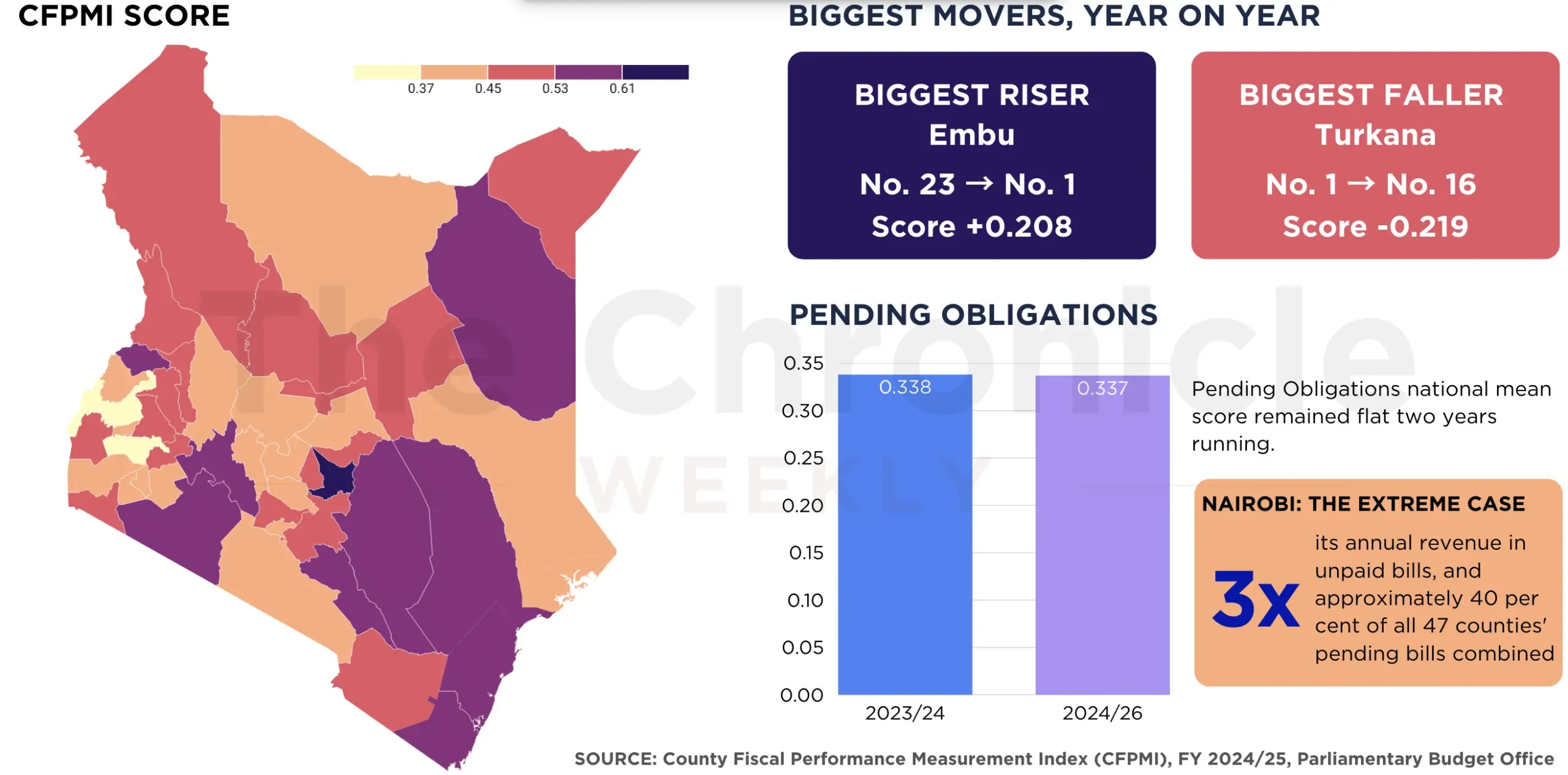
The County Fiscal Performance Measurement Index (CFPMI) is the Senate’s first standardised, data-driven scorecard for how Kenya’s 47 county governments manage public money. It was built by the Parliamentary Budget Office, Parliament’s in-house fiscal think tank, and formally launched by Senate Speaker Amason Kingi on August 6, 2026.
How It Works
Each county is scored on seven indicators of public finance management:
- Budget implementation: How much of the approved budget is actually spent
- Development expenditure: Share of the budget spent on development projects, against the 30 per cent legal minimum
- Own-source revenue: Locally raised revenue against target
- Wages and benefits expenditure: Compliance with wage bill ceilings
- Pending obligations: Unpaid bills
- County assembly expenditure ceilings: compliance with CRA-set limits
- Audit outcomes: Quality of the county’s audit opinion
Each indicator is scored between 0 and 1 using min-max normalisation, comparing each county against the best and worst performing county on that measure, then combined into a single composite score. That composite score is mapped onto a five-tier grading scale: A (0.80–1.00), B (0.60–0.79), C (0.40–0.59), D (0.20–0.39), and E (0.00–0.19).
Why It Exists
The Senate has constitutional oversight of county revenue under Article 96, but until now had no standardised, comparable tool for exercising it, relying instead on separate reports from the Auditor-General, the Controller of Budget and the Kenya National Bureau of Statistics, each measuring different things in different formats. The CFPMI pulls those sources into one composite score, which PBO says is intended to be published annually and used to direct Senate scrutiny toward the worst-performing counties.
What It Covers
The inaugural report scores all 47 counties across two financial years, FY 2023/24 and FY 2024/25, allowing year-on-year comparison for the first time.