



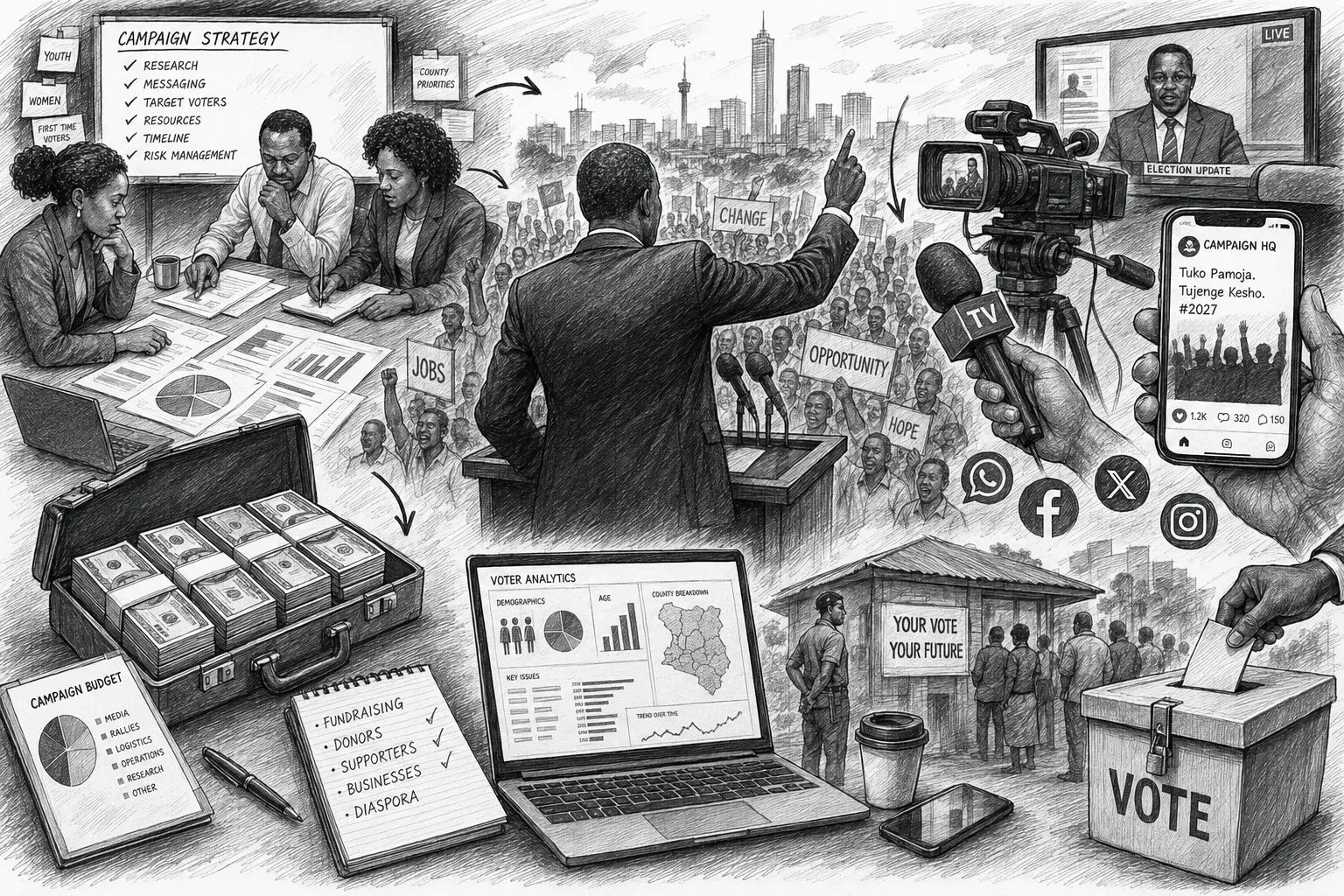
Elections are often presented as contests of ideas, personalities and competing visions for the country, but in Kenya, as in most democracies, political competition is a substantial economic enterprise.
Every election creates its own ecosystem of consultants, advertisers, pollsters, media houses, event organisers, transporters, designers, technology companies, security providers, lawyers, strategists and thousands of temporary workers whose fortunes rise and fall with the electoral calendar.
As Kenya moves towards the 2027 General Election, that ecosystem is already beginning to stir. Political parties are reorganising, aspirants are testing messages, opinion research is being commissioned, digital audiences are being built, and the machinery of mobilisation is gradually moving from preparation to operation. Long before voters enter polling stations, the business of winning will already have generated its own economy.
The real question is not simply how much money will be spent on the next election. It is what that money will buy, who will benefit from it and what the increasingly professionalised political marketplace tells us about the nature of power in Kenya.
Economic Event
Kenya’s elections have become increasingly sophisticated exercises in communications and logistics. The days when political campaigns could rely almost entirely on rallies, posters and roadside banners are gone.
Today’s campaigns operate across television, radio, newspapers, WhatsApp groups, social media and increasingly sophisticated digital targeting systems.
A serious campaign now requires research before messaging, message development before advertising, rapid response during crises and constant monitoring of public sentiment.
Candidates need photographers and videographers, graphic designers, social media managers, speechwriters and media handlers. They need people who can interpret polling data, understand constituency dynamics and identify the local issues that can shift a campaign.
The result is a political industry that increasingly resembles the commercial communications industry, except that the product being sold is not a phone, a bank account or a packet of flour. It is a candidate, a political identity and a promise of governance.
This is where the campaign strategist has become as important as the rally organiser. Winning elections increasingly depends on the ability to build a coherent narrative across multiple audiences and maintain it under pressure. The campaign that understands what voters are thinking before its competitors do has a significant advantage.
Politics of Spending
Every large political campaign creates demand for transport, accommodation, food, event production and security. Rallies require tents, sound systems, stages and generators. Political parties need agents across polling stations and coordinators across constituencies.
Around every candidate exists a second campaign that is less visible but equally important: the campaign to secure contracts and access. For businesses, elections can be both an opportunity and a risk.
The spending generated by political competition can temporarily stimulate sectors of the economy, but it can also create distortions. Companies that become dependent on political contracts can find themselves exposed when alliances change.
Suppliers who flourish under one administration may struggle under another. The election economy reflects Kenya’s political economy, where relationships and access matter as much as price and efficiency.
This is why political campaigns should be understood not merely as expensive exercises in persuasion, but as temporary economic systems. They attract money, redistribute it and create networks that can survive long after the election is over.
New Political Marketplace
The next generation of Kenyan political campaigns will be more data-driven, digital and segmented. Candidates will increasingly be expected to understand not just where their voters live but what they watch, search for, fear, and share.
The political consultant is therefore becoming a hybrid professional: part strategist, part researcher, part communicator and part crisis manager.
But this creates a paradox. As campaigns become more sophisticated, the greater the danger that politics becomes a competition between communication machines rather than competing visions of government.
A well-produced video can create the impression of competence. A carefully targeted advertisement can manufacture momentum. A viral clip can dominate a news cycle. Yet none of these necessarily tells voters whether a candidate can manage a county, run a ministry or repair a broken institution.
The business of winning can therefore become detached from the business of governing, and that distinction matters. A campaign can be exceptionally good at winning attention while being completely unprepared to exercise power.
It can have a robust communications strategy and no credible economic programme. It can understand the electorate’s emotions without understanding the country’s structural problems.
The Election After the Election
The most consequential part of the election economy, however, begins after the votes have been counted. Political campaigns create expectations among supporters, financiers and business interests. Those expectations do not disappear when the winner is declared. They become part of the informal political economy of the new administration.
This is where the cost of political competition becomes more difficult to measure. The campaign money is visible; the networks created around that spending are not. The contracts, appointments, influence and access that may follow are harder to track but often more consequential.
Kenya’s electoral cycles have therefore become periods in which political competition and economic competition increasingly overlap. Businesses watch elections because policy matters.
Investors watch them because stability matters. Professionals watch them because appointments matter. Communities watch them because development promises matter. Everyone, in one way or another, is trying to understand what winning will mean for them.